How to Play a Hex-and-Counter War Game: Integrated Ground War Game Rules
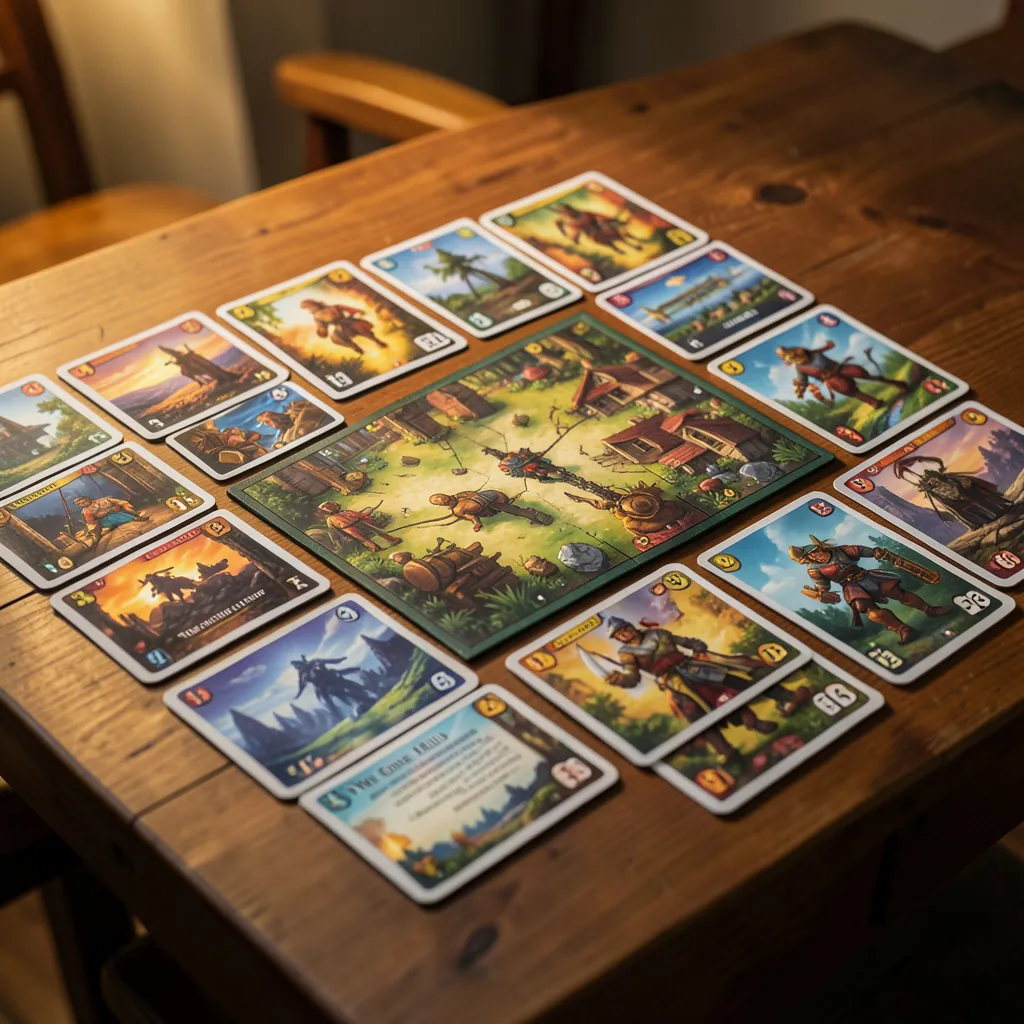
How to Play a Hex-and-Counter War Game: Integrated Ground War Game Rules
Contents
🎲 War game rules describe how sides or teams move counters on a map, resolve information and fire, and judge victory against scenario objectives. This guide synthesizes the hex-board Ground War Game with related umpired and COA war-game methods; it is not a trick-taking card game.
Players: 3-5 — conflict flag: Source 2 is a two-side/player game, Source 1 uses 4–6-member player teams plus control, and Source 5 is a two-player ground-vs-aviation game.
Play Time: 20-30 minutes — conflict flag: no source supports this figure; Source 5 ends after 20 turns, and Source 1 describes longer multi-team games.
Age: 10+ — unverified: the sources do not state an age.
Difficulty: Easy — conflict flag: Source 1 targets specialists, and Source 2 requires an umpire and a death-adjudication table.
Type: Trick-taking card game — conflict flag: the sources describe operational/strategic board war games, not a trick-taking card game.
Setup
Primary hex-board setup, based on the Ground War Game
- Use a honeycomb pattern of hexagonal “squares,” the same board type described in Source 2.
- Use colored chips for pieces, plus cities and trucks; trucks are represented by a different color chip and, like cities, can be captured.
- The umpire discretionally sets up the complete position for each side, deciding the allotment and positions of pieces, trucks, and cities, subject only to the positional restrictions that apply during play.
- Both players or sides are informed of the initial position before play begins.
- If playing without an umpire, Source 2 permits modifications: alternate moves and fire with complete information on one board, or simultaneous moves with two boards and information only up to the last cycle, using an intervening vertical board.
Variant setup notes from other sources
- Source 1’s SIERRA-style preparation includes selecting the geographic area and time period, collecting area data, organizing and extrapolating data, and preparing the game context.
- Source 5’s scenario setup uses a ground player who rolls a six-sided die to determine a secret course of action, then places armor and fog-of-war pieces under scenario restrictions; the aviation player places FARP and air units under separate restrictions.
- Source 3’s COA war game is turn-based and focuses on validating a friendly course of action through friendly action, enemy reaction, and friendly counteraction.
How to Play
The Ground War Game in Source 2 proceeds in a repeating cycle with five stages: simultaneous movement, information/reconnaissance, aiming fire, removing dead, and production. Use the following numbered procedure for the primary hex-board game.
-
Move both sides simultaneously. Men may move to an adjacent square, but no pile of more than three men of the same player may be formed; all men in a pile move individually. A truck may carry one, two, or three men. A truck’s move is three or fewer consecutive man-moves, but it must stop as soon as it reaches a square adjacent to one occupied by an enemy man at the end of the last cycle. Men may disembark before the truck moves, but not while it moves or after it has moved. A truck must carry at least one man to move.
-
Receive information on adjacencies and reconnaissance. The umpire gives each player specific information: exact enemy forces—men and trucks—on squares occupied by that player’s men or adjacent to them; the exact arrangement of enemy trucks no more than two squares from one of that player’s men; and qualitative information about which squares within two moves of that player’s men contain enemy men. The umpire should avoid revealing unnecessary information.
-
Aim fire. Each man that is adjacent to an enemy man and is not on a square also occupied by the enemy may aim fire at any adjacent square. A man on a contested square—a square also occupied by an enemy man—automatically fires on the square he occupies.
-
Remove dead on the umpire’s instructions. The number of men lost on a square receiving fire depends on how many men the player has there and how many enemy men are firing on it. Source 2 states that six units of fire power suffice to destroy any pile of men, while one unit is inadequate to destroy anything.
-
Receive new men at cities through production. Production occurs on a city square, and the produced man’s color is that of the city’s possessor. Production does not occur if an enemy man is on the city square or if three of the possessor’s men are already there. Production occurs only after the city has been possessed for five consecutive cycles, including from the start of the game.
-
Capture cities and trucks at the end of a cycle. A city is captured if, at the end of a cycle, its square is occupied exclusively by men of the capturing player. The same rule governs capture of a truck. A truck can be moved only by its possessor, carries only that player’s men, and must carry at least one man to “drive” it.
-
End the game when the umpire awards victory or a draw. The umpire may discretionally award victory or call a draw, but Source 2 requires the umpire to award victory if the opponent resigns or if a player has both killed all enemy men and gained possession of all enemy cities.
How do the source move cycles differ?
| System / source | Core cycle | Information and adjudication | Victory or termination |
|---|---|---|---|
| Ground War Game, Source 2 | Simultaneous move → information/reconnaissance → aim fire → remove dead → production | Incomplete information with an umpire, or umpire-free modifications using one board with complete information or two boards with last-cycle information | Umpire awards victory or draw; mandatory victory if opponent resigns or all enemy men are killed and all enemy cities captured |
| SIERRA-style two-sided game, Source 1 | One complete round of blue and red moves plus control evaluation | Two sides submit moves simultaneously to a control team; forms include open information, closed information with predetermined form, and closed information with situation-determined form | Control decides the termination point; post-game analysis evaluates outcomes |
| COA war game, Source 3 | Turn includes friendly action, anticipated enemy/local-population reaction, and friendly counteraction | Focused on validating and refining the friendly course of action; the friendly force has two moves | Additional moves may be required to achieve desired effects; no fixed point score is given in the source |
| Scenario game, Source 5 | Each turn begins with the aviation player and ends after the ground player’s turn | Ground player’s COA remains secret; aviation player may attempt one COA determination before turn 10 | Game ends after 20 turns or when all units of one side are eliminated; win criteria are scenario-specific |
Scoring
There is no universal point score in the primary Ground War Game rules. In Source 2, the umpire awards victory or a draw, and victory is mandatory if the opponent resigns or if a player has killed all enemy men and gained possession of all enemy cities. In Source 1’s two-sided games, play continues until the control team decides on a termination point, and post-game analysis focuses on evaluating how gamed actions contributed to the outcome. In Source 5’s scenario, the game ends after 20 turns or when all units of one side are eliminated; the ground player wins by meeting the chosen COA’s crossing, defense, or armor-presence criteria, while the aviation player wins if all armor units are eliminated or the ground player fails the COA after 20 turns. The “trick-taking card game” scoring implied by the template is not supported by any source.
💡 Strategy Tips
- Protect city possession for five consecutive cycles. In the Ground War Game, production only begins after five consecutive cycles of possession, so losing and retaking a city resets the long-term value of that city.
- Respect the three-man stacking limit. No pile of more than three men of the same player may be formed; overstacking is a common beginner error that can invalidate or limit movement.
- Use trucks as transport, not as solo units. A truck must carry at least one man to move, stops when it reaches a square adjacent to an enemy man from the end of the last cycle, and can be captured like a city.
- Use the information rules deliberately. Source 2 gives exact enemy force information near your men and qualitative information within two moves; the umpire should not reveal unnecessary information, so ask only for what the rules provide.
- In COA-style games, use action-reaction-counteraction. Source 3 emphasizes validating the friendly course of action through enemy reaction and friendly counteraction, including decision points and additional capability requirements.
🎲 Variations
- Umpire-free Ground War Game: Source 2 allows alternate moves and fire with complete information on one board, or simultaneous moves with two boards and information only up to the last cycle using an intervening vertical board.
- Production and mobility changes: Source 2 lists allowable modifications including changing city production rates—most likely downward—and changing truck mobility.
- Inter-city jump moves: Source 2 also permits a fast-air-transport-style rule in which a man may move from one productive city to another adjacent productive city, with each city receiving at most one man per cycle and sending at most one man per cycle; adjacency is defined by the umpire at the outset.
- Information-form variants: Source 1 describes two-sided games with open information, closed information with predetermined form, and closed information with situation-determined form.
- Player-count variants: Source 2 is two sides/players plus an optional umpire; Source 1’s SIERRA-style games use player teams of four to six members plus a control team; Source 5 is a two-player ground-vs-aviation scenario. The template’s “3-5 players” value is not supported by these sources.
❓ FAQ
How many players are needed for a war game?
It depends on the ruleset. Source 2’s Ground War Game is played by two sides or players, with an umpire or an umpire-free modification. Source 1 uses player teams of four to six members plus a control team, and Source 5 is a two-player ground-vs-aviation game.
How do you win a war game?
Victory is usually defined by the scenario or umpire, not by a universal point total. In Source 2, the umpire awards victory or a draw and must award victory if the opponent resigns or if all enemy men are killed and all enemy cities are captured. In Source 5, the game ends after 20 turns or when all units of one side are eliminated, with scenario-specific win criteria.
Can you play a war game with 2 players?
Yes. Source 2 is a two-side game, and Source 5 is explicitly a two-player ground-vs-aviation game. For team-style games such as Source 1’s SIERRA-style method, two players would need to use a simplified or modified format because the source describes larger player teams and a control team.
Is it hard to learn?
The primary hex-board Ground War Game is not an “Easy” beginner game as the template suggests. Source 2 requires an umpire or modified two-board procedure, a death-adjudication table, and detailed movement and information rules; Source 1 is aimed at specialists and control teams.
How long does a game take?
The sources do not support a fixed 20–30-minute play time. Source 5 ends after 20 turns or when all units of one side are eliminated, while Source 1 describes longer multi-team games with control evaluation and post-game analysis.
What is a zone of control in a hex war game?
Source 4 defines a zone of control as the six hexes surrounding a unit on a hex-grid map, or more generally the area of effect around a unit. Its effects can be described by movement type—locking, rigid, elastic, or open—combat type—active or inactive—and supply/retreat type—interdicting or suppressive.
Related guides
- Azul Max Players: How to Play, Setup, Scoring, and Player Count Guide
- Battleship Best Placement: Where to Hide Your Fleet and How to Play
- Battleship Best Strategy: How to Play, Search, and Win More Often
- Battleship Strategy Placement: How to Play, Set Up, and Hide Your Fleet
- Best Battleship Position: How to Play Battleship and Place Your Fleet to Survive