How to Play Risk: Complete Rules, Setup, Scoring, Strategy, and Variations
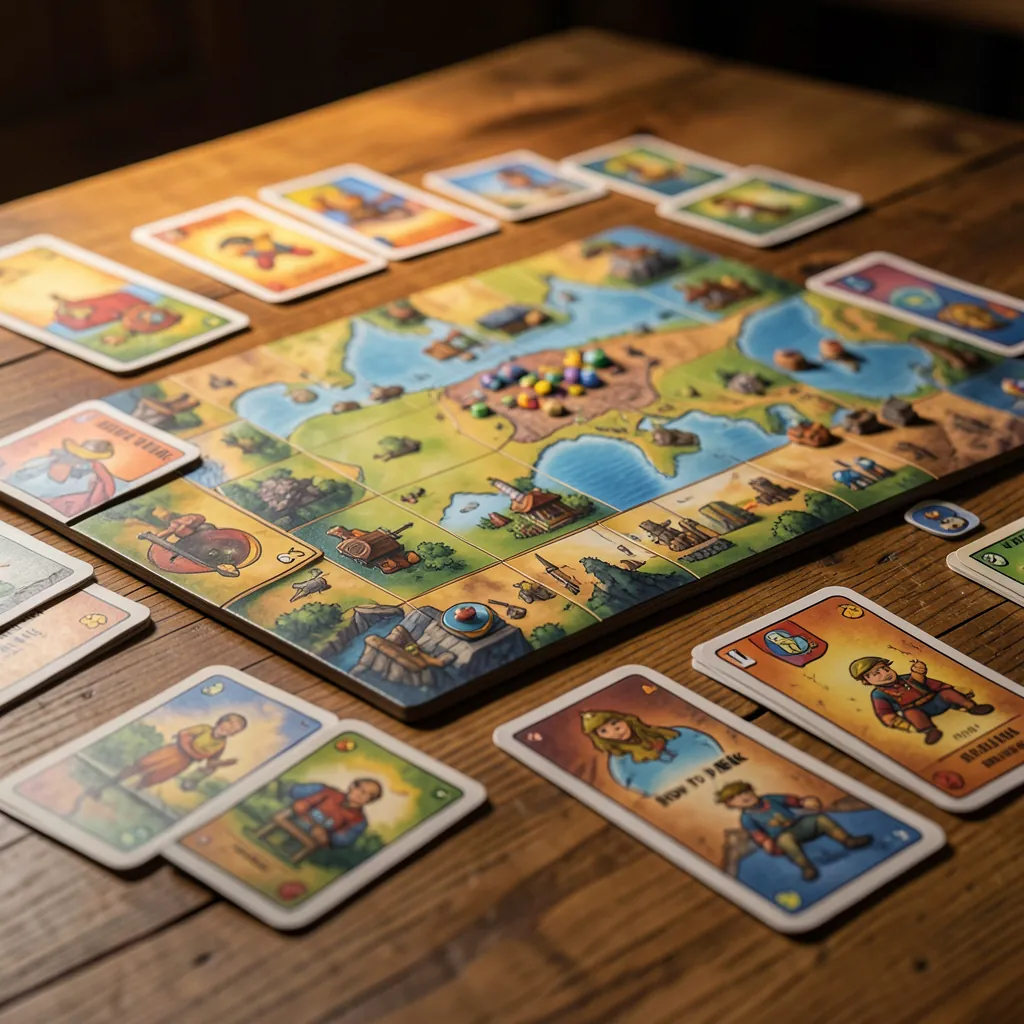
How to Play Risk: Complete Rules, Setup, Scoring, Strategy, and Variations
Contents
♟️ Risk is a world-conquest strategy board game for 2–6 players in which you command armies, reinforce territories, attack adjacent enemies with dice, and fortify borders. The goal is to eliminate every opponent by capturing all 42 territories on the board. A turn follows three phases—deploy reinforcements, attack, and fortify—using continent bonuses, Risk cards, and dice combat.
Players: 2–6 (classic setup often 3–6; 2-player play uses neutral armies)
Play Time: 1–8 hours; most games last 1–3 hours
Age: Not specified in the supplied sources
Difficulty: Easy to learn, strategically deep; dice add luck
Type: Strategy board game (world conquest)
Setup
- Place the Risk board on a flat surface. Each player chooses an army set, dice, and starting army count based on player number: 2 players = 40 armies each, 3 = 35, 4 = 30, 5 = 25, 6 = 20. Some classic rulebooks list starting counts only for 3–6 players and treat 2-player play as a separate neutral-army variant.
- Roll dice to determine who places first. The highest roller takes the first territory by placing one army on any unoccupied territory.
- In turn order, each player places one army on any unoccupied territory until all 42 territories have been claimed.
- After all territories are claimed, players take turns placing their remaining armies onto territories they already occupy. One source lists a 750-army limit per territory; other rulebooks say there is no limit.
- Shuffle the 44 Risk cards—42 territory cards plus 2 wild cards. If your edition includes separate mission/secret cards, remove them for classic play. Place the deck face down beside the board.
- Begin play with the player who placed the first army.
What rules and edition conflicts should I know?
| Rule area | Integrated value / rule | Source conflict or edition note |
|---|---|---|
| Players | 2–6; 2-player play uses neutral armies | One source says 2–6; another lists starting armies for 3–6; two-player variants appear in other rulebooks. |
| Starting armies | 2: 40; 3: 35; 4: 30; 5: 25; 6: 20 | Sources agree for 3–6; 2-player count comes from the two-player variant. |
| Territories / cards | 42 territories; 44 cards = 42 territory cards + 2 wilds | Consistent across the main rule sources. |
| Continent bonuses | North America 5; South America 2; Europe 5; Africa 3; Asia 7; Australia 2 | One OCR source lists Australia as 3; most sources say Australia is 2. |
| Army limit per territory | No limit in most rulebooks | One manual lists a 750-army limit; other rulebooks explicitly say no limit. |
| Card trade threshold | Trade matched sets at the start of a turn if you have 5 cards; some summaries say 5 or 6. After taking an eliminated player’s cards, trade down if your hand is too large. | Sources disagree on “5,” “5 or 6,” and “6 or more” thresholds. |
| Owned-territory card bonus | +2 armies on a territory you own when that card is traded in | One source caps this at 2 extra armies per turn; another says once per set. |
| Two-player neutrals | Neutral armies act as a buffer and cannot attack or receive reinforcements | One rulebook uses card piles to assign neutral territories; another randomly distributes them. Details vary by edition. |
How to Play
- Deploy reinforcements. At the start of your turn, count the territories you occupy and divide by 3, discarding any fraction. You receive that many armies, with a minimum of 3. Add continent bonuses for any continent you fully control at the start of your turn. Add armies from any Risk card sets you trade in. Place all new armies on territories you already own.
- Trade Risk cards if required or useful. A matched set is 3 cards of the same design, 3 cards of different designs, or any 2 cards plus a wild. Trade values increase during the game: first set 4 armies, second 6, third 8, fourth 10, fifth 12, sixth 15; after that, each additional set is worth 5 more armies. If a traded card shows a territory you own, you may place 2 extra armies on that territory, subject to the edition’s cap. At the start of a turn with 5 cards—or 5–6 in some summaries—you must trade a matched set.
- Attack adjacent territories. You may attack only territories adjacent to one of yours, including dashed-line sea connections. You must have at least 2 armies in the attacking territory. The attacker rolls 1–3 dice and must have more armies than dice rolled; the defender rolls 1–2 dice and needs at least 2 armies to roll 2 dice. Roll simultaneously and compare highest die to highest die, then next-highest to next-highest if both rolled multiple dice. Higher roll wins; ties go to the defender. Remove one army for each comparison lost, with a maximum of 2 armies removed per battle round.
- Capture territories. If the defender loses all armies on a territory, you capture it. Move in at least as many armies as the number of dice you rolled in the final battle, and always leave at least one army behind. Every territory must always contain at least one army.
- Draw one Risk card. If you captured at least one territory during your attack phase, draw one Risk card at the end of that phase. You draw only one card per turn, no matter how many territories you captured.
- Eliminate opponents. If you take a player’s last territory, that player is eliminated and you receive their Risk cards. If this makes your hand too large, immediately trade matched sets until you are down to 4 or fewer cards, depending on the edition’s threshold.
- Fortify. After attacking, you may make one fortifying move: move any number of armies from one of your territories to one adjacent territory you own. Leave at least one army behind. Fortifying is optional.
- End your turn. Pass play to the left. You do not have to attack or fortify, but you must deploy reinforcements.
Scoring
Classic Risk does not use a point total. The winner is the first player to eliminate every opponent by occupying all 42 territories. A player is eliminated when they lose their last territory and army. In the two-player neutral-army variant, you win by eliminating your opponent; you do not have to eliminate every neutral army.
Reinforcement formula: territories ÷ 3, discarding the fraction, minimum 3 armies.
Continent bonuses:
| Continent | Bonus armies |
|---|---|
| North America | 5 |
| South America | 2 |
| Europe | 5 |
| Africa | 3 |
| Asia | 7 |
| Australia | 2 |
One OCR source lists Australia as 3; the clearer rulebooks list Australia as 2.
Risk card set trade values:
| Set traded in the game | Armies received |
|---|---|
| 1st set | 4 |
| 2nd set | 6 |
| 3rd set | 8 |
| 4th set | 10 |
| 5th set | 12 |
| 6th set | 15 |
| 7th set | 20 |
| 8th set | 25 |
| Each later set | +5 more than the previous |
These values apply to sets traded by anyone in the game, not just by you.
💡 Strategy Tips
- Do not leave border territories with 1 army. A single army is easy to defeat; keep at least 2 on exposed borders.
- Attack only with superiority. One source recommends minimums such as 4-vs-1, 5-vs-2, 6-vs-3, and 8-vs-4; for larger stacks, about 1.5 attackers per defender is a safer guideline.
- Use bottlenecks. Securing two key territories can defend a whole region more efficiently than spreading armies everywhere.
- Deny continent bonuses. Sometimes breaking an opponent’s continent bonus is more valuable than completing your own.
- Manage cards and alliances carefully. With progressive card bonuses, wait to trade as long as it is safe; defeating card-heavy players gives you their cards. Temporary alliances can help, but they are unenforceable—and in ranked digital play, not playing to win can be treated as a rules violation.
🎲 Variations
- Two-player neutral-army variant: Each player takes 40 armies, and a third neutral army set is added. Neutral armies act as a buffer, cannot attack, and never receive reinforcements. One rulebook randomly distributes neutral territories and has each player place 2 of their own armies plus 1 neutral army per turn; another older version uses card piles to assign neutral territories. When you attack a neutral territory, your opponent rolls defense for it. You win by eliminating your opponent; you do not need to eliminate all neutral armies.
- Player-count and edition differences: Classic setup often supports 3–6 players, while later editions and guides describe 2–6 players. The two-player game uses the neutral-army variant rather than the standard multiplayer setup.
- Progressive card bonus: Some digital/custom rules increase the card-trade bonus each time anyone trades. In that format, waiting longer to trade can be stronger.
- Digital/custom rules: The Hasbro digital version includes 50+ maps, custom rules, and a Blitz dice option to resolve battles faster.
- Alliances: Classic rules do not mention alliances, but groups often allow them socially. They are not enforceable, and there can be only one winner.
- Headquarters and U.K. variants: One rulebook’s table of contents lists these variants, but the supplied excerpt does not include their full rules, so they are not detailed here.
❓ FAQ
How many players can play Risk?
Risk supports 2–6 players in the supplied sources. Classic setup tables often list starting armies for 3–6 players, and 2-player play uses a separate neutral-army variant.
How do you win Risk?
Eliminate all opponents by capturing all 42 territories. Classic Risk has no point score; the last player holding territories wins. In the two-player neutral variant, eliminate your opponent—neutral armies do not all need to be eliminated.
Can you play Risk with 2 players?
Yes. Use a third neutral army as a buffer. Neutral armies cannot attack or receive reinforcements. Exact neutral placement differs by edition: one rulebook randomly distributes neutral territories and has players place 2 own armies plus 1 neutral army per turn; another uses card piles.
Is Risk hard to learn?
Not very—one classic rulebook calls it “not difficult”—but it is strategically deep and can take hours. The three-phase turn is easy to teach; dice luck and long games add difficulty.
How long does a game of Risk take?
About 1–8 hours, with most games lasting 1–3 hours according to one guide. Length varies with player count, edition, and luck.
What do you need to play Risk?
A Risk board with 42 territories, six army sets, five dice—2 white and 3 red in the classic edition—and 44 Risk cards: 42 territory cards plus 2 wilds. The two-player neutral variant needs a third army set.
Related guides
- Azul Max Players: How to Play, Setup, Scoring, and Player Count Guide
- Battleship Best Placement: Where to Hide Your Fleet and How to Play
- Battleship Best Strategy: How to Play, Search, and Win More Often
- Battleship Strategy Placement: How to Play, Set Up, and Hide Your Fleet
- Best Battleship Position: How to Play Battleship and Place Your Fleet to Survive