Battleship Best Placement: Where to Hide Your Fleet and How to Play
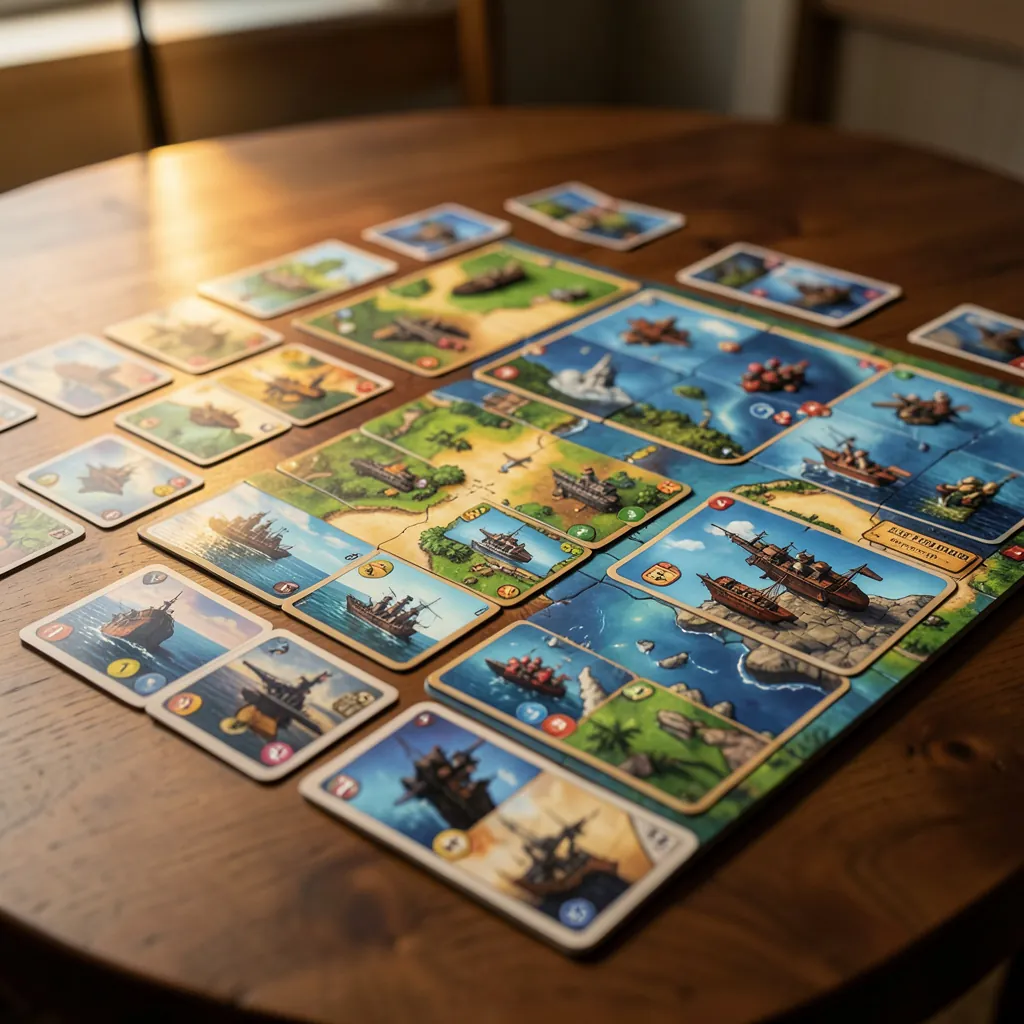
Battleship Best Placement: Where to Hide Your Fleet and How to Play
Contents
🎲 Battleship is a two-player grid game in which each player hides a fleet and fires at coordinates to sink the other fleet first. For best placement, spread ships across at least three quadrants, leave gaps, mix horizontal and vertical orientations, and put only one or two ships near edges; against AI/probability targeting, a corner cluster can help, but sources conflict on whether ships may touch.
Players: 2 standard; one source also describes online 2v2 team play
Play Time: 10 minutes for the lesson-plan game; standard full-game time not stated
Age: 10–11 in the classroom lesson example; retail age varies by edition
Difficulty: Easy to learn; strategy-heavy placement
Type: Grid-based board/paper game
Setup
- Give each player a grid. The printable version uses two boards per player: one “opponent” grid for recording shots and one “myself” grid for placing ships. Full Battleship is usually played on a 10×10 grid; the classroom lesson source also uses a 3×3 grid and a 4×4 extension.
- Agree on the fleet before placing. A common 17-cell fleet in the sources is Carrier 5, Battleship 4, Cruiser 3, Submarine 3, Destroyer 2. Conflict to flag: Arcadeum lists a different 20-cell “canonical” fleet: 1×4, 2×3, 3×2, and 4×1-cell patrol boats; Rare Pike says the fleet occupies 17 squares. Use your edition’s rulebook.
- Place ships horizontally or vertically in adjacent boxes. The lesson source explicitly forbids diagonal ship placement.
- Agree on adjacency. Conflict to flag: Arcadeum says ships cannot touch horizontally, vertically, or diagonally; Rare Pike recommends at least one gap; OriginalMOM recommends 1–2 spaces between ships; FunAI’s corner-cluster strategy assumes touching ships can be clustered. Resolve this before play.
- Keep your placement secret and mark hits/misses on the opponent grid.
How to Play
- Players alternate turns. On your turn, call one coordinate on your opponent’s grid, such as B2.
- Your opponent announces “hit” or “miss.” Both players record the result on the correct grid.
- After a hit, use hunt-and-target tactics: probe the four orthogonal neighboring cells—north, south, east, and west. Once a second hit confirms a line, continue along that axis until the ship sinks.
- When every cell of a ship has been hit, declare that ship sunk. Under no-touch rules, mark a one-cell buffer around the sunk ship as a dead zone where no other ship can be. If your house rules allow touching, that exclusion may not apply.
- Continue alternating shots until one player has sunk the opponent’s entire fleet. In the 3×3 classroom version, count how many guesses it takes to sink the single 2-cell ship and record the result.
Scoring
Standard Battleship is usually win/loss rather than points: the first player to sink all of the opponent’s ships wins. Conflict to flag: OriginalMOM’s intro says players “sink the most ships to win,” but it also says printable Battleship is played like regular Battleship; standard rules use sink-the-whole-fleet. In the classroom version, scoring is by guess count: fewer guesses is better, with most 3×3 games expected to finish in about 5–6 guesses and a possible range of 2–9 guesses.
💡 Strategy Tips
Which Placement Strategy Should You Use?
| Placement strategy | How it works | Best for | Trade-off / risk | Source notes |
|---|---|---|---|---|
| Balanced spread / hybrid | Ships across at least 3 of 4 quadrants; 1–2 edge ships; gaps; mix horizontal and vertical | Default human-play strategy; avoiding predictable patterns | Requires discipline; gaps may be mandatory under no-touch rules | Rare Pike and OriginalMOM support spread and gap advice |
| Corner cluster island | 3–4 ships grouped in one corner or edge, often touching in an L-shape | Exploiting probability/AI targeting, especially “Hard” AI | If one ship is found, neighbors may be found quickly; may violate no-touch rules | FunAI recommends this against AI; conflicts with no-touch rules |
| Edge perimeter | Spread ships along edges without clustering | Reducing adjacent attack vectors; exploiting players who neglect edges | Predictable to experienced players; don’t put every ship on the edge | FunAI, Rare Pike, and Arcadeum discuss edge trade-offs |
| Full scatter | Each ship in a different area with no adjacency | Longest search; one hit gives little information about other ships | Ships can still be found one by one; high variance | FunAI and Rare Pike support scattering as a defensive option |
| 4-quadrant distribution | One major ship plus small ships distributed across 5×5 quadrants | Preventing a single lucky quadrant from revealing the fleet | Repeating the same layout becomes predictable | Arcadeum and Rare Pike describe quadrant balance |
| Perimeter + scattered small boats | Larger ships along the border; small 1-cell boats scattered in the center | Preserving open ocean and hiding tiny ships | Depends on whether your fleet uses 1-cell patrol boats | Arcadeum’s “Perelman” style; fleet differs from 17-cell versions |
| Diagonal staggering | Separate straight ships arranged on parallel diagonal trajectories | Reducing the chance one linear sweep uncovers multiple ships | Can become a detectable pattern if reused | Arcadeum lists this as a placement option |
Conflicts to resolve before play: fleet size differs between 17-cell and 20-cell versions; adjacency differs between “no touching at all,” “leave gaps,” and “corner clusters may touch”; and the “best” placement depends on opponent type. FunAI strongly favors corner clusters against Hard AI, while Rare Pike and OriginalMOM emphasize balanced spread and avoiding patterns. Both sides agree on one thing: avoid obvious all-center, all-edge, single-row, or same-every-game layouts.
- Start with the balanced hybrid: place ships in at least three quadrants, keep gaps, mix horizontal and vertical orientations, and put only one or two ships on edges.
- Avoid common beginner patterns: the center stack, the perfect grid, the single row, full edge coverage, and placing your fleet identically every game.
- Use a corner cluster only when your rules allow touching and you are facing probability/AI-style targeting; it can delay discovery, but it risks revealing neighbors once found.
- Treat the Carrier as the hardest ship to hide: give it open space rather than forcing it into a tiny pocket. Put the Destroyer in a region you expect the opponent to check last.
- On offense, use parity search—fire on alternating squares like a checkerboard—then switch to adjacent targeting after a hit. This is more efficient than random guessing against ships of length 2 or more.
🎲 Variations
- 3×3 classroom game: Use one 2-cell ship. There are 12 unique horizontal/vertical placements; the center B2 square is occupied in 4 of 12 arrangements, while a corner like C3 is occupied in only 2 of 12. The center is the better early guess.
- 4×4 classroom extension: Keep the same ship size but enlarge the grid; the lesson source notes the probability work becomes more complex.
- Printable pencil-and-paper version: Print two boards per player, place ships with letters such as AAAAA, BBBB, CCC, SSS, and DD, and record shots on the opponent grid.
- Online/AI variants: FunAI discusses Easy, Medium, and Hard AI opponents; Arcadeum includes online 2v2 team play, parity search, and dead-zone exclusion.
- House-rule conflicts: Some versions forbid any touching, some require gaps, and some allow clustered ships. Fleet composition also varies. Agree on fleet size and adjacency before placing.
❓ FAQ
What is the best Battleship placement?
For standard human play, the safest default is a balanced spread: ships across at least three quadrants, gaps between ships, mixed orientations, and only one or two ships near edges. Against probability/AI targeting, a corner cluster can be effective if your rules allow touching, but it is a high-risk choice once one ship is found.
How many players can play Battleship?
Standard Battleship is a two-player game: each player has a fleet and an opponent grid. One source also describes an online 2v2 team variant. The supplied sources do not describe a standard 3–5-player Battleship format.
How do you win Battleship?
In standard play, you win by sinking all of your opponent’s ships before they sink yours. In the classroom 3×3 version, the focus is on recording how many guesses it takes to sink the ship; lower guess counts are better.
Can you play Battleship with 2 players?
Yes—two players is the standard setup. Each player hides a fleet on their own grid and fires at the other player’s grid.
Is Battleship hard to learn?
No. The basic turn—call a coordinate, record hit or miss, and target adjacent cells after a hit—is easy to learn. The harder part is placement and probability: sources disagree on whether the best defense is balanced spread, edge placement, full scatter, or an AI-specific corner cluster.
How long does a game take?
The sources do not give a standard clock time. The lesson plan schedules about 10 minutes for a classroom game in pairs and expects a 3×3 game to finish in roughly 5–6 guesses. Full 10×10 tactical discussions refer to shot counts in the tens, depending on fleet size and placement style.
Related guides
- Azul Max Players: How to Play, Setup, Scoring, and Player Count Guide
- Battleship Best Strategy: How to Play, Search, and Win More Often
- Battleship Strategy Placement: How to Play, Set Up, and Hide Your Fleet
- Best Battleship Position: How to Play Battleship and Place Your Fleet to Survive
- Battleship Strategy Guide: How to Play and Win More Often