Battleship Strategy Placement: How to Play, Set Up, and Hide Your Fleet
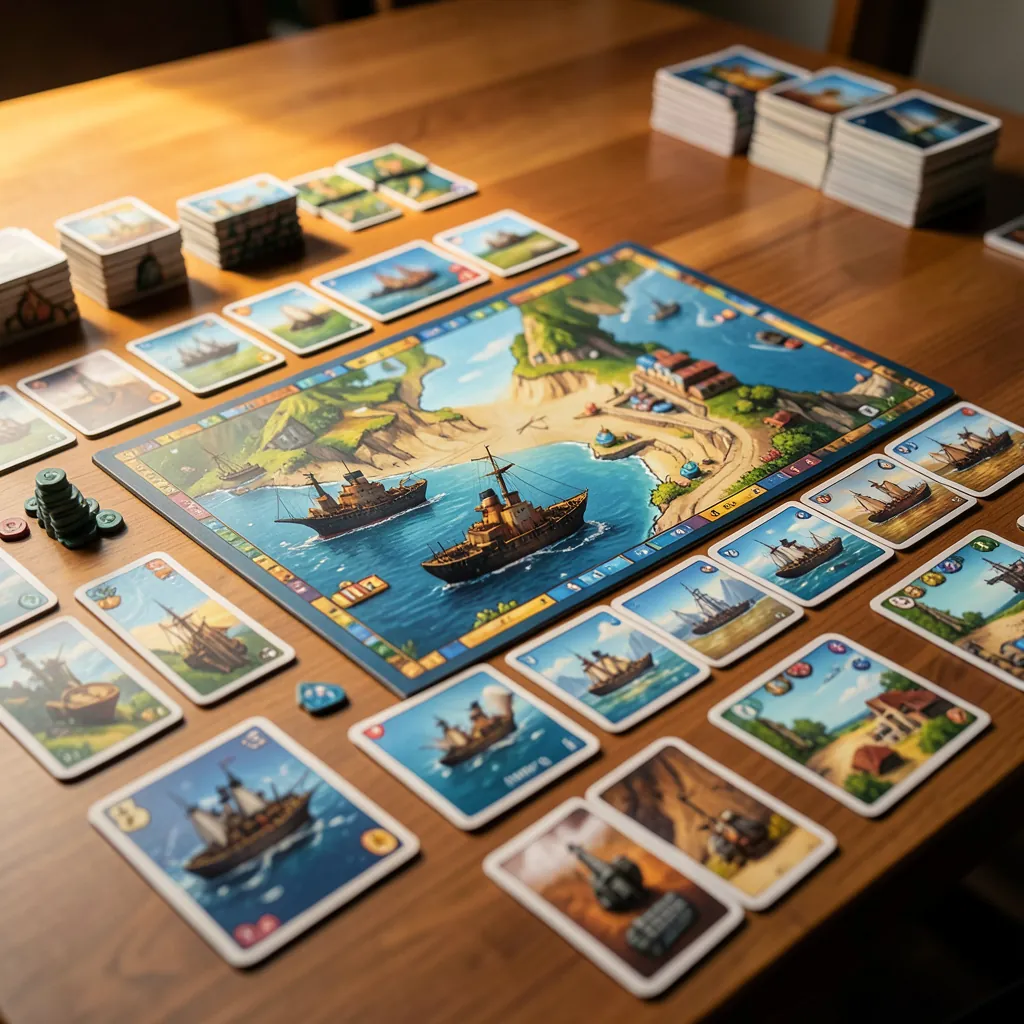
Battleship Strategy Placement: How to Play, Set Up, and Hide Your Fleet
Contents
🎲 Battleship is a two-player hidden-information board game: each player secretly places five ships on a 10×10 grid, then players alternate calling coordinates to hit and sink the opponent’s fleet. The goal is to sink all five enemy ships first. Placement matters, but evidence from a 48,000-game simulator says firing strategy matters far more than where you hide your ships.
Players: 2
Play Time: Not specified in the sources; simulator games average ~109 combined shots, with the winning side averaging ~57 shots
Age: Not specified in the sources
Difficulty: Easy to learn
Type: Two-player hidden-information board game
Setup
- Use two 10×10 grids per player: one for your own fleet and one to track shots at the opponent’s fleet. The sources describe Battleship as a two-player game played on 10×10 boards.
- Give each player the standard five-ship fleet. This is 17 occupied cells out of 100.
| Ship | Length |
|---|---|
| Carrier | 5 cells |
| Battleship | 4 cells |
| Cruiser | 3 cells |
| Submarine | 3 cells |
| Destroyer | 2 cells |
- Place ships horizontally or vertically, never diagonally. Ships cannot overlap each other or hang off the edge of the grid.
- Keep your fleet hidden from your opponent. Use your second grid to mark hits and misses on the enemy board.
- Decide who fires first. In the 48,000-game simulator dataset, Player 1 won 51.5% of games—a real but modest first-mover edge.
- Online versions may offer an Auto-Place option that scatters the whole fleet legally in one click; this is a setup convenience, not a rules change.
How to Play
- Secretly place all five ships on your own 10×10 grid before play begins.
- Choose the first player. Players then alternate turns.
- On your turn, call one coordinate on your opponent’s grid.
- Your opponent answers “Hit” if a ship occupies that square, or “Miss” if it does not.
- Mark the result on your tracking grid. In the rules adopted by the academic Battleship study, a turn alternates even if an attack hits.
- When you get a hit, switch from hunting to targeting: fire at adjacent cells until you establish the ship’s axis, then keep firing along that straight line until the ship sinks.
- When every cell of a ship has been hit, the ship sinks. The academic rules state that only the ship type is announced when a ship sinks, such as “A battleship sank.”
- After sinking a ship, return to hunt mode and search for the remaining ships.
- The first player to sink all five of the opponent’s ships wins.
Scoring
Battleship is normally a win/loss game, not a point-scoring game. The first player to sink all five enemy ships wins, and the simulator notes that draws are structurally impossible because every game has exactly one winner. Digital versions may report shots fired, hits, accuracy, and surviving ships, while the simulator compares strategies by win rate and shot efficiency. In the 48,000-game dataset, Player 1 won 51.5% of games.
💡 Strategy Tips
The strongest evidence-based lesson is that firing strategy dominates—but placement still shifts win rates. The table below synthesizes the main placement approaches from the sources.
| Placement approach | How it works | Evidence and trade-offs |
|---|---|---|
| Random | Ships placed without regard to edges, spacing, or pattern. | Source 1: 0.453 average win rate, the lowest placement result. Source 3: truly random placement can be hard to anticipate. |
| Edge-biased / edges | Ship ends sit on or along the board edges; may use or avoid corners. | Source 1: edge_biased averaged 0.542 win rate, the best placement group. Source 2: edge placement was superior, and prohibiting connected placements gave the best results. Conflict: Source 3 warns that edge and corner habits can become easy to detect once anticipated. |
| Clustered / grouped | Ships are placed adjacent or confined to one zone. | Source 1: clustered averaged 0.493, slightly below 50%. Source 3: grouped placement is popular and can exploit opponents who avoid squares next to sunk ships. |
| Spaced / no-connected | Ships are not touching or are kept well apart. | Source 2: prohibiting connected placements produced the best results with the edge strategy. Source 4: spread ships apart so one lucky area does not sink several at once. Source 3: spacing helps avoid direction-following after an initial hit. |
| Checkerboard / dispersed | Ships are spread with parity preference and maximum dispersion. | Source 1: checkerboard averaged 0.512. Source 4 recommends mixing orientations and avoiding center-hugging placement. |
- Prioritize firing strategy over placement. In Source 1’s 48,000-game simulation, firing strategy was worth about 5× more than placement strategy.
diagonal_gridaveraged 0.682 win rate, whilerandom_firingmanaged only 0.133. A strong search pattern beats clever hiding more reliably than the reverse. - Use an edge-biased, no-connected default—but do not be predictable. Source 1 and Source 2 both point toward edge-biased placement, and Source 2 found that prohibiting connected ship placements was best. However, BGA tips warn that repeated edge and corner habits can be anticipated, especially against repeat opponents, so vary your setup.
- Spread ships and hide the small ones. Source 2’s best placement condition prohibited connected ships; Source 4 advises spreading ships apart so one hit does not lead the opponent into a cluster; Source 3 notes the smaller ships are harder to find, so place them well hidden and away from other ships.
- Mix orientations and avoid obvious patterns. Source 4 recommends mixing horizontal and vertical ships, and Source 3 warns that symmetrical, parallel, or otherwise regular patterns can be anticipated and exploited.
- Use hunt/target discipline and parity search. Source 4 explains the checkerboard parity hunt: because every ship is at least two cells long, firing on one parity class—50 cells instead of 100—still guarantees finding every ship. Once you hit, stop hunting and finish the wounded ship. After the 2-cell Destroyer is sunk, you can spread hunting shots further because the shortest remaining ship is 3 cells. Common beginner mistakes are drifting back to random shots while a wounded ship is still afloat and placing the whole fleet in the most-fired-at center region.
🎲 Variations
- Board size: The main sources use 10×10 boards. Source 2 notes that some other sites use 16×16 boards, so that is a supported size variation—but it is not the default used in these sources.
- Player count: The sources describe Battleship as a two-player game. No supported 3–5 player variant appears in these sources.
- Turn rule: Source 2’s adopted rules alternate turns even after a hit. If you see or use a house rule where a hit grants another shot, treat it as a separate convention rather than the rule set described here.
- Online setup: Source 4’s Auto-Place is a convenience feature for placing a legal fleet quickly; it does not change hit, miss, turn, or win rules.
- Repeat opponents: Source 3 advises changing your placement approach against repeat opponents who may anticipate your earlier patterns. This is a tactical adjustment, not a formal rule change.
❓ FAQ
How many players can play Battleship, and can you play with 2?
Two. The sources describe Battleship as a two-player hidden-information game; no supported 3–5 player variant appears in these sources.
How do you win Battleship?
Sink all five opponent ships. You do this by calling coordinates and hitting every cell occupied by each ship; the first player to sink the entire enemy fleet wins.
What is the best ship placement strategy in Battleship?
Edge-biased placement with no connected ships has the strongest evidence in these sources. A 48,000-game simulator gave edge_biased the best placement win rate—0.542 versus 0.453 for random—and an academic study found edge placement plus prohibiting connected placements best. But the same simulator says firing strategy matters about 5× more than placement, and BGA tips warn that edge/corner habits become predictable against repeat opponents.
Is Battleship hard to learn?
No. The core rules are simple: place ships, call coordinates, answer hit or miss, and sink all five ships. The depth comes from search patterns and placement decisions.
How long does a Battleship game take?
The sources do not give a real-time play duration. In the simulator, the average game lasted ~109 shots combined, and the winning side averaged ~57 shots; use those as a pace indicator rather than a clock time.
What do you need to play Battleship?
Two 10×10 grids and the standard five-ship fleet per player. The fleet is Carrier 5, Battleship 4, Cruiser 3, Submarine 3, Destroyer 2—17 occupied cells—plus markers or a tracking grid for hits and misses.
Related guides
- Azul Max Players: How to Play, Setup, Scoring, and Player Count Guide
- Battleship Best Placement: Where to Hide Your Fleet and How to Play
- Battleship Best Strategy: How to Play, Search, and Win More Often
- Best Battleship Position: How to Play Battleship and Place Your Fleet to Survive
- Battleship Strategy Guide: How to Play and Win More Often
Sources
- GitHub - dimassaa/battleship-strategy-analysis: A deterministic Battleship simulator that pits configurable placement and firing strategies against each other in full round-robin tournaments, records every game as a replay, and reports statistically-grounded results with Wilson confidence intervals and explicit data-quality flags · GitHub
- Evaluation of Attacking and Placing Strategies in the Battleship Game without Considering Opponent Models