How to Set Up and Play Checkers (Draughts): Rules, Setup, Scoring & FAQ
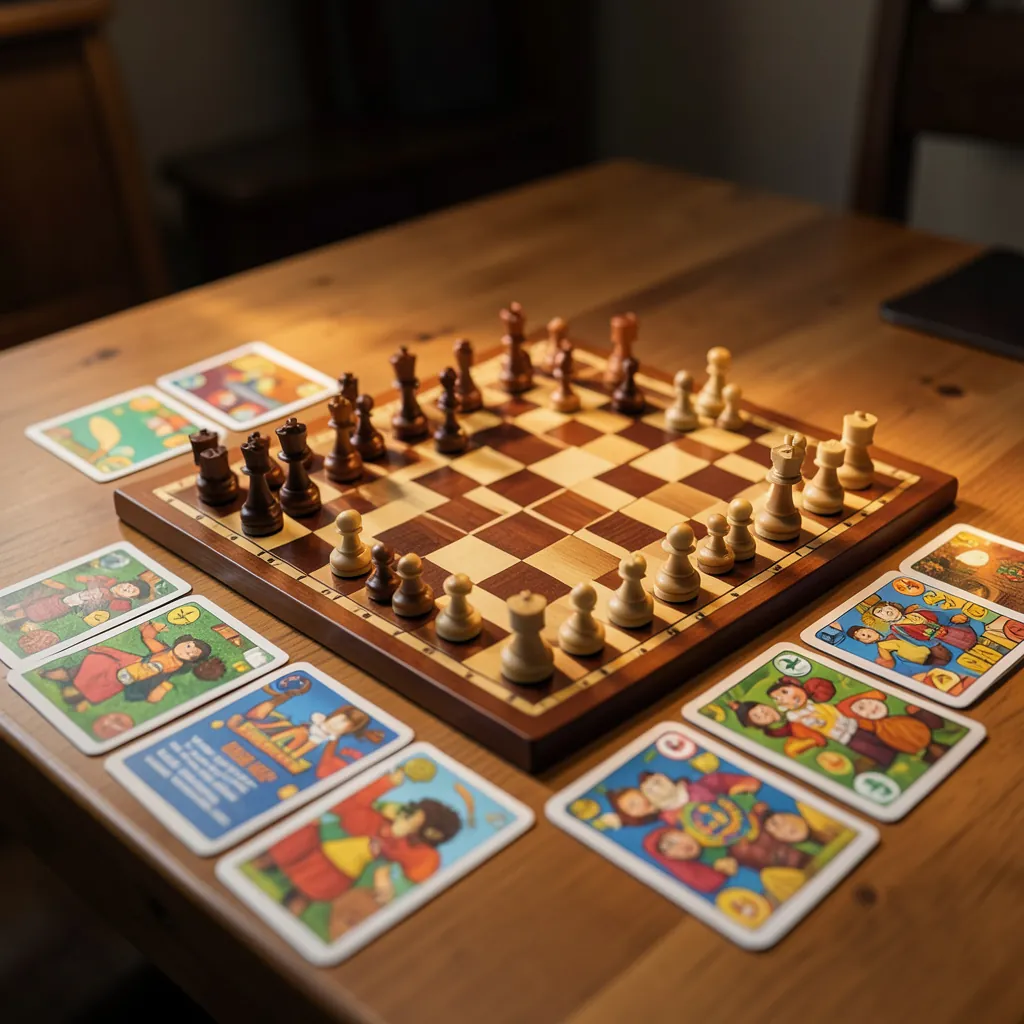
How to Set Up and Play Checkers (Draughts): Rules, Setup, Scoring & FAQ
Contents
♟️ Checkers—also called draughts—is a two-player strategy game on an 8×8 board. To set up, place the board with a dark square on each player’s left, give each player 12 pieces, and put all 12 on the dark squares of the three rows nearest each player; leave the two middle rows empty. The goal is to capture all opposing pieces or block them so they cannot move.
Players: 2
Play Time: Varies; no fixed time in the sources
Age: 5+ (Source 3 says a five-year-old can grasp it)
Difficulty: Easy to learn
Type: Strategy board game (checkers/draughts)
Setup
- Use a standard 8×8 checkerboard. Checkers and draughts are the same game; “draughts” is the British name and “checkers” is the American name (Source 3). The board has 64 alternating light and dark squares, but only the 32 dark squares are used (Sources 3 and 5).
- Orient the board correctly. Place it between the two players so each player has a light square in the near-right corner; this is equivalent to having a dark square on each player’s near-left corner. Source 5 also specifies the double-corner on the right. Sources 1, 3, and 5 agree on this orientation when read together.
- Give each player 12 pieces. Use two contrasting sets, such as red and black, black and white, or red and white. Source 1 uses 12 red and 12 black; Source 3 uses 12 pieces per player; Source 5 uses 12 checkers each of contrasting colors.
- Place all 12 pieces on the dark squares of your nearest three rows. This fills all 12 dark squares in those three rows. Leave the two centre rows empty between the two armies (Source 3; Source 5 also says three rows nearest each player).
- Decide who moves first. The player with the darker pieces moves first. In Hasbro’s red/black set, Black moves first (Sources 1, 3, and 5).
How do the main sources compare on setup and core rules?
| Rule/setup point | Hasbro instructions (Source 1) | Jaques draughts guide (Source 3) | Official US Checkers rules (Source 5) | Synthesis / conflict note |
|---|---|---|---|---|
| Game and board | Checkers on a double-faced gameboard | Draughts = checkers; standard 8×8 board; only 32 dark squares used | Straight Checkers/English draughts; 8×8 board; dark squares only | All agree it is checkers/draughts on an 8×8 board using dark squares |
| Board orientation | Light square in each player’s right-hand corner | Dark square on near-left corner | Dark square on each player’s left; double-corner on right | Equivalent if light is on the right and dark on the left; Source 5 adds double-corner detail |
| Pieces per player | 12 red and 12 black | 12 each; traditionally black/white or red | 12 each of contrasting colors | Agree: 12 per player; colors vary |
| Starting rows | Set up as Diagram 1 | Dark squares of three rows nearest each player; two centre rows empty | Dark squares of three rows nearest each player | Agree on three nearest rows; Source 3 explicitly says two centre rows empty |
| First move | Black plays first | Darker pieces conventionally move first | Darker checkers make first move | Agree when Black is the darker set; Source 1 names Black |
| Capturing rule | Must jump; failure may be “huffed” | Compulsory capture; choose among captures; chain all jumps | Compulsory capture; huff not permitted; retract incorrect move | Compulsory capture agreed; conflict on missed-capture penalty: huff (Source 1) vs retraction/no huff (Source 5) |
| King crowning | Opponent places a “captured man” on top | Stack a second captured piece of the same colour | Opponent crowns with a same-colour checker; cannot move until done | Use same-color checker; Source 1’s wording is ambiguous |
| Win/draw | Remove all opponent’s men or block them | Capture all or leave no legal move | Capture all or block; draw if neither can accomplish this | Win condition agrees; Source 5 adds draw; Sources 1 and 3 omit draw |
Scope note: Source 2 is GNU Backgammon’s manual position setup, so it describes backgammon, not checkers. Source 4 is a Bukkit Checkers plugin configuration; it supports 8×8 EnglishDraughts as the default and has a global forced_jump default of true, useful for digital variants.
How to Play
- Start with the darker pieces. The player with the darker checkers moves first; in Hasbro’s red/black set, Black starts. Players then alternate one move per turn (Sources 1, 3, and 5).
- Move a man one square diagonally forward. On your turn, move one ordinary checker—a “man”—one square diagonally forward onto an empty dark square. Men cannot move straight, sideways, or backward (Sources 3 and 5).
- Jump to capture. If your man is diagonally next to an opponent’s piece and the dark square immediately beyond is empty, jump over the piece, land on the empty square, and remove the captured piece. Men jump forward only. If several jumps are possible, you may choose one; once you start a capture sequence, you must continue jumping with the same piece as long as further jumps are available (Sources 1, 3, and 5).
- Captures are compulsory. If a capture is available, you must take it. Under Official US rules, if you fail to capture, the incorrect move is retracted and a correct capture must be made; “huffing” is not permitted. Older Hasbro instructions instead allow a “huff” penalty—removing the man that should have captured. This is a rules conflict to flag, not a rule to merge silently (Sources 1 and 5).
- Crown kings on the far row. When a man reaches the opponent’s back row—the king row—it becomes a king. The move ends there, even if the man arrived by a jump. The opponent crowns it by placing another checker of the same color on top; the opponent must do this before making their own next move (Sources 3 and 5; Source 1 says “captured man,” but Sources 3 and 5 specify same color).
- Move and jump with kings in both directions. A king moves one square diagonally forward or backward to an empty dark square. It captures by jumping forward or backward and may continue jumping. A king may not jump the same opposing piece more than once (Source 5).
- Men can jump kings. Many players believe men cannot jump kings; Source 5 says that is incorrect—men may jump kings in the same way they capture other men.
- Win by capture or block. You win when you remove all your opponent’s pieces or block them so they have no legal move on their turn. Source 5 adds that if neither player can accomplish this, the game is a draw (Sources 1, 3, and 5).
Scoring
Checkers/draughts does not use point scoring in the sources; the result is a win, loss, or draw.
- Win: Remove all opponent’s men, or block the opponent so they cannot move (Sources 1, 3, and 5).
- Draw: Source 5 says if neither player can accomplish the win condition, the game is a draw. Sources 1 and 3 describe the win condition but do not mention draws.
- Time forfeit: Source 5 says a player loses if their time expires before they complete the required number of moves when time limits are used.
- No points for captured pieces: The sources do not describe scoring points for captures; the objective is the win condition above.
💡 Strategy Tips
- Control the centre. Pieces in the middle command more diagonals and squares than pieces stranded on the edge. Push toward the centre early to dictate where captures happen (Source 3).
- Protect your back row. The pieces guarding your king row stop the opponent from crowning. Keep them home as long as you sensibly can; every turn the opponent fails to make a king keeps you level (Source 3).
- Use compulsory capture against the opponent. Because captures are forced, you can offer a single piece to force a reply that opens a bigger jump or a two-for-one trade. Trade when ahead; avoid trading when behind (Source 3).
- Watch for multi-jumps. A common beginner mistake is forgetting that a capture sequence must continue. When several captures exist, choose the sequence carefully, then complete all jumps in that sequence (Sources 1, 3, and 5).
- Do not treat kings as immune. Men can jump kings. Leaving a king next to an enemy man can lose the king if the landing square is open (Source 5).
🎲 Variations
- Standard two-player 8×8 checkers/English draughts: Use 12 pieces per player on the dark squares of the nearest three rows. Source 4’s plugin config uses
default_rules.8: EnglishDraughtsfor 8×8 boards. - Larger digital board variants: Source 4 lists
default_rules.10: InternationalDraughtsfor 10×10 boards anddefault_rules.12: CanadianCheckersfor 12×12 boards. The source names these rule sets but does not spell out their full rules. - Forced-jump setting in the Bukkit Checkers plugin:
forced_jumpdefaults totrueglobally, meaning “if you can make a jump, you must,” and it can be overridden per game. This matches the compulsory-capture rule in Sources 1, 3, and 5. The plugin uses/checkers setcfg <key> <value>to change settings (Source 4). - House-rule conflict—huffing vs. retraction: Older Hasbro instructions allow “huffing” as a penalty for missing a capture (Source 1). Official US rules say huffing is not permitted and require retracting the incorrect move and making a correct capture (Source 5). Decide which house rule you will use before play.
- Player-count note: Checkers is a two-player game. The sources do not describe a standard 3–5 player version. Source 2 is a backgammon setup manual, not a checkers variant.
❓ FAQ
How many players play checkers?
Checkers is a two-player game. Use 12 pieces per player on an 8×8 board; the sources do not describe a standard 3–5 player version (Sources 1, 3, and 5). So yes—you play checkers with 2 players.
How do you win at checkers?
You win by capturing all your opponent’s pieces or blocking them so they cannot move. Source 5 adds that if neither player can accomplish this, the game is a draw; Sources 1 and 3 describe only the win condition.
Do you have to jump if you can?
Yes. Captures are compulsory. If multiple captures exist, you may choose one, but once you choose a sequence you must complete all jumps in that sequence. Official US rules require retracting a missed capture; older Hasbro instructions allow huffing as a penalty.
Is checkers hard to learn?
No—it is easy to learn. Source 3 says the single movement rule can be grasped in under a minute and is simple enough for a five-year-old; the strategy is deep enough for experienced players.
How long does a game take?
The sources do not give a fixed game length. Source 5 permits time limits based on fixed time per move or fixed time for a given number of moves, and a player loses if time expires before completing required moves. Casual games vary.
What do you need to play checkers?
You need an 8×8 checkerboard with 64 alternating light and dark squares and 12 pieces per player in contrasting colors. Only the 32 dark squares are used, and the two centre rows start empty (Sources 3 and 5).
Related guides
- Azul Max Players: How to Play, Setup, Scoring, and Player Count Guide
- Battleship Best Placement: Where to Hide Your Fleet and How to Play
- Battleship Best Strategy: How to Play, Search, and Win More Often
- Battleship Strategy Placement: How to Play, Set Up, and Hide Your Fleet