How to Play Mancala: Rules, Setup, Scoring, and Variations
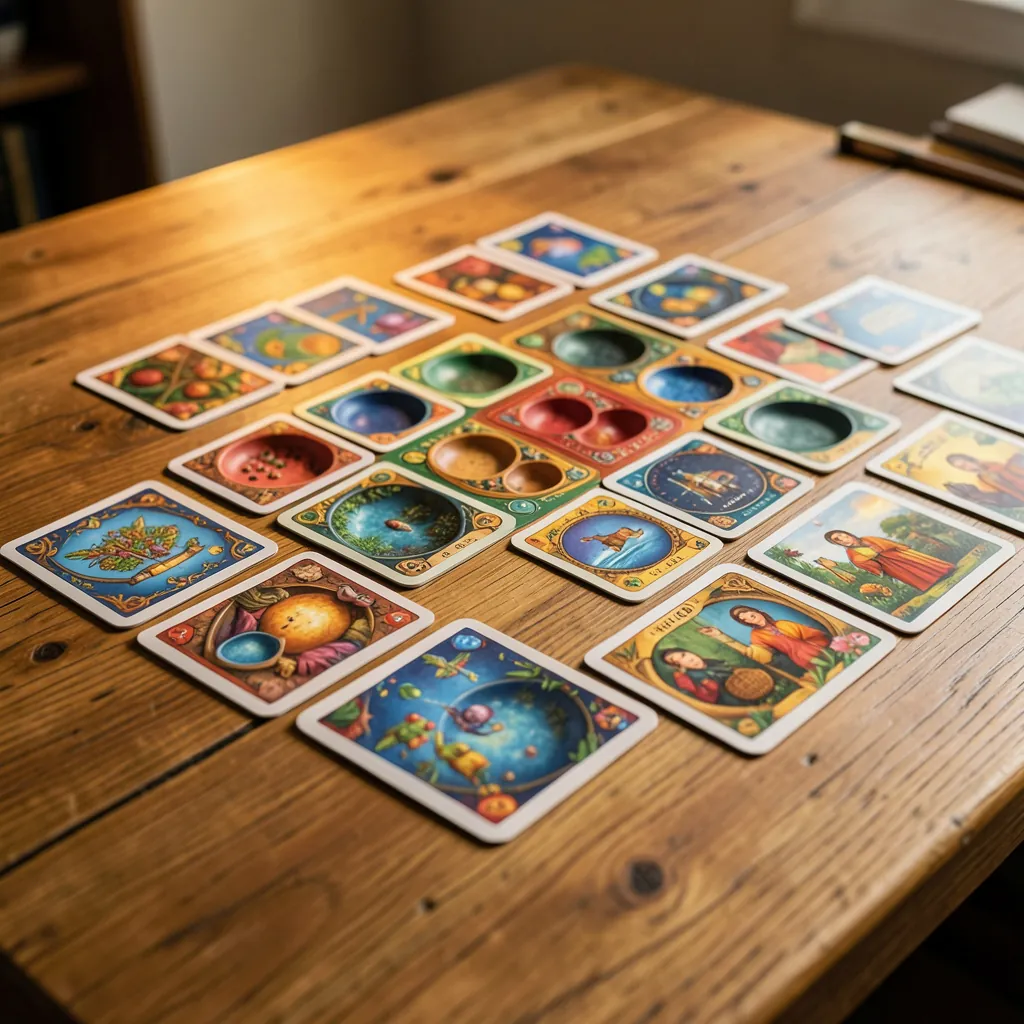
How to Play Mancala: Rules, Setup, Scoring, and Variations
Contents
♟️ Mancala is a family of ancient count-and-capture board games in which two players or teams sow seeds, shells, or stones around a board and try to capture the most pieces. In the common two-row, six-bin-per-side version, each player starts with three counters in each bin, sows anti-clockwise, captures from opposite bins, and wins by having the most counters in their own mancala.
Players: 2 (or 2 teams in some variants; the common two-row rules use 2 players)
Play Time: Not specified in the sources; varies by version
Age: Not specified in the sources
Difficulty: Easy to learn; strategy matters more than luck
Type: Count-and-capture / sowing board game
Setup
The rules below follow the common two-row, six-small-bins-per-side version described in Source 1. Named regional versions such as ayoayo, ayo, wari, and oware can have different rules, so agree on a version first.
- Use a two-row mancala board with six small bins on each player’s side and one large mancala/store at each end. Source 1’s classroom version uses 36 counters; museum examples use cowrie shells (34 or 36) or seeds, so exact piece counts can vary by set.
- Place three counters in each of the 12 small bins. Leave both mancalas empty.
- Collect 36 counters if using Source 1’s rules; pebbles, dried beans, seeds, or shells can be used.
- Identify each player’s six bins and mancala. On a turn, play only from bins on your own side and sow to the right/anti-clockwise.
- If making a board, Source 1 suggests tracing the board onto card, decorating it, and gluing string or wool around bins to stop counters rolling. Source 1 and Source 5 also note that boards can be holes dug in the ground, sand, rock, or carved wood.
How to Play
The following numbered rules are for the common two-row version in Source 1; other named versions may differ.
- Scoop up all counters from any one bin on your side that has counters.
- Moving to the right, anti-clockwise, drop one counter into each bin you pass.
- If you reach your own mancala, drop one counter into it. If you reach your opponent’s mancala, skip over it and do not place a counter.
- If your last counter lands in your own mancala, take another turn.
- If your last counter does not land in your own mancala, your turn ends and the other player plays.
- To capture, your last counter must land in an empty bin on your own side. Take any opponent counters in the bin directly opposite that empty bin and put them in your mancala.
- After a capture, your turn ends; the other player plays.
- Continue alternating turns until all six bins on one side are empty.
- End-of-game collection: the player with counters remaining in their bins picks them up and puts them into their own mancala. The player whose bins are empty does not collect those remaining counters.
- Count each player’s mancala. Under Source 1’s rules, the player with more counters in their own mancala wins.
Scoring
- In the common two-row version, counters in your own mancala are your score. When one side is empty, the player with counters still in their bins adds those counters to their own mancala; the player with empty bins does not add the other player’s remaining counters. Count the mancalas; most counters wins (Source 1).
- Source 2 describes ayoayo’s goal differently: capture a majority of the pieces or at least immobilize the opponent. This is a variant goal, not a conflict with the common “most counters” rule.
- Source 2 says successful play depends on strategy more than luck.
💡 Strategy Tips
- Plan extra turns: ending your last counter in your own mancala gives you another turn.
- Count before you sow: know where your last counter will land, because only an empty bin on your side triggers a capture from the opposite bin.
- Watch capture opportunities for both players: set up your own empty-bin capture and avoid leaving your counters opposite an empty bin on your opponent’s side.
- Remember to skip your opponent’s mancala; a mis-sow can change whose turn follows.
- Common beginner mistake: at the end, the player whose bins are empty does NOT collect the remaining counters; the player with counters still in their bins collects them into their own mancala.
🎲 Variations
Mancala is a generic term for a family of games, not one single rule set. Source 2 notes thousands of vernacular names, and Sources 2–4 note two-, three-, and four-row boards with wide regional rule differences. Source 3 says the name “mancala” comes from an Arabic verb meaning “to move.” Use this comparison table to see what the sources support:
| Version / term | Region or source example | Board / pieces | Players | Source-stated goal or note |
|---|---|---|---|---|
| Mancala (generic) | Africa, Asia, Americas, Middle East, Caribbean (Sources 2–5) | 2-, 3-, or 4-row boards; seeds, stones, shells, cowrie shells; wood, ground, sand, or rock | 2 players or teams (Sources 2–3) | Count-and-capture/sowing game; aim to capture most pieces; strategy more than luck (Sources 2–4) |
| Common two-row rules | Source 1 classroom rules | 2 rows × 6 small bins + 1 mancala per side; 36 counters | 2 | Start with 3 counters per bin; sow anti-clockwise; capture opposite; most counters in your mancala wins |
| Main Chakot | Thailand (Source 1) | Boat-shaped wooden board with ten holes; fruit seeds used as counters | Not stated in Source 1 | Source 1 calls it “slightly different to African mancala”; do not assume the six-bin rules apply |
| Ayoayo / ayo | Yoruba, Nigeria (Sources 2–3) | 2-row, 12-hole opon ayo; hard seeds | 2 people or rarely two teams | Capture a majority or immobilize opponent; strategy more than luck |
| Wari / oware | West Africa/Caribbean; Ghana (Sources 3–4) | 2-row, six holes per side + end storage holes; cowrie shells or large seeds | 2 players or teams | Wari and ayo are best-known versions; oware is a popular form; rules vary locally |
How Do You Play with 2 Players?
Use the common two-row rules above: each player owns six bins and one mancala, starts with three counters per bin, sows anti-clockwise, captures from the opposite bin, and counts counters in their own mancala. Source 1 specifically says two players.
Can More Than Two Play?
Sources mention two people or rarely two teams (Source 2) and two players or teams (Source 3), but they do not give a standard 3–5-player individual rule set. Do not assume 3–5 individual players unless you are using a specific local variant with rules for it.
What Named Versions Appear in the Sources?
- Ayoayo / ayo: Yoruba version played on a 2-row, 12-hole board; the goal is to capture a majority or immobilize the opponent (Source 2; Source 3 mentions ayo in Nigeria).
- Wari: played across West Africa and the Caribbean; one of the two best-known versions along with ayo (Source 3).
- Oware: popular form played on a 2-row, six-hole-per-side board from Ghana; pieces may be cowrie shells or Caesalpinia bonduc seeds (Source 4).
- Main Chakot: Thai mancala board shaped like a boat with ten holes for counters (Source 1).
What Equipment Varies?
- Boards can be carved wood, holes in the ground, sand, rock, or museum-style boards; pieces can be seeds, stones, shells, beans, or cowrie shells (Sources 1–5).
- Source 1 uses 36 counters; museum examples use 34 or 36 cowrie shells, so exact piece count depends on the board/version.
❓ FAQ
How many players can play mancala?
Two players in the common two-row rules from Source 1. Some sources also mention two teams for ayoayo/wari, but the sources provided do not give a standard 3–5-player individual rule set.
How do you win at mancala?
In the common two-row rules, you win by having the most counters in your own mancala after the final collection. In ayoayo, Source 2 says the goal is to capture a majority of the pieces or immobilize the opponent.
Can you play mancala with 2 players?
Yes. Source 1’s rules are specifically for two players, and the common two-row board has six bins per player plus one mancala each.
Is mancala hard to learn?
It is easy to learn: Source 1 calls the rules simple, and Source 2 says success depends on strategy more than luck.
How long does a game take and what do you need?
The sources do not give a fixed play time; it varies by version. For Source 1’s two-player game you need a two-row board with six small bins per side, two mancalas, and 36 counters such as pebbles or dried beans.
What do sources disagree about on mancala’s origins?
Source 1 says mancala is “believed to have been invented by the Egyptians around 1400 BC.” Source 5 calls the origins controversial and says the earliest historical mention is in the first half of the 10th century CE (Kitāb al-Aghānī, c. 950), while older cup-mark boards are debated. The sources do not agree on one origin date.
Related guides
- Azul Max Players: How to Play, Setup, Scoring, and Player Count Guide
- Battleship Best Placement: Where to Hide Your Fleet and How to Play
- Battleship Best Strategy: How to Play, Search, and Win More Often
- Battleship Strategy Placement: How to Play, Set Up, and Hide Your Fleet
- Best Battleship Position: How to Play Battleship and Place Your Fleet to Survive