How to Play Sequence: Rules, Setup, Scoring, and Strategy
How to Play Sequence: Rules, Setup, Scoring, and Strategy
Contents
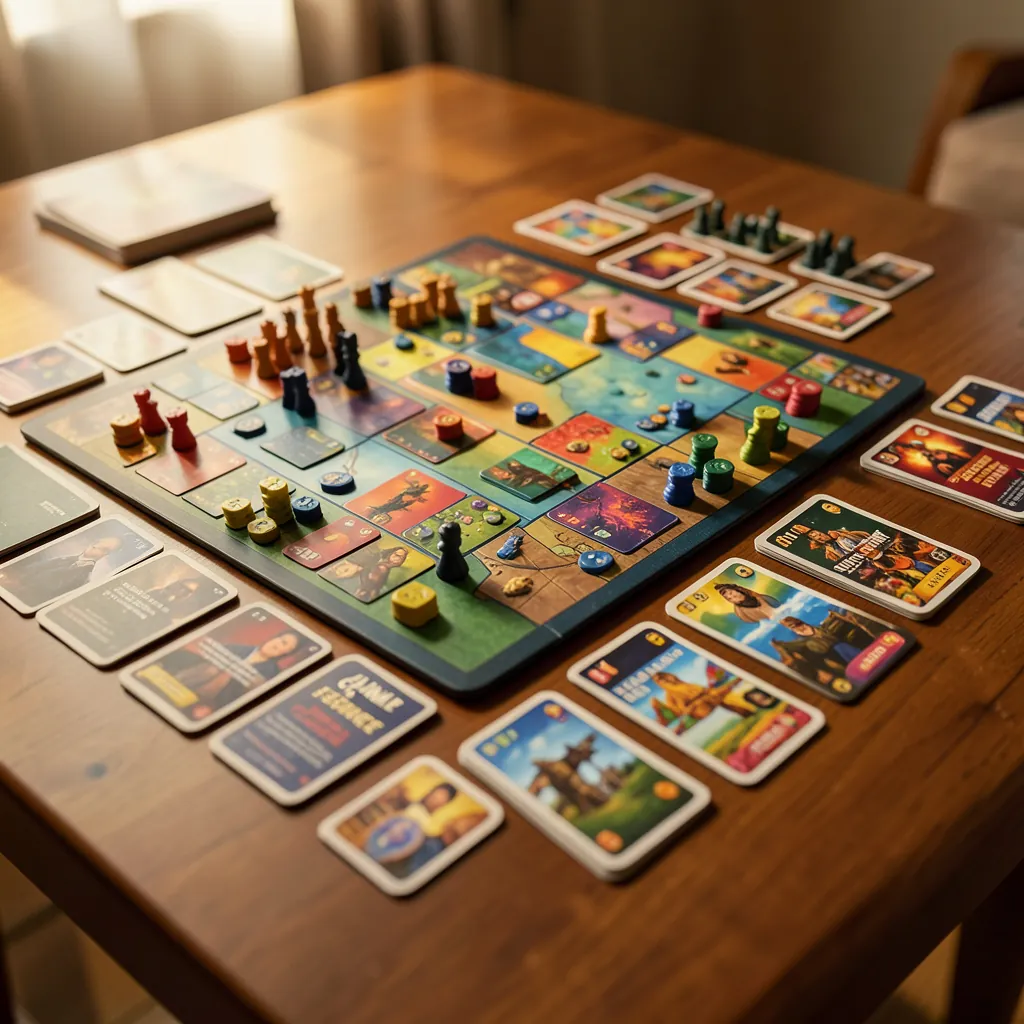
🎲 Sequence is a board-and-card abstract strategy game in which players play cards from their hand and place chips on matching spaces on a 10×10 board, racing to make five connected chips in a row, column, or diagonal. The goal is to complete the required number of sequences before opponents do, using Jacks and blocking to disrupt them.
Players: 2-12
Play Time: Usually under 30 minutes; can vary with luck and player count
Age: Not specified in the supplied rule sources; a product listing mentions 7+
Difficulty: Easy to learn
Type: Board-and-card abstract strategy/party game; not a trick-taking card game in the core rules — see the source-conflict note below
Setup
- Place the Sequence board where all players can reach it. The board shows all cards except the Jacks from two standard 52-card decks, laid out in a 10×10 pattern.
- Give each player or team a set of colored marker chips. The supplied product descriptions say the game includes 135 playing chips.
- Treat the four corner spaces as free spaces that count for all players equally.
- Shuffle the Sequence playing cards. There is a source conflict on dealing: one product description says to deal all the cards and notes that players may not have equal numbers if the deck does not divide evenly, while another source describes cards being played from a hand. The supplied sources do not give a single consistent hand size or draw rule, so use the rulebook included with your edition.
- Choose the first player according to your edition’s rulebook. One product description says the player to the dealer’s left makes the first play, but that same description also includes a conflicting card-sequence procedure, so confirm this against your copy.
- Agree on how many sequences or connections are needed to win. The sources say the game ends when someone reaches a “specified number” of connections, but they do not give one universal target number.
Note: Sources 1 and 4 describe a mathematical “sequence arithmetic” game using 0/1 sequences and theorems. That is not the commercial Sequence board game, so those rules are not used for the play instructions below.
How to Play
- On your turn, play a card from your hand.
- Place one of your marker chips on a board space that corresponds to the card you played. The core goal is to place chips on cards you have “laid down” and connect them on the board.
- Work toward rows, columns, or diagonals of five connected checkers/chips.
- Use the four corner spaces carefully: when a corner is used as part of a Sequence, only four of your marker chips are needed to complete it. More than one player may use the same corner as part of a Sequence.
- Use two-eyed Jacks as wild cards, according to the product descriptions.
- Use one-eyed Jacks to remove an opponent’s checker, according to the product descriptions.
- Block opponents while building your own lines; the sources specifically mention blocking opponents and removing their chips.
- The game ends when a player or team reaches the specified number of connections/sequences.
Source comparison: what the rules sources agree and disagree on
| Rule area | What the supplied sources say | How to handle it |
|---|---|---|
| Players | Source 2 says Sequence can be played by 2 to 12 players; Source 5 lists up to 12. | 2-12 players is supported. |
| Board | 10×10 board showing all cards except Jacks from two standard 52-card decks; four corners are free for all players. | Supported by Sources 3 and 5. |
| Goal | Create rows, columns, or diagonals of 5 connected chips/checkers; reach a specified number of connections. | Supported by Sources 3 and 5. |
| Jacks | Two-eyed Jacks are wild; one-eyed Jacks remove an opponent’s checker. | Supported by Sources 3 and 5. |
| Core turn | Play a card and place a chip on a matching board space. | Supported by Sources 2 and 5. |
| Dealing | Source 3 says deal all cards; Source 2 describes cards played from a hand. | Conflict — use your edition’s rulebook. |
| Winning number | Sources say a “specified number” of connections but do not give the number. | Unspecified — confirm in your rulebook. |
| Alternative card procedure | Sources 3 and 5 also describe playing the lowest card in a suit, then the next-highest, up to the Ace. | Conflicts with the core “play a card, place a chip” rules; flag as a source conflict, not a standard extra rule. |
| “Sequence arithmetic” | Sources 1 and 4 describe a mathematical 0/1 sequence game, not the board game. | Exclude from board-game rules. |
Scoring
The supplied sources do not describe a point total for standard Sequence. Winning is based on completed connections: the first player or team to reach the specified number of sequences/connections wins. The four corner spaces are free and count for all players equally; when a corner is used, only four marker chips are needed to complete a Sequence. The sources do not state one universal winning target, so check your edition’s rulebook for the exact number.
💡 Strategy Tips
- Build more than one possible line. Since opponents can block and remove chips, a single obvious line is easier to stop.
- Use the corners correctly. A corner can complete a Sequence with only four of your chips, and more than one player may use the same corner.
- Save one-eyed Jacks for key disruptions. They can remove an opponent’s checker and break a developing line.
- Use two-eyed Jacks as flexible wilds to fill gaps or finish a line.
- Block early. Watch opponents’ rows, columns, and diagonals and disrupt them before they become immediate threats.
Common beginner mistakes: thinking you need five chips through a corner, forgetting that multiple players can share the same corner, and ignoring the tactical value of Jacks.
🎲 Variations
- Two players: The sources list a 2-12 player range, and a Source 5 review says Sequence works well for 2 players. The supplied sources do not give a special two-player rule change.
- Teams: Reviews in Source 5 describe playing with 4 players in teams of 2 and with 3 adults in 2 teams. The full team rules are not provided in the supplied sources, so use your edition’s rulebook.
- Remote play: A Source 5 review mentions playing via Zoom with multiple locations using their own boards. Treat this as an unofficial remote-play adaptation.
- Card-sequence variant/conflict: Sources 3 and 5 include a procedure where players play the lowest card in a suit, then the next-highest, up to the Ace. This resembles a trick-taking-style card sequence and conflicts with the core chip-placement rules from Source 2. Do not treat it as a standard extra rule unless your specific edition says so.
❓ FAQ
How many players can play Sequence?
Sequence can be played by 2 to 12 players according to Source 2, and Source 5 also lists up to 12 players. Reviews mention common 4-player team play.
How do you win at Sequence?
The first player or team to reach the specified number of connections/sequences wins. The sources say “specified number” but do not give one universal target, so confirm the exact number in your rulebook.
Can you play Sequence with 2 players?
Yes. Source 2 lists a 2-12 player range, and a Source 5 review says it works for 2 players. The supplied sources do not give a special two-player rule variation.
Is Sequence hard to learn?
No. The sources describe Sequence as easy-to-learn, fun, and family-friendly; one review says the instructions may sound complicated but become easy once play begins.
How long does a game take?
Usually under 30 minutes. A Source 5 review says a game can easily be completed in under 30 minutes, though luck and player count can make some games last longer.
What do you need to play Sequence?
You need the Sequence board, the Sequence playing cards, and colored playing chips. Sources mention 135 playing chips, a 10×10 board using two standard 52-card decks except Jacks, and four free corner spaces.
Related guides
- Azul Max Players: How to Play, Setup, Scoring, and Player Count Guide
- Battleship Best Placement: Where to Hide Your Fleet and How to Play
- Battleship Best Strategy: How to Play, Search, and Win More Often
- Battleship Strategy Placement: How to Play, Set Up, and Hide Your Fleet
- Best Battleship Position: How to Play Battleship and Place Your Fleet to Survive