How to Play Chess: Complete Beginner’s Guide to Rules, Setup, and Strategy
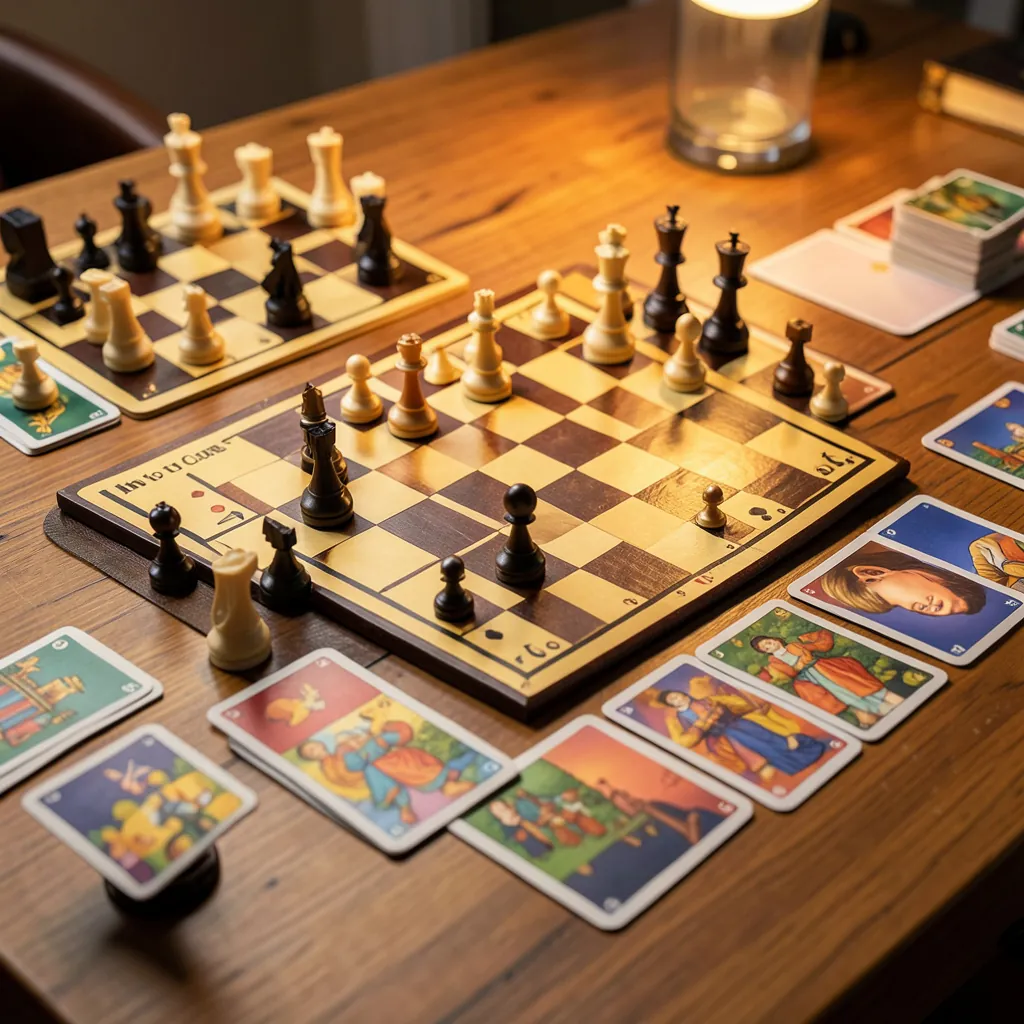
How to Play Chess: Complete Beginner’s Guide to Rules, Setup, and Strategy
Contents
♟️ Chess is a two-player strategy board game played on an 8x8 board with 16 pieces per side. The goal is to checkmate your opponent’s king—trap it so it cannot escape capture—while following each piece’s movement rules and special moves like castling, en passant, and pawn promotion. White always moves first.
Players: 2
Play Time: Varies; often 10–60+ minutes, tournament games longer
Age: 4+ (kids as young as 4 can learn)
Difficulty: Easy to learn (basic rules ~30 minutes), hard to master
Type: Strategy board game (abstract strategy)
Setup
- Orient the board correctly: Place the board so each player has a light (white) square in the bottom-right corner. “White on the right” is the classic check. The board has 64 squares—32 light and 32 dark.
- Place the back row: On each player’s first rank, put rooks in the corners, knights next to them, bishops next to the knights, the queen on her own color (white queen on a light square, black queen on a dark square), and the king on the remaining square next to the queen.
- Fill the second row: Place all 8 pawns directly in front of the back-row pieces.
- Note coordinates (optional): Files are lettered a–h along the bottom; ranks are numbered 1–8 along the side. Each square has a name, such as e5. Recording moves with these names is called algebraic chess notation.
- Decide who plays White: White always moves first. Players commonly decide colors by chance—such as flipping a coin or hiding a pawn for the other player to guess.
- Optional: If playing a timed game, set a chess clock so each player gets a fixed amount of time for the whole game.
How to Play
- White moves first, then players alternate turns—White, Black, White, Black—until the game ends.
- On each turn, move exactly one piece (the only exception is castling, which moves two pieces at once).
- Move the King: One square in any direction—up, down, sideways, or diagonally. The king may never move into check (a square attacked by an enemy piece). Two kings can never be on adjacent squares.
- Move the Queen: Any number of squares in a straight line—horizontally, vertically, or diagonally—as long as her path is clear. She cannot jump over pieces.
- Move the Rook: Any number of squares horizontally or vertically, as long as the path is clear. Rooks cannot jump.
- Move the Bishop: Any number of squares diagonally, as long as the path is clear. Each bishop stays on its starting color all game (one light-squared, one dark-squared).
- Move the Knight: In an “L” shape—two squares in one direction, then one square perpendicular. The knight is the only piece that can jump over other pieces.
- Move the Pawn: Forward one square at a time, except on its very first move when it may advance two squares. Pawns capture diagonally forward one square—never straight ahead—and can never move or capture backward. A pawn cannot move past or capture a piece directly in front of it.
- Capture by landing on an opponent’s piece: Remove the opponent’s piece from the board and take its square. You cannot land on a square occupied by your own piece.
- Respond to check: When your king is attacked by an enemy piece, it is in check. You must immediately get out of check in one of three ways: move the king to a safe square, block the attack with another piece, or capture the attacking piece. You cannot ignore check or make a move that leaves your king in check.
- Win by checkmate: If your king is in check and there is no legal way to escape—no safe square, no blocking move, no capture of the attacker—it is checkmate. The game ends and the checking player wins. The king is never actually captured; checkmate ends the game.
- Special move—Castling: This is the only time you move two pieces in one turn. Move the king two squares toward a rook, then place that rook on the square the king crossed. It is legal only if: neither the king nor that rook has moved yet; there are no pieces between them; the king is not currently in check; and the king does not pass through or land on a square attacked by an enemy piece.
- Special move—En passant: If an enemy pawn moves two squares on its first move and lands directly beside your pawn, you may capture it “in passing” as if it had moved only one square. This capture must be made immediately on your next move, or the right is lost.
- Special move—Pawn promotion: When a pawn reaches the farthest rank from its starting position, replace it with any piece of your choice except a king (or another pawn). Players usually choose a queen, but you may promote to a rook, bishop, or knight. You may promote even if you already have a queen.
- Draws: A game can end in a draw by stalemate (the player to move has no legal move and is not in check), by mutual agreement, by insufficient material to force checkmate, by threefold repetition of the same position, or by the fifty-move rule (50 consecutive moves by each player with no pawn move and no capture).
- Other endings: A player may resign, or in a timed game a player may lose on time.
Piece Movement and Value Comparison
| Piece | How It Moves | How It Captures | Value (points)* |
|---|---|---|---|
| King | One square in any direction | Same as movement | Game (infinitely valuable) |
| Queen | Any number of squares horizontally, vertically, or diagonally | Same as movement | 9 |
| Rook | Any number of squares horizontally or vertically | Same as movement | 5 |
| Bishop | Any number of squares diagonally; stays on one color | Same as movement | 3 |
| Knight | L-shape: two squares one way, then one square perpendicular; can jump over pieces | Same as movement | 3 |
| Pawn | Forward one square (two on first move only) | Diagonally forward one square; en passant special capture | 1 |
*Point values are heuristic estimates used for evaluating material advantage during play—they are not official chess rules and do not determine the winner.
Scoring
Chess does not use a cumulative point score like many card or family games. The game is won by checkmate, by resignation of the opponent, or by time forfeit in timed games. A game can also end in a draw as described above (stalemate, agreement, insufficient material, threefold repetition, or the fifty-move rule). The piece values in the table above are decision-making tools, not a final score. The king’s value is often described as “infinite” or “the game” because checkmate ends the game. Note that sources list draw conditions with slightly different levels of detail; the list above combines the standard reasons mentioned across the sources.
💡 Strategy Tips
- Control the center: The four central squares are prime real estate. Pieces in or controlling the center have more mobility and influence.
- Develop your pieces early: Bring knights and bishops out before launching an attack. Avoid moving the same piece twice in the opening unless necessary.
- Castle early for king safety: Castling tucks your king behind a pawn wall and activates a rook. Top players castle in nearly every game.
- Don’t give away pieces for free: Check what your opponent is threatening before every move. Use piece values to judge exchanges, but remember the king’s safety comes first.
- Avoid bringing your queen out too early: Beginners often rush the queen, but she can be attacked and chased, wasting time. Develop minor pieces first.
- Common beginner mistakes: Moving without thinking, ignoring opponent threats, leaving pieces undefended, and forgetting to protect the king. Slow down and ask, “What is my opponent threatening?”
🎲 Variations
- Timed games (chess clocks): A common practical variation uses a chess clock, giving each player a fixed amount of time for the whole game. When a player’s time runs out, they lose (unless the opponent has insufficient material to checkmate).
- Playing against a computer: Useful for practice; computers never get tired and let you learn from mistakes.
- Standard player count: Official chess is for exactly two players. With more people, use a tournament rotation, play teams, or take turns—there are no official multi-player chess rules in the sources.
- Casual house rules: Some groups allow take-backs or friendly mulligans, but these are non-standard. The rules above reflect standard tournament chess.
❓ FAQ
How many players can play chess?
Chess is a two-player game. One player controls the white pieces, the other controls black.
What is the goal of chess and how do you win?
The goal is to checkmate the opponent’s king—put it in check with no legal escape. You can also win if your opponent resigns or, in timed games, if they run out of time.
Is chess hard to learn?
No. The basic rules take about 30 minutes to learn. Becoming a strong player takes months or years of practice, but anyone can learn to play.
How long does a game of chess take?
It varies widely. Casual games often last 10–60+ minutes; tournament games can be much longer. Timed games use a chess clock to set a fixed limit per player.
What do you need to play chess?
An 8x8 chessboard with 64 squares, 32 chess pieces (16 white, 16 black), and an opponent. A chess clock is optional for timed games.
Can you play chess with more than two people?
Official chess is for two players. With more people, you can rotate players, form teams, or run a small tournament—but the standard rules assume exactly two sides.
Related guides
- Azul Max Players: How to Play, Setup, Scoring, and Player Count Guide
- Battleship Best Placement: Where to Hide Your Fleet and How to Play
- Battleship Best Strategy: How to Play, Search, and Win More Often
- Battleship Strategy Placement: How to Play, Set Up, and Hide Your Fleet
- Best Battleship Position: How to Play Battleship and Place Your Fleet to Survive