How to Play Sequence: Rules, Setup, Scoring, and Strategy
How to Play Sequence: Rules, Setup, Scoring, and Strategy
Contents
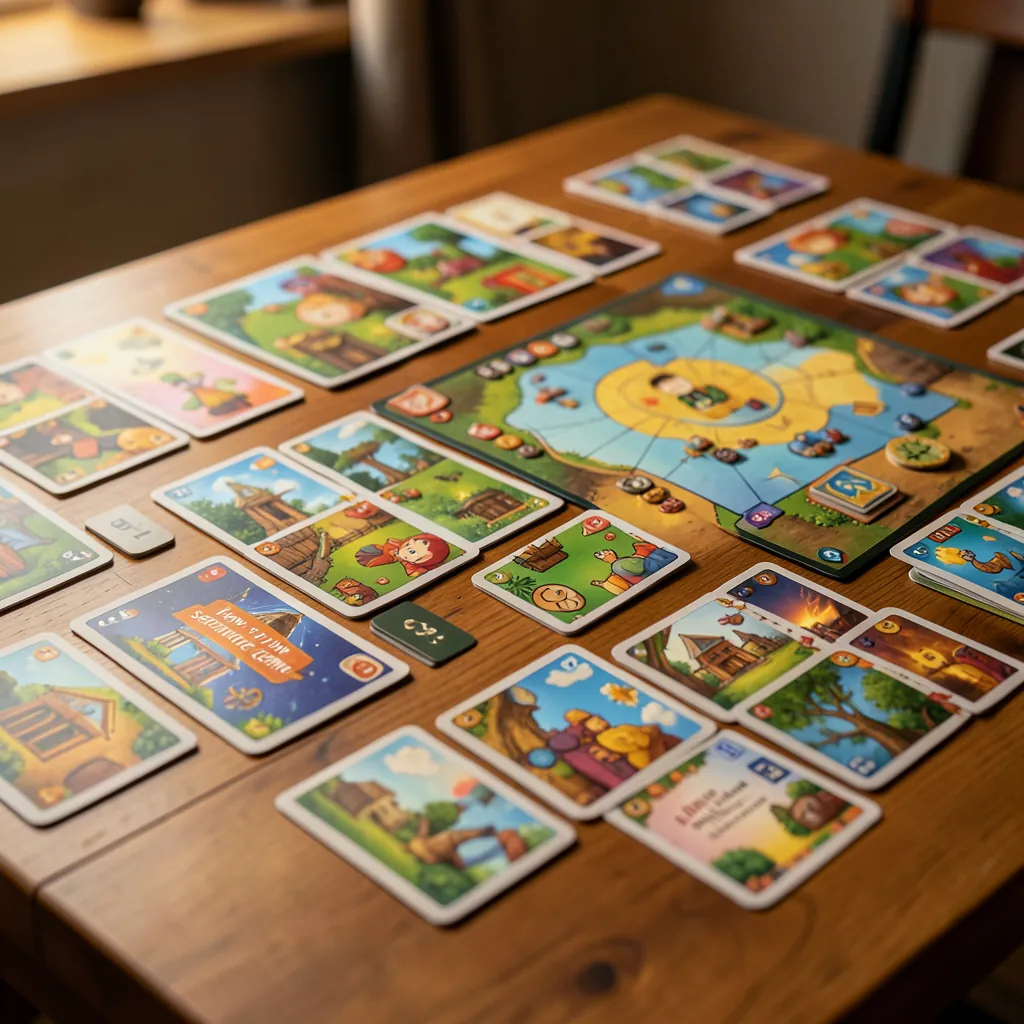
♟️ Sequence is a board-and-card strategy game for 2–12 players in which you play cards from your hand to place chips on matching board spaces. The goal is to be the first player or team to complete the required number of sequences—usually two sequences in a two-player/two-team game and one in a three-player/three-team game. You build rows of five chips horizontally, vertically, or diagonally; corner free spaces count as your chip.
Players: 2–12 (legal standard counts are 2, 3, 4, 6, 8, 9, 10, or 12; more than 3 players use teams)
Play Time: About 30 minutes
Age: 7+
Difficulty: Easy to learn
Type: Abstract strategy board-and-card game
Setup
- Place the Sequence board on a flat surface with room for the draw deck, discard piles, and marker chips.
- Remove the Jokers from two standard 52-card decks; standard Sequence uses 104 cards total.
- Choose chips. Use only blue and green chips for two players or two teams; red chips are used only when there is a third player or third team. A standard set has 50 blue, 50 green, and 35 red chips.
- If more than three people are playing, divide evenly into two or three teams. Team members should use the same color chips and alternate seating with opponents around the table.
- Choose the dealer by cutting cards; the lowest card deals, with Aces high. Shuffle and deal the correct number of cards to each player.
- The player to the left of the dealer starts, and play continues clockwise.
How Many Cards Does Each Player Get?
| Players | Cards dealt to each player | Standard winning target |
|---|---|---|
| 2 | 7 | First player or team to 2 sequences |
| 3 | 6 | First player or team to 1 sequence |
| 4 | 6 | Usually two teams of 2; first team to 2 sequences |
| 6 | 5 | Two teams of 3: 2 sequences; or three teams of 2: 1 sequence |
| 8 | 4 | Two teams of 4; first team to 2 sequences |
| 9 | 4 | Three teams of 3; first team to 1 sequence |
| 10 | 3 | Two teams of 5; first team to 2 sequences |
| 12 | 3 | Two teams of 6: 2 sequences; or three teams of 4: 1 sequence |
Does Sequence for Kids Use the Same Rules?
No. One source describes Sequence for Kids, which is a different version. This guide covers standard Sequence unless noted. Do not mix the rules.
| Feature | Standard Sequence | Sequence for Kids |
|---|---|---|
| Sequence length | 5 chips in a row, or 4 chips plus a free corner | 4 chips in a row, or 3 chips plus a free corner |
| Hand size | Varies by player count: 7, 6, 5, 4, or 3 cards | 3 cards |
| Special cards | 4 two-eyed Jacks are wild; 4 one-eyed Jacks remove an opponent’s chip | 2 Dragon cards remove an opponent’s chip; 2 Unicorn cards place a chip on any open space |
| Board corners | Free spaces for all players; no chip is placed there | Free spaces for all players; no chip is placed there |
How to Play
- Starting with the player to the left of the dealer and moving clockwise, choose one card from your hand and place it face up on your personal discard pile.
- Place one of your chips on an open board space that matches the played card. Each card appears twice on the board, so either open matching space is legal.
- Use Jacks as special cards. A two-eyed Jack is wild: discard it and place a chip on any open space. A one-eyed Jack removes one opponent’s chip; under standard rules, you cannot remove a chip from a completed sequence, and you cannot place your own chip on that same space during that turn. Playing a Jack ends your turn.
- After playing or discarding, draw one card from the draw deck so you end your turn with your starting hand size.
- Treat the four printed corner spaces as free spaces. Every player may use a corner as though their own chip is there, more than one player may use the same corner, and no chip is placed on it. For a five-chip sequence, four chips plus a corner complete the sequence.
- Build sequences horizontally, vertically, or diagonally. Sequences of the same color may intersect, but only at a single position. In a two-sequence game, you may use one chip from your first sequence as part of your second, so a straight row of nine chips can count as two sequences.
- If you hold a dead card—a card whose two matching board spaces are both covered—announce it at the start of your turn, discard it, draw one replacement card, then take your normal turn. You may exchange only one dead card per turn.
- If you forget to draw after your turn and the next player completes their move and draws first, you forfeit that draw and must finish the game with fewer cards.
- In team play, there is no table talk or coaching. If a teammate gives advice, every member of that team forfeits one card of their choice to the discard pile.
- When the draw deck runs out, shuffle all discard piles together to make a new draw deck.
- Play continues clockwise until a player or team completes the required number of sequences. If no one reaches the target, the game can end in a draw.
What Rule Conflicts Should You Know?
- Standard Sequence vs. Sequence for Kids: The kids’ version uses 4-chip sequences, 3-card hands, and Dragon/Unicorn cards. Standard Sequence uses 5-chip sequences, variable hand sizes, and Jacks. Use the rules that match your box.
- One-eyed Jacks and completed sequences: One source says one-eyed Jacks can remove a chip already part of a completed sequence, but another standard-rules source says completed sequences cannot be broken. The safer standard rule is that completed sequences stand.
- Winning target: Standard rules require two sequences for two players or two teams, and one sequence for three players or three teams. Some versions or team formats may require only one sequence; check your rulebook.
Scoring
Standard Sequence does not use a point total. Your “score” is the number of completed sequences. The first player or team to reach the required number wins: two sequences in a two-player or two-team game, and one sequence in a three-player or three-team game.
A sequence is five chips in a row, or four chips plus a free corner. Sequences may intersect only at one position. In a two-sequence game, the two sequences may share one chip, so nine chips in a straight row can count as two sequences. A completed sequence cannot be broken under standard rules. If no one reaches the required number, the game can end in a draw. Some house variants use points instead: fill the board, score one point per sequence, and the most points wins.
💡 Strategy Tips
- Play offense early. Start building sequences and keep extending lines; switch to blocking opponents more heavily as the game nears its end.
- Watch diagonals. Diagonal sequences are easy to miss, especially when you are learning.
- Use Jacks flexibly. Two-eyed Jacks can complete your sequence or block an opponent; save one-eyed Jacks for key opponent chips, remembering that completed sequences cannot be broken under standard rules.
- Track dead cards and the draw deck. If both board spaces for a card are covered, exchange it at the start of your turn.
- Avoid common beginner mistakes: forgetting to draw, missing the second copy of a card on the board, ignoring free corners, and talking to teammates during team play.
🎲 Variations
- Two players: Deal 7 cards each, use blue and green chips, and play to two sequences.
- Three players: Deal 6 cards each and play to one sequence.
- Team play: More than three players form two or three teams. Two teams need two sequences; three teams need one sequence. Teammates use the same color and alternate seats with opponents.
- Sequence for Kids: Use 4-chip sequences, 3-card hands, Dragon and Unicorn cards, and 3 chips plus a corner for a sequence.
- Fill-the-board scoring: Play until the board is full, score one point per sequence, and the most points wins. Some groups allow chips from completed sequences to be removed.
- Corner rule variant: Instead of free corners, a team may skip a turn to place a token in a corner when four of their chips are lined up against it; a two-eyed Jack can block that corner.
- Sudden Death Overtime: If the next player or team can complete their final needed sequence on their next turn, force an overtime period; the first to complete another sequence wins.
- Sequence Dice: Uses dice instead of cards and generally requires one sequence to win. Sources vary on the exact sequence length in two-player/two-team games, so check your edition.
❓ FAQ
How many players can play Sequence?
Sequence supports 2 to 12 players, but standard legal counts are 2, 3, 4, 6, 8, 9, 10, or 12. Up to three people can play individually; more than three must form two or three teams.
How do you win at Sequence?
Complete the required number of sequences: two sequences for a two-player or two-team game, and one sequence for a three-player or three-team game. A sequence is five chips in a row, or four chips plus a free corner.
Can you play Sequence with 2 players?
Yes. Deal seven cards to each player, use blue and green chips, and the first player to complete two sequences wins.
Is Sequence hard to learn?
No. The rules are easy to understand, and the game is recommended for ages 7 and up. Strategy can become more complex as you learn to block and use Jacks well.
How long does a game take?
A typical game takes about 30 minutes, though team games or close games can run longer.
What do you need to play Sequence?
You need the Sequence board, two standard 52-card decks for 104 cards total with Jokers removed, and 135 poker chips: 50 blue, 50 green, and 35 red. For two players or two teams, use only blue and green; red is for a third player or team.
Related guides
- Azul Max Players: How to Play, Setup, Scoring, and Player Count Guide
- Battleship Best Placement: Where to Hide Your Fleet and How to Play
- Battleship Best Strategy: How to Play, Search, and Win More Often
- Battleship Strategy Placement: How to Play, Set Up, and Hide Your Fleet
- Best Battleship Position: How to Play Battleship and Place Your Fleet to Survive