How to Play Catan: Rules, Setup, and Winning Strategies
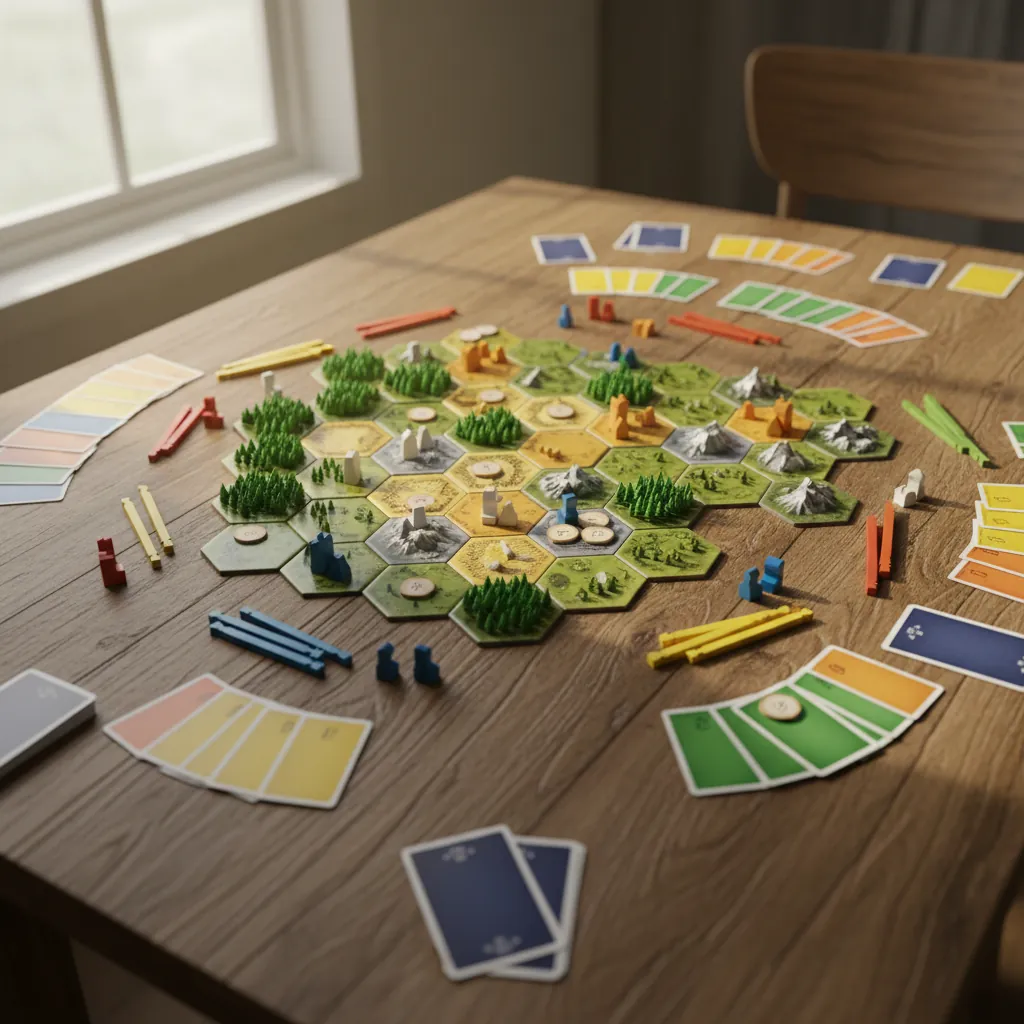
How to Play Catan: Rules, Setup, and Winning Strategies
Contents
Catan is a 3-4 player strategy board game (ages 10+) where players compete to settle an uncharted island by collecting resources, trading, and building roads, settlements, and cities. The first player to reach 10 victory points wins.
What You Need
- Game board components: 19 terrain hexes (3 hills, 4 forests, 4 pastures, 4 fields, 3 mountains, 1 desert), 6 sea frames
- Tokens: 18 numbered discs (2-12), 1 robber pawn
- Cards: 95 resource cards (brick, lumber, wool, grain, ore), 25 development cards
- Player pieces: 4 colors with 15 roads, 5 settlements, and 4 cities each
- Special cards: Longest Road (2 VP) and Largest Army (2 VP) tiles
- Miscellaneous: 2 dice, building cost reference cards
How to Play
-
Setup the board:
- Assemble sea frames and place terrain hexes inside (use beginner layout for first games).
- Place numbered tokens clockwise starting from a corner (6/8 avoid touching). Put robber on desert.
- Each player places 2 settlements and roads on intersections as per beginner setup.
-
Collect starting resources:
Players receive 1 resource card for each hex adjacent to their second settlement (e.g., settlement bordering forest/hills/field gets 1 lumber, 1 brick, 1 grain). -
Take turns clockwise:
Each turn has two phases:- Production phase:
- Roll dice - all hexes with that number produce resources. Cities yield 2 resources, settlements 1.
- If rolling 7: Players with >7 cards discard half, then current player moves robber to block a hex and steals 1 random card from a player there.
- Action phase:
- Trade with players/bank (4:1 default, 3:1 or 2:1 at ports).
- Build roads (1 brick + lumber), settlements (1 of each except ore), cities (3 ore + grain), or buy development cards (wool + ore + grain).
- Production phase:
How to Win
Reach 10 victory points first by:
- Building settlements (1 VP) and upgrading to cities (2 VP)
- Holding Longest Road (5+ connected roads) or Largest Army (3+ knight cards)
- Development cards with VPs (revealed when won)
Strategy Tips
- Initial placement: Prioritize hexes with high-probability numbers (6/8) and diverse resources.
- Ports: Build near 2:1 ports if producing matching resources (e.g., wool port if on pastures).
- Trade smartly: Leverage surplus resources; avoid giving opponents advantages.
- Development cards: Early knights help control robber; VP cards stay hidden until victory.
Resource Production Odds
| Number | Probability (out of 36) |
|---|---|
| 2,12 | 1 |
| 3,11 | 2 |
| 4,10 | 3 |
| 5,9 | 4 |
| 6,8 | 5 |
| 7 | 6 |
FAQ
Can you play Catan with 2 players?
Yes, but requires a variant (e.g., using neutral players’ pieces to block).
Is Catan luck-based?
While dice introduce randomness, strategy in placement/trading outweighs luck.
What’s the best opening move?
Hybrid approach: One settlement on high-probability hexes, another on key ports.
Do cities count for longest road?
No, only roads. Cities break continuous road segments if placed between them.
Related guides
- Azul Max Players: How to Play, Setup, Scoring, and Player Count Guide
- Battleship Best Placement: Where to Hide Your Fleet and How to Play
- Battleship Best Strategy: How to Play, Search, and Win More Often
- Battleship Strategy Placement: How to Play, Set Up, and Hide Your Fleet
- Best Battleship Position: How to Play Battleship and Place Your Fleet to Survive