How to Play Sequence: Setup, Rules, Scoring, and Variations
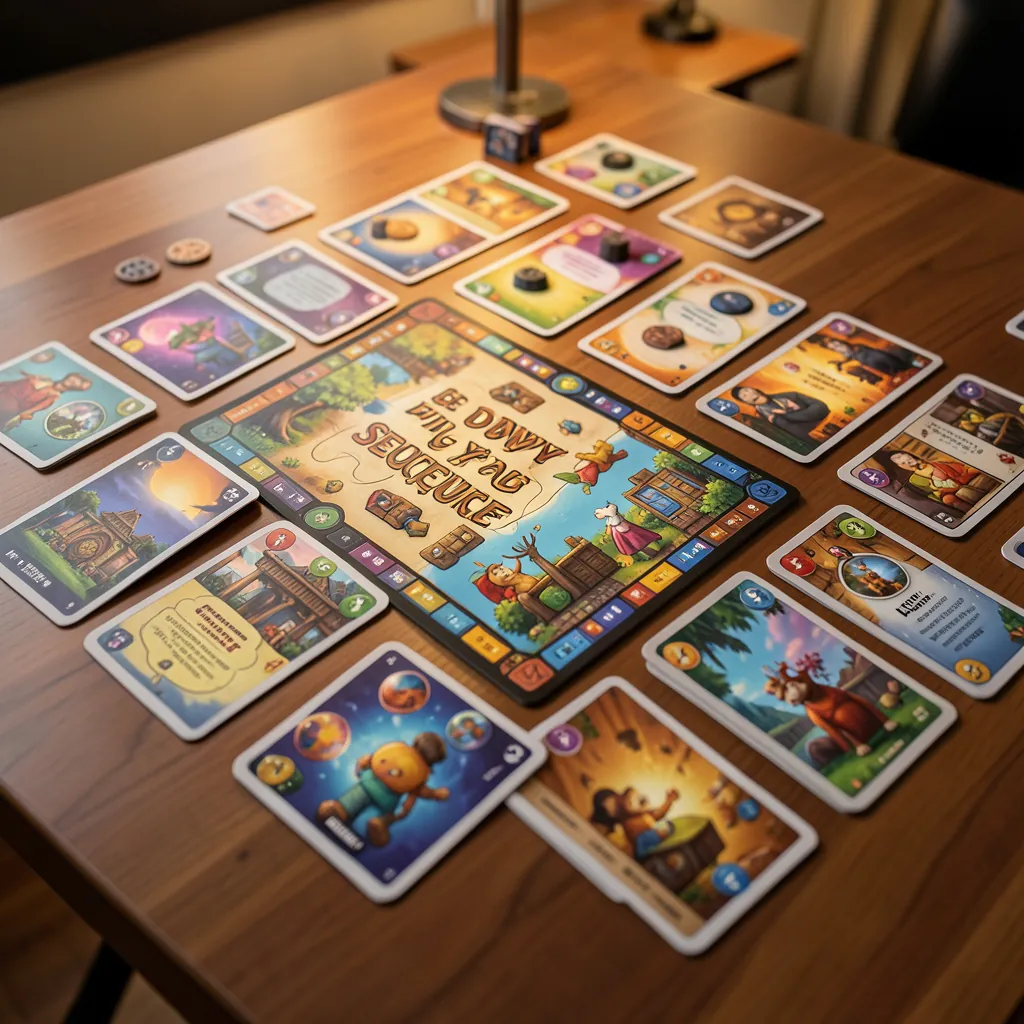
How to Play Sequence: Setup, Rules, Scoring, and Variations
Contents
🎲 Sequence is an abstract strategy board-and-card game invented by Douglas Reuter in the 1970s. Players play cards to place chips on matching board spaces and aim to line up five chips in a row (four chips plus a free corner counts) before opponents do. The standard game is for 2–12 players, takes about 30 minutes, and is recommended for ages 7+.
Players: 2–12
Play Time: About 30 minutes
Age: 7+
Difficulty: Easy
Type: Abstract strategy board-and-card game
Setup
- Place the Sequence board on a flat table or floor with room for the draw deck, discard piles, and chip piles.
- Remove the jokers from two standard 52-card decks (104 cards total) and shuffle them together. Jokers are not used in standard Sequence.
- Decide the dealer. Sources describe drawing for the lowest card or cutting the deck; the player with the lowest card deals, then reshuffle if needed.
- Each player or team chooses a set of poker chips. Standard equipment is 135 chips: 50 blue, 50 green, and 35 red. All teammates use the same color; red is only used if there are three teams.
- Deal cards face down according to the player count in the table below. Players may look at their own cards.
- Put the remaining cards face down as the draw deck. Each player or team needs a visible discard pile. The player to the dealer’s left starts.
- If more than three individuals are playing, divide evenly into two or three teams. With two teams, alternate seats with opponents; with three teams, seat teammates every third player.
How many cards does each player get?
| Players/teams | Cards dealt to each player |
|---|---|
| 2 | 7 |
| 3 | 6 |
| 4 | 6 |
| 6 | 5 |
| 8 | 4 |
| 9 | 4 |
| 10 | 3 |
| 12 | 3 |
Source note: The source lists do not give counts for 5, 7, or 11 players. For team games, use the count for the total number of players.
How to Play
- On your turn, choose one card from your hand and place one of your chips on a matching open space on the board. Example: play Ace of Diamonds and place a chip on an Ace of Diamonds space.
- Each card appears twice on the board. You may use either matching space if it is not already covered by another player’s chip.
- Put the played card face up in your discard pile. Then draw one card from the draw deck. Your turn is over; play passes to the left. You should end your turn with the correct number of cards for your player count.
- If you hold a dead card—a card whose matching spaces are both covered—announce it at the start of your turn, discard it, draw one replacement (one per turn), and then take your normal turn.
- Two-eyed Jacks are wild: play one to place a chip on any open space. A two-eyed Jack can be used to complete a sequence or block an opponent.
- One-eyed Jacks remove one opponent’s chip from the board. Playing a Jack ends your turn.
- Free corners: the standard rules treat each printed corner as a free space that any player may use as though it had a chip of their color. No chip is placed on a corner. A row of four chips plus a free corner counts as a sequence. More than one player may use the same corner.
- A sequence is five chips in a straight line—horizontal, vertical, or diagonal. Sequences of the same color may intersect, but only at a single position. In a two-player or two-team game, two sequences may share one chip, so a straight row of nine chips can count as two sequences.
- Team play has extra discipline: no table talk or coaching, and follow the order card, chip, replacement card. If you forget to draw before the next player completes a turn, some rules say you forfeit that draw and continue with a reduced hand.
- Some rulebooks require a player to announce a completed sequence; if it is not announced, it may not count until it is announced. Check your edition’s rulebook.
- If the draw deck runs out, shuffle the discard piles together to make a new draw deck. Play continues until someone reaches the winning number of sequences.
What rules conflicts should players check?
- Winning sequences: The FreeDictionary encyclopedia says the game ends when a player or team completes 2 sequences. HowStuffWorks and Wikipedia give the more detailed standard: 2 sequences for a two-player or two-team game, but only 1 sequence for a three-player or three-team game. Use your edition’s target or agree before play.
- Free corners: The rulebook-style and encyclopedia sources describe corners as free spaces that count for everyone and do not receive chips. One HowStuffWorks summary describes placing a chip on a corner; that conflicts with the standard no-chip corner rule.
- Sequence for Kids is a different ruleset: It uses 3 cards, a 4-chip sequence, and Dragon/Unicorn cards; do not mix those rules with the standard game.
How does Sequence compare with Sequence for Kids and Sequence Dice?
| Version | Main equipment | Goal | Key special rules |
|---|---|---|---|
| Standard Sequence | Board, two 52-card decks (104 cards, no jokers), 135 chips | Five chips in a row; usually 2 sequences for 2 players/teams, 1 for 3 players/teams | Jacks are wild; free corners; dead cards; no table talk in teams |
| Sequence for Kids | Board, cards, colored chips | First to make a 4-chip sequence | Deal 3 cards; Dragon removes an opponent’s chip; Unicorn places a chip on any open space; free corners need only 3 chips |
| Sequence Dice | Board and dice instead of cards | Usually one 5-chip sequence to win | Special rolls can remove an opponent’s chip, place a chip anywhere, or grant another turn; some sources say a two-player/two-team game needs 6 in a row |
Scoring
Standard Sequence does not use point scoring. You win by completing the required number of sequences:
- Two-player or two-team game: 2 sequences.
- Three-player or three-team game: 1 sequence.
- Conflict note: The FreeDictionary encyclopedia says 2 sequences generally; HowStuffWorks and Wikipedia specify the 2-vs-1 target above. Check your edition.
A sequence is five chips in a straight line horizontally, vertically, or diagonally. A free corner can count as one of the five, so four chips plus a corner counts. In two-player or two-team games, sequences can overlap by one chip; a straight line of nine chips counts as two sequences. If no one reaches the target, Wikipedia says the game ends in a draw. In the unofficial fill-the-board variant, players score 1 point per sequence and the most points wins. Sequence for Kids is won by the first player to make a 4-chip sequence. Sequence Dice usually requires one sequence to win, though one source says a two-player/two-team game needs six in a row.
💡 Strategy Tips
- Build your own sequences early and through the midgame; switch more to blocking opponents late, as inventor Doug Reuter advised.
- Watch diagonals carefully—they are easier to miss than horizontal and vertical lines.
- Use two-eyed Jacks flexibly: complete your own sequence or block an opponent’s key space.
- Save one-eyed Jacks for important opponent chips rather than removing low-value pieces.
- Common beginner mistakes: forgetting to draw, missing an opponent’s diagonal threat, talking or coaching in team play, and not checking both board spaces before calling a card “dead.”
🎲 Variations
- Two players: Deal 7 cards each. You need 2 sequences to win, and the sequences may share one chip; a straight row of 9 chips can count as two sequences.
- Three players/teams: Deal 6 cards each for 3 players and require 1 sequence to win.
- Four to twelve players: Divide evenly into two or three teams; all teammates use the same chip color, and no table talk or coaching is allowed.
- Unofficial fill-the-board variant: Fill the board with sequences, score 1 point per sequence, and allow chips from completed sequences to be removed. Most points wins.
- Other house rules and official versions: Sudden Death Overtime, the “corner rule,” trapped-pair removal, adult drinking-game rules, Sequence Dice, Sequence for Kids, and themed editions such as States and Capitals, Numbers, Jumbo, Travel, and Deluxe.
❓ FAQ
How many players can play Sequence?
Sequence can be played by 2 to 12 players. More than three individual players should divide evenly into two or three teams; more than 12 cannot play.
How do you win Sequence?
Complete the target number of sequences. The detailed standard rules say 2 sequences for two players/teams and 1 sequence for three players/teams. Some sources say 2 sequences generally, so check your edition.
Can you play Sequence with 2 players?
Yes. Deal 7 cards each. You need 2 sequences to win, and the two sequences may share one chip; a straight row of 9 chips can count as two sequences.
Is Sequence hard to learn?
No, it is easy to learn. The rules are simple, but strategy and card luck matter. HowStuffWorks lists ages 7+ and a typical game of about 30 minutes.
How long does a game take?
About 30 minutes for a typical standard game, depending on player count and how quickly sequences are completed.
What do you need to play Sequence?
A Sequence board, two standard 52-card decks with jokers removed (104 cards), and 135 poker chips: 50 blue, 50 green, and 35 red. You also need space for draw and discard piles.
Related guides
- Azul Max Players: How to Play, Setup, Scoring, and Player Count Guide
- Battleship Best Placement: Where to Hide Your Fleet and How to Play
- Battleship Best Strategy: How to Play, Search, and Win More Often
- Battleship Strategy Placement: How to Play, Set Up, and Hide Your Fleet
- Best Battleship Position: How to Play Battleship and Place Your Fleet to Survive