How to Play Chess: Rules, Setup, Scoring, and Strategy
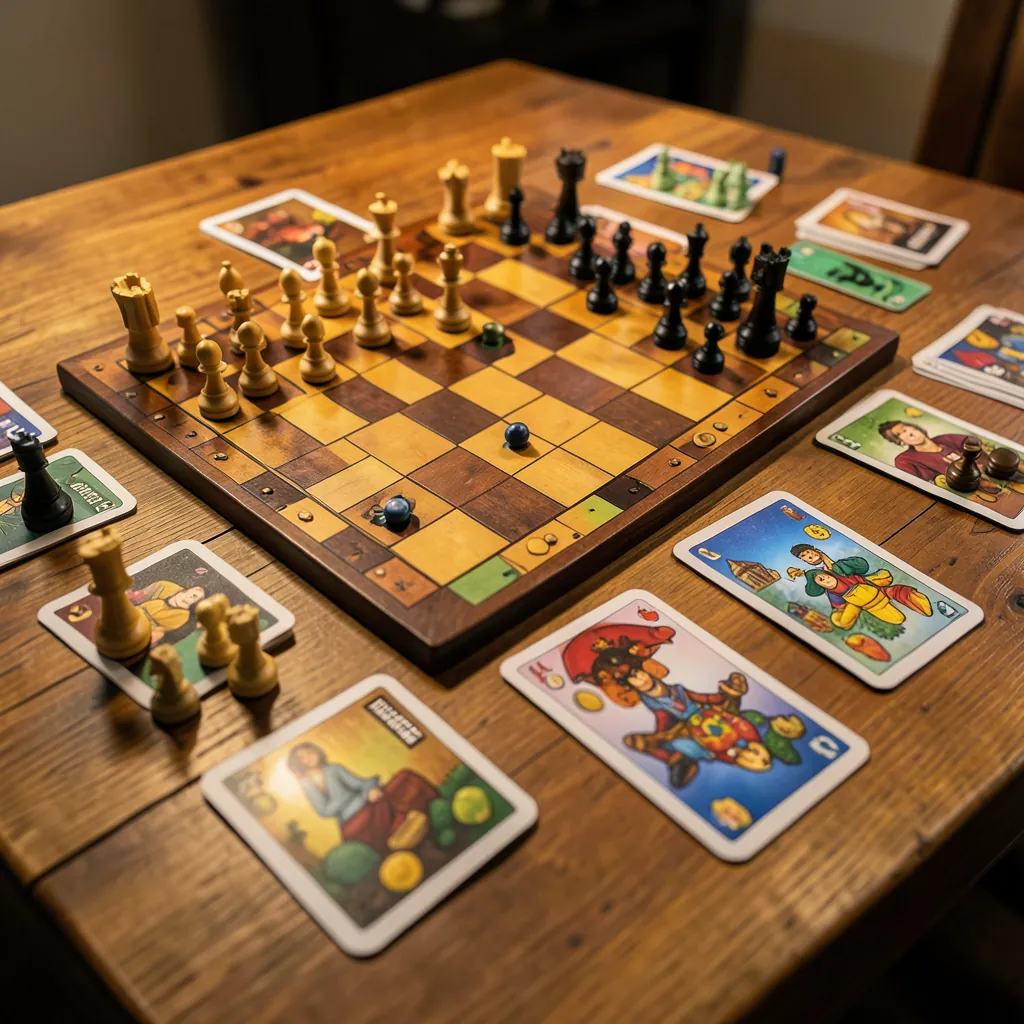
How to Play Chess: Rules, Setup, Scoring, and Strategy
Contents
♟️ Chess is a two-player strategy board game played on an 8×8 board with 16 pieces per side. White moves first, players alternate moves, and the goal is to checkmate the opponent’s king—put it in check with no legal escape. The FIDE Laws of Chess (effective 1 January 2023) are the authoritative rules for over-the-board play.
Players: 2
Play Time: No fixed time; depends on time control
Age: Not specified in the sources
Difficulty: Easy to learn the rules; competitive mastery is harder
Type: Strategy board game
Setup
- Use an 8×8 chessboard with 64 alternating light and dark squares. Place the board so each player has a light square in the near right-hand corner.
- Each player has 16 pieces: White has light-colored pieces, Black has dark-colored pieces.
- Place the pawns on the second rank nearest each player.
- On the back rank, place the rooks in the corners, then knights next to the rooks, then bishops next to the knights.
- Place the queen on her own color—White queen on a light square, Black queen on a dark square—and place the king on the remaining square next to the queen.
- White moves first; then players alternate turns.
The files are labeled a–h and the ranks 1–8. Recording moves with these coordinates is called algebraic chess notation.
How to Play
- White makes the first move. Players then alternate, moving one piece per turn; castling is the exception because it moves both the king and a rook as one move.
- You may not move onto a square occupied by your own piece. If you move onto a square occupied by an opponent’s piece, that piece is captured and removed from the board.
- The objective is checkmate: attack the opponent’s king so that it has no legal escape. You are not allowed to leave your own king in check, expose your own king to check, or capture the opponent’s king.
- Move each piece according to its legal movement. Bishops, rooks, and queens may not move through intervening pieces; knights are the only pieces that can jump over other pieces.
- When your king is in check, you must get out of check by moving the king, blocking the attack, or capturing the attacking piece. The king may never move into check, and the two kings may not stand on adjacent squares.
- Use the special moves—castling, en passant, and pawn promotion—only under their specific conditions.
- The game ends by checkmate, resignation, forfeit on time, or a draw. A checkmated player loses.
- In FIDE competitive over-the-board play, touch-move and one-hand rules apply under Article 4 of the FIDE Laws.
What are the piece movements and values?
| Piece | How it moves | Capture rule | Relative value |
|---|---|---|---|
| King | One square in any direction, but may not move into check | Captures the same way it moves; the king is not captured | Infinite |
| Queen | Any number of squares along a file, rank, or diagonal, without jumping | Captures the same way it moves | 9 |
| Rook | Any number of squares along a file or rank, without jumping | Captures the same way it moves | 5 |
| Bishop | Any number of squares diagonally, without jumping; stays on one color all game | Captures the same way it moves | 3 |
| Knight | In an “L”: two squares in one direction, then one square perpendicular | Captures the same way it moves; only piece that can jump over other pieces | 3 |
| Pawn | Forward one square; optionally two squares on its first move if both squares are empty | Captures diagonally forward one square; never moves or captures backward | 1 |
The piece values above are from Chess.com’s beginner guide and are a decision-making guide for exchanges—not a game score.
What are chess’s special moves?
- Castling: The king moves two squares toward a rook, and that rook moves to the square the king crossed. It is legal only if the king and that rook have not moved, no pieces are between them, the king is not in check, and the king does not pass through or land on an attacked square.
- En passant: If an opponent’s pawn moves two squares from its original square and lands beside your pawn, you may capture it as if it had moved only one square. This capture is legal only on the immediately following move.
- Pawn promotion: When a pawn reaches the farthest rank, it must be exchanged for a queen, rook, bishop, or knight of the same color. The choice is not restricted to previously captured pieces. Players usually choose a queen.
How do check, checkmate, and draws work?
Check means the king is under immediate attack. The checked player must escape by moving the king, blocking the check, or capturing the attacking piece. Checkmate happens when the king is in check and no legal escape exists; the game ends immediately.
A draw can occur by stalemate—when the player to move has no legal move but is not in check—by agreement, by insufficient material to force checkmate, by threefold repetition of the same position, or by the fifty-move rule when fifty consecutive moves occur without a pawn move or capture. The FIDE Laws also recognize a drawn position when neither player can possibly checkmate.
Scoring
Chess is not won by collecting points for captured pieces. The decisive result is checkmate: the player who checkmates the opponent’s king wins, and the opponent loses. Games can also end by resignation or forfeit on time, and many games end in a draw.
The familiar piece values—pawn 1, knight 3, bishop 3, rook 5, queen 9, king infinite—are only a practical guide for deciding whether to capture or exchange. They are not a score at the end of the game. The FIDE Laws include Article 10: Points for competitive scoring, but the supplied excerpt does not reproduce its text, so FIDE-rated events should use the full FIDE Laws and event regulations.
💡 Strategy Tips
- Protect your king early. Castling is usually a good way to move the king toward safety and activate a rook; top players castle in most games.
- Do not give pieces away. Use relative piece values to avoid careless losses: pawn 1, knight/bishop 3, rook 5, queen 9.
- Control the center. Pieces and pawns that control central squares have more room to move and make it harder for the opponent to find good squares.
- Develop all your pieces. Bring rooks, knights, bishops, and the queen into the game rather than leaving pieces stuck on the back rank.
- Practice and check threats. Common beginner mistakes include leaving the king in check, trying to castle through check, moving the king into check, and forgetting that pawns cannot move backward.
🎲 Variations
- Standard chess: The FIDE Laws describe chess as a game between two opponents. The sources do not include an official 3–5 player chess variant; for more players, use multiple boards or a tournament format.
- Chess960: The FIDE Laws include Guidelines II for Chess960, a variant with a randomized starting position. The supplied excerpt lists the Chess960 rules but does not give their full details.
- Rapid and Blitz: FIDE Appendices A and B cover rapid chess and blitz, which are time-control variants of standard chess.
- House rules and time controls: Casual players may agree on time controls or other house rules before play, but FIDE-rated games must be played according to the FIDE Laws.
❓ FAQ
How many players can play chess?
Standard chess is exactly a two-player game. FIDE Laws Article 1.1 states that chess is played between two opponents, White and Black. The supplied sources do not describe an official 3–5 player version.
How do you win a game of chess?
You win by checkmate: placing the opponent’s king in check with no legal way to escape. A player can also win if the opponent resigns or forfeits on time; otherwise, the game may be drawn.
Can you play chess with 2 players?
Yes—standard chess is designed for two players. White moves first, then players alternate moves until checkmate, resignation, time forfeit, or a draw.
Is chess hard to learn?
The basic rules are easy to learn, according to Chess.com’s beginner guide. Competitive mastery takes practice; the sources do not specify an age minimum.
How long does a chess game take?
The sources do not give a fixed game length. Duration depends on the time control: FIDE Laws include chessclock rules, and FIDE has separate Rapid and Blitz appendices. Casual games vary widely.
What do you need to play chess?
You need an 8×8 chessboard, 16 light-colored pieces and 16 dark-colored pieces, and two players. A chess clock is used for timed competitive games but is not required for casual play.
Related guides
- Azul Max Players: How to Play, Setup, Scoring, and Player Count Guide
- Battleship Best Placement: Where to Hide Your Fleet and How to Play
- Battleship Best Strategy: How to Play, Search, and Win More Often
- Battleship Strategy Placement: How to Play, Set Up, and Hide Your Fleet
- Best Battleship Position: How to Play Battleship and Place Your Fleet to Survive