How to Play Sequence: Setup, Rules, Scoring, and Variations
How to Play Sequence: Setup, Rules, Scoring, and Variations
Contents
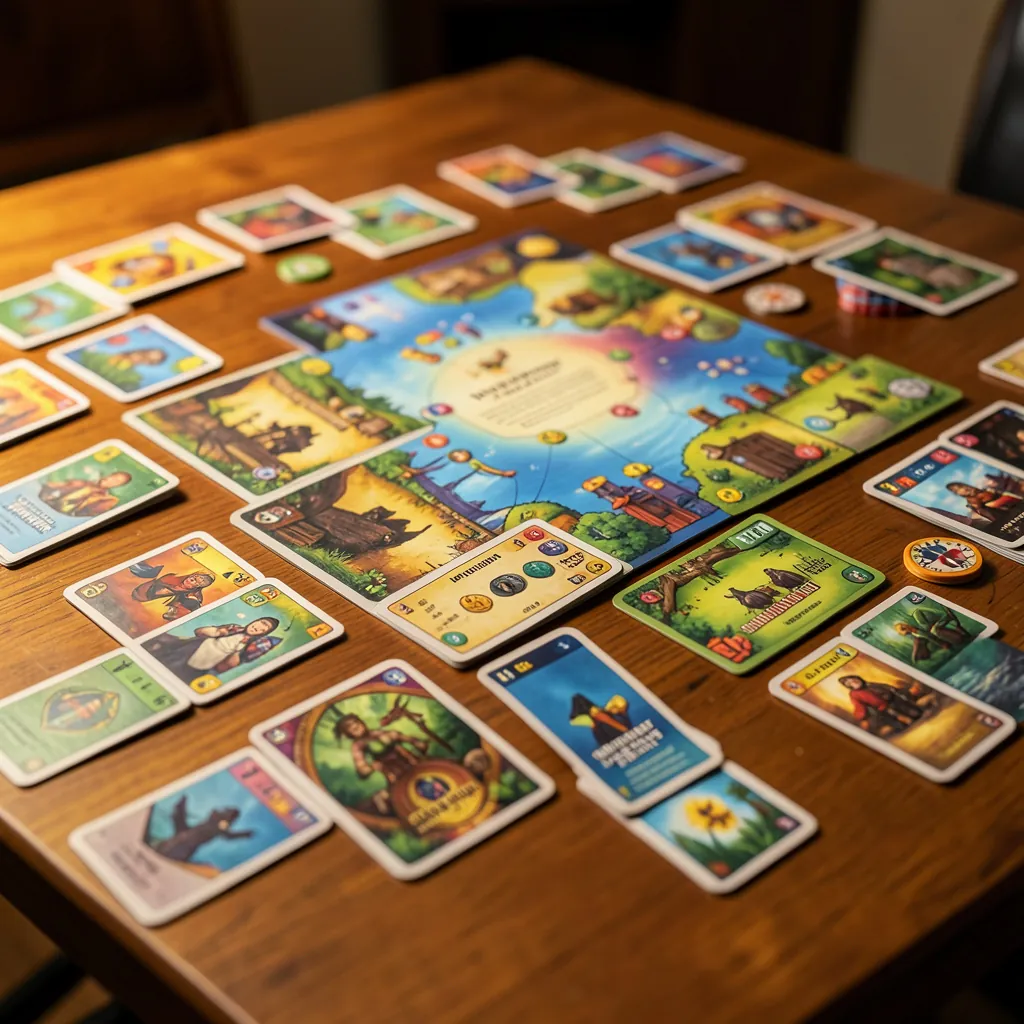
♟️ Sequence is an abstract strategy board-and-card game for 2–12 players in which you play cards to place chips on matching board spaces. The goal is to be the first player or team to complete the required number of sequences—five chips in a straight line. Corners count as free spaces, so a line of four chips plus a corner is a sequence.
Players: 2–12 (official valid counts: 2, 3, 4, 6, 8, 9, 10, or 12; up to 3 can play individually, and more than 3 must play in teams)
Play Time: 30–60 minutes (Source 5; official instructions do not state a time)
Age: 7+ (Source 5; other editions/versions may differ)
Difficulty: Easy
Type: Abstract strategy board-and-card game
Setup
- Place the game board on a flat surface with room around it for the draw deck, chip piles, and each player’s visible discard pile.
- Use the 104 Sequence cards (two 52-card decks). Source 1 says jokers are not used in standard Sequence; Source 5 says you can include jokers, which conflicts—use the official no-joker rule unless your copy says otherwise.
- Choose chips. For 2 players or 2 teams, use blue and green only. Add red only when there is a third player or third team. Team members should all use the same color.
- Decide seating. Up to 3 players may play individually; more than 3 must play in teams, with no more than 3 teams. Team members alternate seats around the board with opponents.
- Cut cards to choose the dealer: lowest card deals, Aces high. The dealer shuffles and deals the number of cards shown in the table below.
- The player to the dealer’s left goes first, and play moves clockwise.
How many cards does each player get?
| Official player count | Cards dealt to each player | Team/individual note |
|---|---|---|
| 2 | 7 | Individual or 2 teams; use blue and green |
| 3 | 6 | Up to 3 may play individually; 3 teams add red |
| 4 | 6 | Must be teams, such as 2 teams of 2; blue and green |
| 6 | 5 | Can be 2 teams or 3 teams; add red for a third team |
| 8 | 4 | 2 teams; blue and green |
| 9 | 4 | 3 teams; blue, green, and red |
| 10 | 3 | 2 teams; blue and green |
| 12 | 3 | 2 teams of 6 or 3 teams of 4; use blue/green or all three colors |
Source 1 lists only these counts; 5, 7, and 11 are not official setup numbers in that ruleset.
How to Play
- Start clockwise from the dealer’s left. The player to the dealer’s left takes the first turn, and play continues clockwise.
- Play one card from your hand. Choose a card and place it face up on your own discard pile, visible to everyone. In standard Sequence, you do not draw first.
- Place a chip on a matching space. Put one of your colored chips on an open board space that matches the card. Each non-Jack card is printed twice, so choose either matching space if both are open.
- Follow the Jack rules. There are 8 Jacks; Jacks have no board spaces. A two-eyed Jack is wild: discard it and place a chip on any open space. A one-eyed Jack is anti-wild: discard it and remove one opponent’s chip that is not part of a completed sequence; you cannot place your own chip on that same space that turn. Completed sequences cannot be broken.
- Draw a replacement card. After you finish your turn’s card action, draw one card from the draw deck. If you forget and the next player moves and draws, Source 1 says you lose the right to that card and must finish with fewer cards.
- Handle dead cards. If both board spaces for a card in your hand are covered, on your turn put that card on your discard pile, announce it is a dead card, and take one replacement card. Then continue with your normal turn. You may do this only once per turn (Source 1).
- Reform the draw deck when needed. If the draw deck runs out, shuffle all discard piles together to make a new draw deck.
- Win by completing the required sequences. A sequence is five chips of your color in a straight line vertically, horizontally, or diagonally. A corner is a free space: it counts as your color, so four chips plus a corner complete a sequence, and more than one player may use the same corner. In a 2-player or 2-team game, complete two sequences; in a 3-player or 3-team game, complete one. In the two-sequence game, you may use one space from your first sequence as part of your second (Source 1); Wikipedia also notes a straight row of nine chips can count as two sequences (Source 2).
- Respect table-talk rules. No table talk or coaching in team play. If a teammate says something that alerts a teammate to a mistake or plan, every member of that team forfeits one card of their choice to the discard pile (Source 1).
- Continue until someone wins. Play continues clockwise until a player/team reaches the required number of sequences. Wikipedia notes that if no one reaches the target, the game can end in a draw; the JAX instructions describe play continuing until a winner is determined.
Rule conflicts to know: Source 5 says to draw/flip a card at the start of a turn and also draw at the end; this conflicts with the JAX instructions (Source 1), Wikipedia (Source 2), and the app guide (Source 3), which use the standard order: play a card from your hand, place/remove a chip, then draw a replacement. Follow your official rules copy, but for standard Sequence use card → chip → draw. Source 5 also says jokers may be included; Source 1 says jokers are not used in standard Sequence, so do not use them unless your copy says otherwise.
Scoring
Standard Sequence does not use a point score in the basic rules. The winner is the first player/team to complete the required sequences: two sequences in a 2-player or 2-team game, or one sequence in a 3-player or 3-team game. A sequence is five same-color chips in a straight line, or four chips plus a free corner. Completed sequences cannot be broken, and a one-eyed Jack cannot remove a chip that is part of a completed sequence. Source 2 notes a draw is possible if no one reaches the target; Source 1 does not describe a draw and says play continues until someone wins. If you use the unofficial full-board scoring variant, score one point per sequence and highest total wins (Source 2).
💡 Strategy Tips
- Survey the whole board, not just your next move. Look for placements that build your lines and block opponents’ four-in-a-row threats (Source 5).
- Use free corners early and often. A corner counts as your chip, so you need only four actual chips for that sequence; because multiple players can use the same corner, do not assume a corner is “blocked” by an opponent (Source 1; Source 2).
- Save Jacks for high-value moments. Two-eyed Jacks are flexible open-space placements; one-eyed Jacks should remove a key opponent chip from an uncompleted line, never one already in a completed sequence (Source 1; Source 3).
- Avoid the draw-order mistake. In standard play, play your card, place/remove the chip, then draw a replacement; forgetting the draw reduces your hand (Source 1; Source 2). Source 5’s start-of-turn draw description conflicts with this.
- In team games, do not coach or table-talk. The penalty is every team member discarding one card of choice, which can hurt your hand badly (Source 1).
🎲 Variations
What are the player-count variations?
- 2 players or 2 teams: use blue and green; need two sequences; the two sequences may share one chip from the first, and a straight row of nine chips can count as two sequences (Source 1; Source 2).
- 3 players or 3 teams: need one sequence; if there is a third player/team, add red chips (Source 1).
- More than 3 players must be in teams, with no more than 3 teams. Team members alternate seats around the board (Source 1).
- Source 1 lists official counts as 2, 3, 4, 6, 8, 9, 10, or 12; 5, 7, and 11 are not in that list because the number must be divisible by 2 or 3. Source 5 broadly says “2–12 players,” but the JAX setup table is more specific.
What house rules and editions exist?
- Full-board scoring variant: Fill the board with sequences; score one point per sequence; chips from completed sequences may be removed to block opponents; no reshuffle option; highest points wins (Source 2).
- Sudden Death Overtime: If the next player/team can complete its final needed sequence on the next turn, force overtime; all chips remain; first to complete another sequence wins (Source 2).
- Announcement/corner house rules: Some groups require players to announce a sequence immediately; the “corner rule” lets a team place in a corner by skipping a turn when four chips line up against it, and another team may block with a two-eyed Jack (Source 2). These are variations—confirm before play.
- Sequence for Kids: A separate edition uses 4-chip sequences, 3 cards in hand, Dragon cards (remove opponent chip), Unicorn cards (wild any open space), and corners that complete a sequence with only 3 chips (Source 4).
- Sequence Dice: A spin-off uses dice instead of cards; in a two-player/two-team game it requires six chips in a row and only one sequence to win, with special rolls such as 10 removing an opponent’s chip and 11 adding a chip to any open space (Source 2).
❓ FAQ
How many players can play Sequence?
Standard Sequence officially supports 2, 3, 4, 6, 8, 9, 10, or 12 players in Source 1. Up to 3 may play individually; more than 3 must play in teams, with no more than 3 teams. Source 5 gives a broader “2–12 players” description, but the official setup table excludes 5, 7, and 11.
How do you win at Sequence?
The first player or team to complete the required number of sequences wins. In a 2-player or 2-team game, you need two sequences; in a 3-player or 3-team game, you need one. A sequence is five chips in a straight line, or four chips plus a free corner.
Can you play Sequence with 2 players?
Yes. In a 2-player game, each player gets 7 cards, uses blue and green chips, and must complete two sequences. The sequences may share one chip from the first sequence, so a straight row of nine chips can count as two sequences (Source 1; Source 2).
Is Sequence hard to learn?
No—it is an easy-to-learn abstract strategy game. The main rules to master are the Jack powers, dead cards, and the standard turn order: play a card from your hand, place/remove a chip, then draw a replacement (Source 1; Source 2; Source 3).
What do you need to play Sequence?
You need a Sequence board, 104 Sequence cards (two 52-card decks), and 135 marker chips: 50 green, 50 blue, and 35 red (Source 1; Source 5). Official JAX instructions say jokers are not used; Source 5 says players may include jokers, which is a conflict—use the official no-joker rule for standard play.
Do you draw at the beginning or end of your turn?
Draw at the end, after you play a card and place or remove a chip. Source 5 describes drawing/flipping at the start of a turn, but that conflicts with the JAX instructions, Wikipedia, and the app guide, which use the play-card, place-chip, draw-replacement order (Source 1; Source 2; Source 3).
Related guides
- Azul Max Players: How to Play, Setup, Scoring, and Player Count Guide
- Battleship Best Placement: Where to Hide Your Fleet and How to Play
- Battleship Best Strategy: How to Play, Search, and Win More Often
- Battleship Strategy Placement: How to Play, Set Up, and Hide Your Fleet
- Best Battleship Position: How to Play Battleship and Place Your Fleet to Survive