How to Play Chess: Rules, Scoring, and How to Win Your First Game
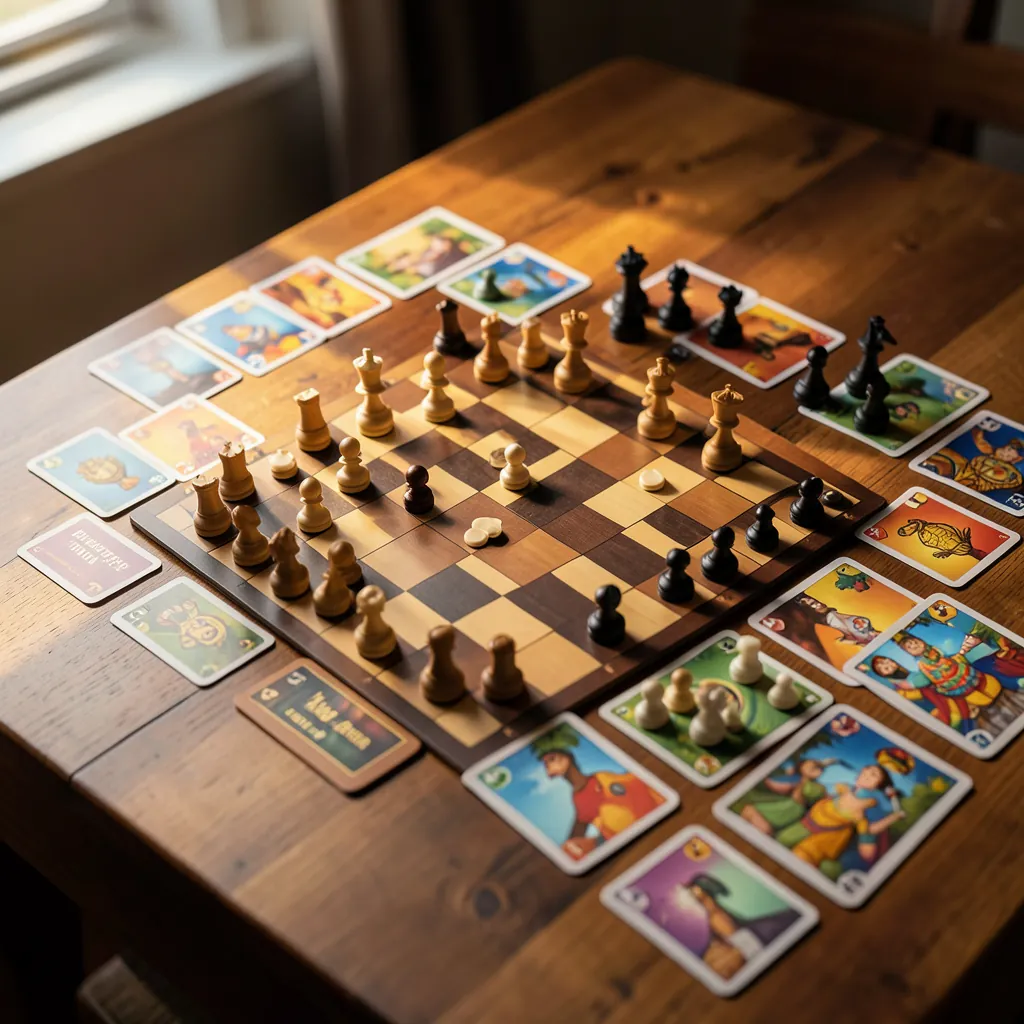
How to Play Chess: Rules, Scoring, and How to Win Your First Game
Contents
♟️ Chess is a two-player strategy game on an 8×8 board where each side commands an army of pieces and tries to trap the opponent’s king. You win by checkmate, and you can also draw by stalemate, agreement, threefold repetition, or 50 moves without a pawn move or a capture. This guide takes you from setup to a complete game.
Players: 2 Play Time: Varies by format — a casual game often runs 20–60 minutes; rapid and blitz use timed finishes, while correspondence chess is played long-distance over days (Source 4) Age: 10+ suggested; the sources present the rules as beginner-level and state no official age limit Difficulty: Easy to learn the rules, hard to master Type: Abstract strategy board game
Setup
- Use the right board. Chess is played on an 8×8 board of 64 squares. Vertical columns are called files and are lettered a–h; horizontal rows are called ranks and are numbered 1–8 (Source 1, “The Language of Chess”). Source 5 devotes a dedicated chapter to the board (p. 6).
- Seat the two players opposite each other, each with a full army of the six piece types: king, queen, rooks, bishops, knights and pawns (Sources 1 and 5).
- Set up the starting position. Source 5 covers this in its “Starting Setup” chapter (p. 10): the major pieces sit on the back rank with the pawns on the rank in front of them. If you are unsure of the exact arrangement, follow that chapter’s diagram before your first game.
- Agree who plays White. White moves first and players then alternate turns.
- Agree a time control if you want one. Untimed games are fine; Source 4 notes that timed finishes (rapid play and blitz) and slow correspondence play are also standard options.
Source note: Sources 1, 2 and 3 are the same chess.com course published in Estonian, Romanian and Turkish — the content is identical, so they do not conflict. Sources 4 and 5 add book-level depth. A gap, not a conflict: Sources 1–3 assume you already know how the pieces move and only cover the rules of a full game, while Source 5 teaches movement piece by piece (pawn p. 13, knight p. 16, bishop p. 18, rook p. 20, queen p. 22, king p. 24).
How to Play
- Learn what each piece is worth first. Every piece has a value used to judge whether a capture is worth making: pawn 1, knight 3, bishop 3, rook 5, queen 9 — and the king is “worth the whole game” (Source 1, “The Value Of The Pieces”). See the table in the Scoring section.
- Move one piece per turn, alternating with your opponent. Source 5 covers the special moves, such as castling and en passant-type exceptions, in a separate “Special Moves” chapter (p. 32) — learn them before your first serious game.
- Capture by moving onto an occupied square. Captures are one of the three key moves in chess, alongside check and checkmate (Source 1, “The Goals Of Chess”). Capturing removes the opponent’s piece from the board and is how you “build a lead.”
- Before every move, scan checks, captures and threats. Source 1’s lesson “Finding the Right Move” is explicit: “Each turn you will want to consider your option and your opponent’s options. You’ll want to pay particular attention to checks, captures and threats.”
- Understand check. Check is when a king is attacked. It is different from checkmate, and telling the two apart is the first thing the course teaches (Source 1).
- Deliver checkmate to win. Checkmate ends the game immediately: the king is attacked and cannot escape.
- Know when the game is a draw. A game can end level through stalemate, agreement between the players, three repetitions of the same position, or 50 moves without a pawn move or a capture (Source 1, “Other Draws”).
- Watch for stalemate specifically. Stalemate occurs when there are no possible moves but neither king is in check. It is a draw “even if one of the players has many more pieces on the board” (Source 1, “Stalemate”).
- Write your moves down if you want to review the game. Every square has a name from the a–h files and 1–8 ranks, and each move is written with a letter for the piece plus the square it moves to (Source 1, “The Language of Chess”). Source 5 covers notation on p. 63.
- Play a full game start to finish. Source 1’s “Playing a Game” lesson walks through a complete game with every move explained — the fastest way to see how steps 1–9 fit together.
How a game ends
| Result | Situation | Source |
|---|---|---|
| Win | Checkmate — the king is attacked and cannot escape | Source 1 |
| Draw | Stalemate — no legal moves, but neither king is in check | Source 1 |
| Draw | Both players agree to a draw | Source 1 |
| Draw | The same position occurs three times (threefold repetition) | Source 1 |
| Draw | 50 moves pass without a pawn move or a capture | Source 1 |
Scoring
Chess does not use a running point score the way card games do: you win by checkmate, and none of the five sources describes a points-per-game scoring system. What chess does use is piece values, which are evaluation tools for deciding which captures are best — not points you tally at the end.
| Piece | Value | What the sources say |
|---|---|---|
| Pawn | 1 | The unit of the 50-move draw rule (no pawn move = progress stalls) |
| Knight | 3 | Equal in value to a bishop |
| Bishop | 3 | Equal in value to a knight |
| Rook | 5 | Worth more than a bishop or knight |
| Queen | 9 | The most valuable piece after the king |
| King | “The whole game” | Checkmate ends the game, so the king’s value cannot be measured in points |
Values from Source 1, “The Value Of The Pieces.” Winning = checkmate. Drawing = the four conditions in the table above. Source 4 notes that games can also be played under timed finishes (rapid play, blitz) or long-distance (correspondence), which changes how games are scheduled but not how they are won.
💡 Strategy Tips
- Evaluate both sides every turn. Source 1’s core habit: “consider your option and your opponent’s options.” Beginners usually plan their own move and forget the reply.
- Run a checks-captures-threats scan before you commit. This is the exact checklist Source 1 recommends and the single highest-value habit for new players.
- Use piece values to judge trades. Giving up a rook (5) for a bishop (3) is a losing exchange; a knight (3) for a bishop (3) is even. Do not trade the queen (9) cheaply.
- Protect the king above all. The king is “worth the whole game” — material advantage means nothing if you get checkmated.
- Common beginner mistake: forgetting that stalemate is a draw. If you are far ahead and leave the opponent with no legal moves (and no check), the game is drawn anyway (Source 1).
- Study the game in three phases. Source 4 structures improvement around the opening, the middlegame and the endgame — Source 5 does the same (opening p. 67, middlegame p. 98, endgame p. 70).
🎲 Variations
| Variation | How it differs | Source |
|---|---|---|
| Rapid play | A timed finish, faster than a classical game | Source 4 |
| Blitz | Very fast timed games | Source 4 |
| Correspondence chess | Slow, long-distance play over an extended period | Source 4 |
| Online chess | Played on a computer against remote opponents; Source 5 includes a tutorial on playing online and matching with other players | Sources 4, 5 |
| Tournament / Chess Congress play | Competitive, organized events | Source 4 |
Player-count note: chess is a two-player game in every source — turns are taken against “your opponent,” and draws are described as “an agreement between the players.” None of the sources describes a 3–5 player or team variant, so treat multi-player chess as unverified house territory rather than a standard rule set. The sources likewise list no house rules, so any local variation is a genuine house rule, not part of the official game.
❓ FAQ
How many players can play chess?
Two. Chess is a two-player game: players alternate turns, and the rules in Sources 1–3 are written entirely around you and one opponent. No 3–5 player version appears in any of the sources.
How do you win at chess?
By checkmate — attacking the opponent’s king so it cannot escape. If neither side can force checkmate, the game can be drawn by stalemate, agreement, threefold repetition, or 50 moves without a pawn move or a capture (Source 1).
Can you play chess with only two people?
Yes — two is the standard and only player count described in the sources. You need one board and two sets of pieces, or an online account to play remotely (Source 5’s online-play tutorial).
How long does a chess game take?
It depends on the format. Untimed casual games run as long as both players need; rapid play and blitz have timed finishes, and correspondence chess is played long-distance over an extended period (Source 4). Sources 1–3 set no time limit.
Is chess hard to learn?
No — the rules of a full game are learnable in a few short lessons. Source 1 is built for players who already know how the pieces move and can set up a board, and Source 4 states that its analysis “commences at the most basic level” before advancing. Mastery is the hard part.
What do you need to play chess?
A chessboard with its a–h files and 1–8 ranks, two armies of pieces, and an opponent. Source 5 also covers playing online, which needs only a device and an account.
Related guides
- Azul Max Players: How to Play, Setup, Scoring, and Player Count Guide
- Battleship Best Placement: Where to Hide Your Fleet and How to Play
- Battleship Best Strategy: How to Play, Search, and Win More Often
- Battleship Strategy Placement: How to Play, Set Up, and Hide Your Fleet
- Best Battleship Position: How to Play Battleship and Place Your Fleet to Survive