Chess Explained: How to Set Up, Move, and Win at Chess
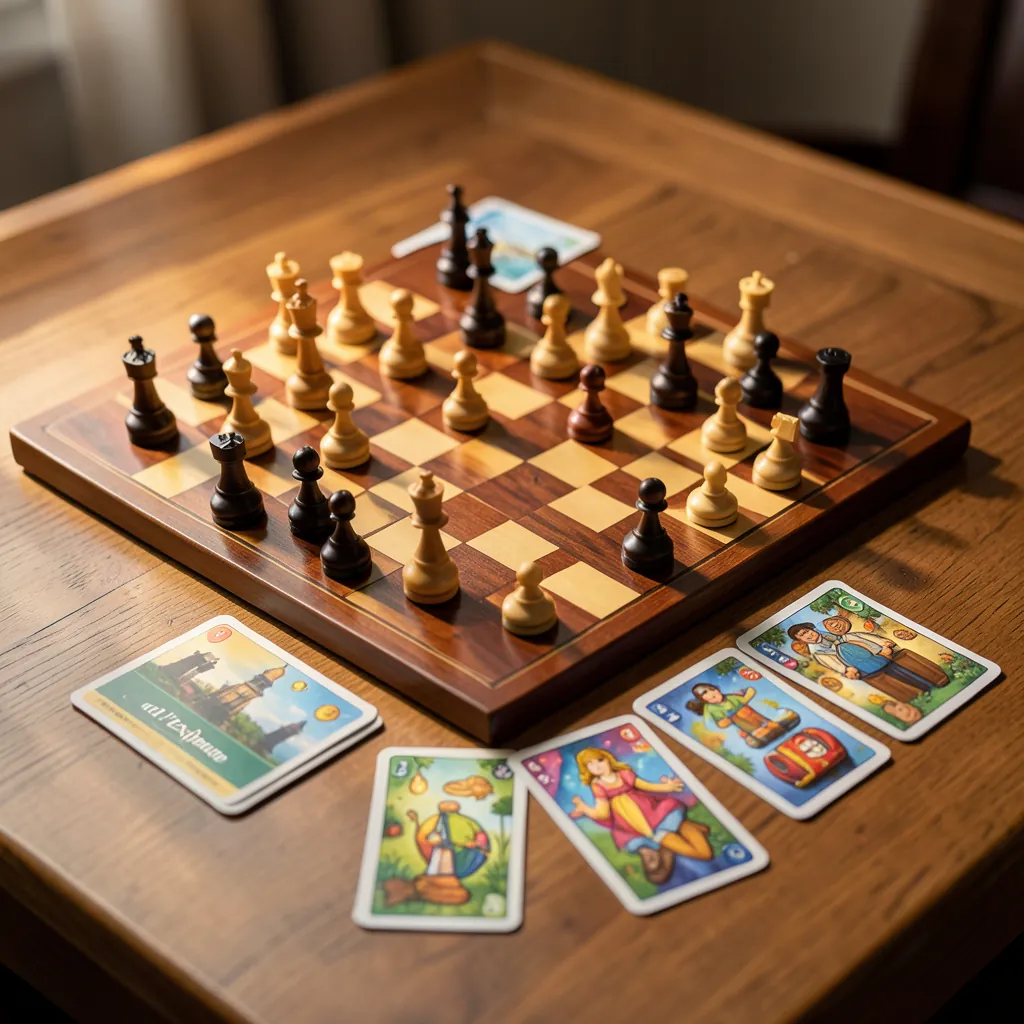
Chess Explained: How to Set Up, Move, and Win at Chess
Contents
♟️ Chess is a two-player strategy board game played on a 64-square checkered board with 16 pieces per side. The goal is to checkmate the opponent’s king—attack it so it cannot escape capture. The sources describe chess—derived from 6th-century Indian chaturanga, with modern rules emerging in Europe around 1500—as easy to learn with instruction but complex to master, and note that white always moves first.
Players: 2
Play Time: Varies; the sources do not give a fixed time
Age: All ages (CBC Life calls it a game for all ages)
Difficulty: Easy to learn; complex to master
Type: Strategy board game
Setup
- Use a checkered board of 64 squares, colored alternately white and black or red.
- Place the board so each player has a white square in the right-hand corner nearest them.
- Each player takes 16 men: 8 pieces—king, queen, two bishops, two knights, two rooks/castles—and 8 pawns. One set is white; the other is black or red.
- Put the pawns on each player’s second row. On the back rank, place rooks in the corners, knights next to rooks, bishops next to knights, and the king and queen on the two center squares. The queen goes on her own color; the king goes on the opposite color.
- Draw lots or use closed hands to decide who plays white. White always moves first; CBC Life notes that playing white is a small advantage. If a series of games is played, players exchange pieces and colors at the start of each game.
How to Play
- Decide colors, then begin with white moving first. Players alternate turns.
- On a turn, move one of your men according to its legal movement. Pieces may move backward or forward, left or right as their rules allow; pawns may only move forward.
- Capture by moving onto the square occupied by an opponent’s piece. Remove the captured piece and place your capturing piece on that square. Pawns capture only diagonally forward.
- Pawns normally move one square forward. On their first move they may move one or two squares; after that, only one. Pawns never move backward. If a pawn reaches the opponent’s royal line/eighth square, it may be promoted to any piece except the king.
- Check and checkmate: if the king is directly attacked, it is in check. An older source says the attacker must warn by calling “check.” The attacked king must move out of check, capture the checking piece, or interpose a man. The king cannot move into check. If none of these responses is possible, the king is checkmated and the game is lost.
- Special moves: promotion is described above. Source 1 says castling lets the king move two squares under certain conditions, and Source 5 names en passant, promotion, and castling as special moves. However, the included excerpts do not give full mechanics for castling or en passant, so this guide does not invent those details.
- Continue until checkmate, resignation, time forfeit, or a draw. Draw conditions are listed under Scoring.
Which piece moves how?
| Piece | Number per player | Legal move | Capture/notes |
|---|---|---|---|
| King | 1 | One square in any direction; may castle two squares under certain conditions | Cannot move into check; checkmate target |
| Queen | 1 | Any number of squares straight or diagonally | Cannot jump over pieces; most powerful piece |
| Rook / Castle | 2 | Any number of squares along a file or rank, backward, forward, or sideways | Cannot jump over pieces |
| Bishop | 2 | Any number of squares diagonally | Cannot jump over pieces |
| Knight | 2 | L-shaped move: two squares one way and one square at a right angle; Source 1 describes it as two steps, one straight and one diagonal | Only piece that can jump over other pieces; changes square color |
| Pawn | 8 | One square forward; first move may be one or two; captures one square diagonally forward | Cannot move backward; promotion at far end |
Source 1 also notes that two knights alone cannot force checkmate, whereas two bishops can.
What do the sources disagree on or leave out?
The older sources and the modern CBC Life guide agree on basic setup, piece movement, check, and checkmate. The main differences are completeness and era:
- Source 5 (CBC Life, 2019) includes modern draw rules: threefold repetition, the 50-move rule, and agreement to draw.
- Source 1, from the Success Library (1901–1902), includes a perpetual-check provision: a player whose king is in perpetual check may demand checkmate within a certain number of moves or claim a draw.
- Source 5 names en passant, promotion, and castling as special moves; Source 1 explains promotion and refers to castling but does not give full castling mechanics in the excerpt. The sources do not fully define en passant or castling here.
Scoring
Chess in these sources is not scored by cumulative points; the result is a win, loss, or draw. A player wins by checkmate. Source 5 also says a player can win if the opponent resigns or runs out of time. Draws include stalemate—when a king is not in check but cannot move without going into check, and no other piece or pawn can move—threefold repetition, 50 consecutive moves with no capture and no pawn move, or agreement by both players. In a series, players exchange colors at the start of each game; the sources do not describe a point-scoring league system.
💡 Strategy Tips
- Develop your pieces before attacking: push center pawns, bring knights out, castle, place bishops on long diagonals, and move the queen only when supported.
- Do not move your queen out too early; she is valuable and can be attacked before lesser pieces are ready to support her.
- Stay alert for one-move blunders: CBC Life’s coach notes that 49 good moves can be undone by one bad move.
- Look at the piece behind the piece that moved; moving one piece can uncover a discovered attack from behind it.
- Learn and practice one piece at a time, and keep a cheat sheet of moves. A common beginner mistake is focusing only on the piece being moved and neglecting overall development and king safety.
🎲 Variations
- Standard chess is a two-player game; the sources do not describe a 3–5 player standard version. For two players, use the standard rules above.
- In series play, exchange colors and pieces at the beginning of each game, as Source 1 describes.
- Beginners can play online or in person. Source 5 notes that sites such as chess.com offer free lessons and automated or live opponents, and that some players start online before buying a physical set.
- Source 5 notes historical and regional relatives of chess, including 6th-century Indian chaturanga and later local variations such as xianqi in China and shogi in Japan; these are related games, not standard chess house rules.
- Rule-era variation: older Source 1 includes a perpetual-check draw provision, while modern Source 5 lists threefold repetition and the 50-move rule. These are era differences and are flagged rather than silently merged.
❓ FAQ
How many players can play chess?
Two. Source 1 says chess is played by two persons, and the sources do not give a standard 3–5 player version.
How do you win at chess?
Checkmate the opponent’s king. Source 5 also says you can win if the opponent resigns or runs out of time; otherwise the game may be drawn.
Can you play chess with 2 players?
Yes—standard chess is already a two-player game. No special two-player variant is needed in the sources.
Is chess hard to learn?
It is easy to learn with instruction but complex to master. Source 5 calls it very doable and easy to learn how to improve; Source 1 says any person of ordinary intelligence can learn after reasonable instruction.
How long does a game take?
The included sources do not give a fixed duration. A game ends by checkmate, resignation, time forfeit, or draw, so length varies; using a clock can produce a time-based result.
What do you need to play chess?
A chessboard, pieces, and an opponent. Source 5 recommends a traditional set for beginners so pieces are easy to recognize, and notes that you can also start online without a physical set.
Related guides
- Azul Max Players: How to Play, Setup, Scoring, and Player Count Guide
- Battleship Best Placement: Where to Hide Your Fleet and How to Play
- Battleship Best Strategy: How to Play, Search, and Win More Often
- Battleship Strategy Placement: How to Play, Set Up, and Hide Your Fleet
- Best Battleship Position: How to Play Battleship and Place Your Fleet to Survive