Can You Play Sequence With 5 Players? Rules, Setup, and Scoring Guide
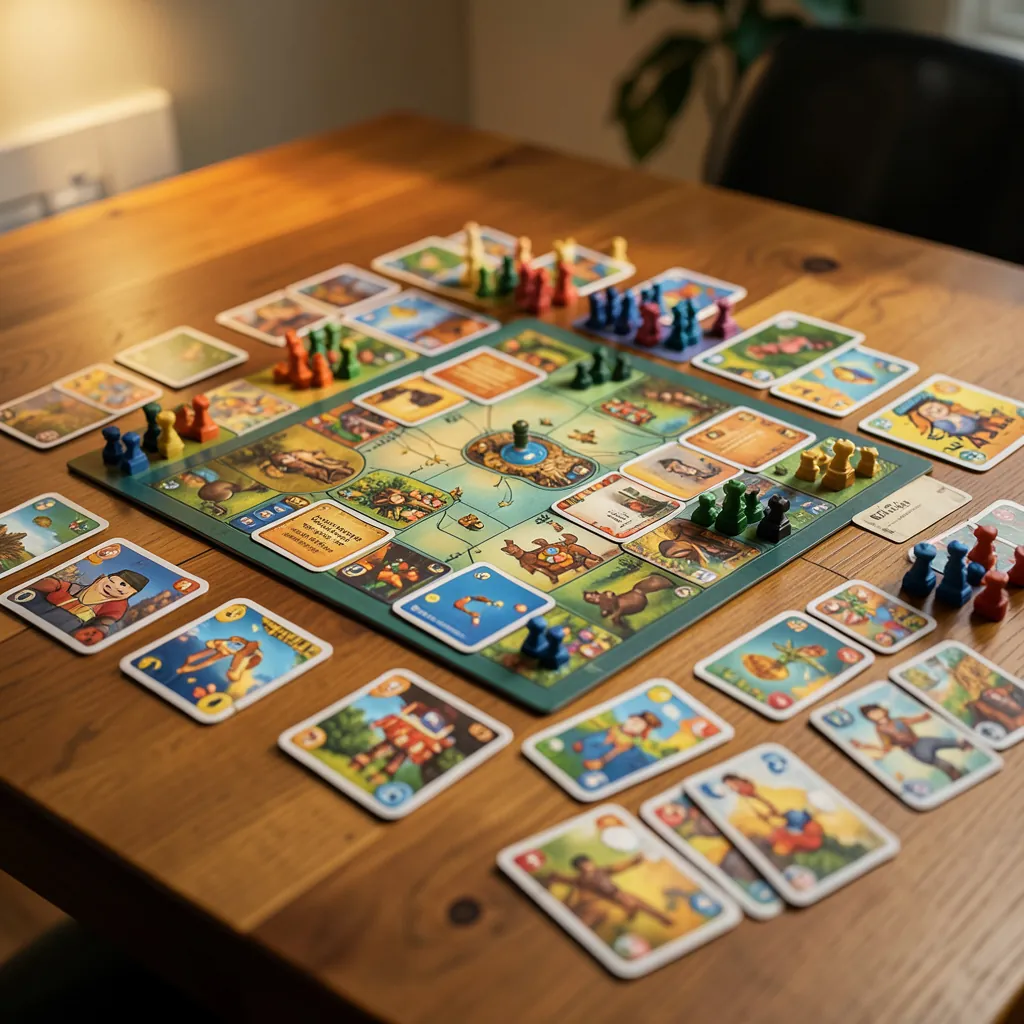
Can You Play Sequence With 5 Players? Rules, Setup, and Scoring Guide
Contents
🎲 Sequence is a board-and-card strategy game where players place chips on card-matching spaces to complete rows of five; the goal is to make the required sequences before opponents. Under standard rules, you cannot play Sequence with 5 players: the supported detailed counts are 2, 3, 4, 6, 8, 9, 10, and 12, and 5 cannot be divided evenly into two or three teams.
Players: 2–12 listed; standard detailed counts are 2, 3, 4, 6, 8, 9, 10, and 12 (5, 7, and 11 are not standard)
Play Time: Not stated in the provided sources
Age: 7+
Difficulty: Easy to learn
Type: Abstract strategy board-and-card game
Can you play Sequence with 5 players?
No — under the standard rules summarized in the sources, 5 players is not a supported count. If more than three people are playing, players must divide evenly into two or three teams; 5 does not divide evenly into either. The detailed sources list 2, 3, 4, 6, 8, 9, 10, and 12 players, and the product listings explicitly exclude 5, 7, and 11.
| Players | Standard allowed? | Team split / notes | Cards each |
|---|---|---|---|
| 2 | Yes | Individual play | 7 |
| 3 | Yes | Individual play | 6 |
| 4 | Yes | Two teams of 2 | 6 |
| 5 | No | Cannot split evenly into two or three teams | — |
| 6 | Yes | Two teams of 3 or three teams of 2 | 5 |
| 7 | No | Cannot split evenly into two or three teams | — |
| 8 | Yes | Two teams of 4 | 4 |
| 9 | Yes | Three teams of 3 | 4 |
| 10 | Yes | Two teams of 5 | 3 |
| 11 | No | Cannot split evenly into two or three teams | — |
| 12 | Yes | Two teams of 6 or three teams of 4 | 3 |
Conflict note: One source says “2 to 12 players” in a single line, but its detailed deal counts and team-division rule — plus the product listings — support only 2, 3, 4, 6, 8, 9, 10, and 12. For 5 players, the standard answer is no.
Setup
- Place the Sequence board on a flat surface with room for the draw deck, discard pile, and chip piles.
- Remove any jokers from two standard 52-card decks; Sequence uses 104 cards total.
- Set out the 135 poker chips: 50 blue, 50 green, and 35 red.
- Decide who deals: shuffle the decks into two stacks, have each player draw a card, and let the lowest card deal; then reshuffle.
- Each player or team chooses a chip color. All members of the same team must use the same color. Red is only used when there are three teams — it is not required for every team.
- Deal cards according to the player-count table above: 2 players = 7 cards each; 3 or 4 players = 6 each; 6 players = 5 each; 8 or 9 players = 4 each; 10 or 12 players = 3 each.
- Arrange team positions correctly: with two teams, players alternate with opponents around the board; with three teams, teammates sit at every third position.
- The player to the left of the dealer goes first.
How to Play
- The player to the left of the dealer starts, and play proceeds to the left.
- On your turn, play one card from your hand. If it is a normal card, place a chip on one of the two matching spaces on the board. If it is a Two-Eyed Jack, use it as a wild card and place a chip on any open space. If it is a One-Eyed Jack, remove one opponent’s chip from a space — but it cannot remove a chip that is part of a completed sequence. Playing a Jack ends the turn.
- Put the played card face-up on the discard pile.
- Draw a replacement card from the draw deck. If the draw deck is empty, shuffle the discard pile and continue drawing.
- Pass the turn to the left.
- If a card has no open matching space, it is a “dead” card. On your turn, you may discard it, announce it, and draw a replacement before taking your normal turn; only one dead-card exchange per turn.
- Each corner of the board is a “Free” space. It acts as if it has a chip of every color, so any player can use it.
- Form sequences by placing five chips in a straight line vertically, horizontally, or diagonally. A row of four chips plus a Free corner also counts. Sequences of the same color may intersect, but only at one position.
- Announce a sequence when you create it. An unannounced sequence is not counted until the player wishes it to count.
- Follow the precise order: play card, place/remove chip, then draw a replacement. If you forget to draw and another player catches it, you cannot make it up later; continue with fewer cards. No table talk or coaching between teammates is allowed.
Conflict note: The source text contains a contradictory sentence about One-Eyed Jacks. The corrected rule used here is that completed sequences stand and cannot be broken by a One-Eyed Jack.
Scoring
Standard Sequence does not use point scoring. The winner is the first player or team to complete 2 sequences.
A sequence is five chips in a row — vertically, horizontally, or diagonally — or four chips plus a Free corner. If two sequences are required, they can be in one straight row of nine chips because any one space from the first sequence may be used as part of the second. A sequence must be announced when created; if it is not announced, it does not count until the player wishes it to. Once a sequence is completed, it stands.
💡 Strategy Tips
- Use the Free corners early. They count as a chip of every color and can help complete a sequence with only four chips.
- Save Two-Eyed Jacks for finishing a sequence or blocking an opponent; use One-Eyed Jacks to remove an opponent’s advantage, but remember they cannot break a completed sequence.
- Watch intersection points. Same-color sequences may cross, but only at one position, so plan whether crossing helps you or your opponent.
- Do not forget the draw step. The order is card → chip → replacement card; forgetting a draw can leave you with fewer cards.
- In team games, avoid table talk or coaching. It is against the rules and can give away your plan.
🎲 Variations
- Player-count variants: 2 players use 7 cards each; 3 players use 6 each; 4 players use 6 each in two teams of 2; 6 players use 5 each in two teams of 3 or three teams of 2; 8 players use 4 each in two teams of 4; 9 players use 4 each in three teams of 3; 10 players use 3 each in two teams of 5; 12 players use 3 each in two teams of 6 or three teams of 4.
- No standard 5-player version: The sources do not provide a standard 5-player variation. A house rule would need to define teams and dealing, which is outside the standard rules.
- Unofficial fill-the-board variant: Keep playing past the usual two sequences and score one point per sequence created. In this unofficial variant, players may remove chips from completed sequences to block opponents; if the deck runs out, do not reshuffle for added difficulty. The game ends when the board is filled, and the highest score wins.
- Official versions: Sequence comes in several editions, including Sequence Dice, Sequence for Kids, Jumbo Sequence, Travel Sequence, and Sequence Deluxe. Sequence Dice uses dice instead of cards and requires only one sequence to win.
❓ FAQ
Can you play Sequence with 5 players?
No, not under the standard rules. Five players is not one of the listed counts, and it cannot be split evenly into two or three teams.
How many players can play Sequence?
The product listings say 2–12, but the detailed standard counts are 2, 3, 4, 6, 8, 9, 10, and 12 players; 5, 7, and 11 are not standard.
Can you play Sequence with 2 players?
Yes. In a 2-player game, each player is dealt 7 cards.
How do you win Sequence?
The first player or team to complete 2 sequences wins. Completed sequences must be announced and then stand.
Is Sequence hard to learn?
No. It is easy to learn, and the product listings rate it for ages 7 and up.
What do you need to play Sequence?
You need the Sequence board, two standard 52-card decks, 135 poker chips, and instructions. The chip mix is 50 blue, 50 green, and 35 red.
Related guides
- Azul Max Players: How to Play, Setup, Scoring, and Player Count Guide
- Battleship Best Placement: Where to Hide Your Fleet and How to Play
- Battleship Best Strategy: How to Play, Search, and Win More Often
- Battleship Strategy Placement: How to Play, Set Up, and Hide Your Fleet
- Best Battleship Position: How to Play Battleship and Place Your Fleet to Survive
Sources
- WECAN FASHION Sequence Board Game With Playing Board Cards & Red Green & Blue Chips Party & Fun Board Game - WECAN FASHION Sequence Board Game With Playing Board Cards & Red Green & Blue Chips Party & Fun Board Game
- SEQUENCE Board Game An Exciting Game Of Strategy Challenging Card Game for Ages 7 & Above Strategy & War Board Game - BESTSELLER