Sequence for Kids Rules: How to Play, Setup, Scoring, and Strategy
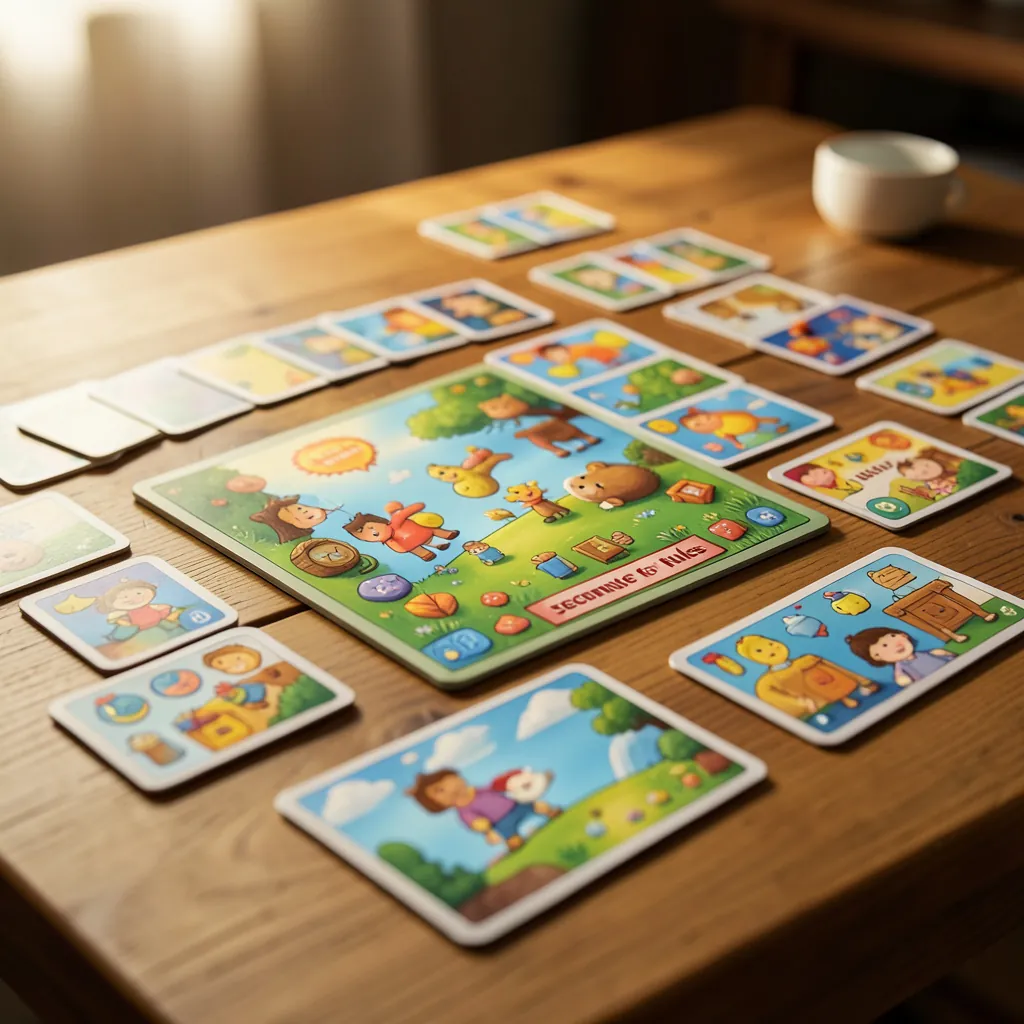
Sequence for Kids Rules: How to Play, Setup, Scoring, and Strategy
Contents
- What’s in the Box?
- Setup
- How to Play
- Scoring
- 💡 Strategy Tips
- 🎲 Variations
- What Do the Sources Disagree About?
- ❓ FAQ
🎲 Sequence for Kids is a children’s board-and-card game (published by Jax, first released in 2001) in which players play animal cards from their hand and cover the matching animal on the board with their own colored chip. The goal is simple: be the first player to line up 4 of your chips in a row — a “sequence” — across, up and down, or diagonally. No reading is required, because every card shows a picture of the animal it matches.
Players: 2-4 Play Time: Up to 30 minutes Age: 3+ (publisher Jax; one retailer lists 6-14) Difficulty: Easy (no reading required) Type: Children’s board & card game (matching / strategy)
What’s in the Box?
| Component | Quantity | Notes |
|---|---|---|
| Folding game board | 1 | Colorful animal board; each card is pictured twice on the board; the four corners are printed free spaces |
| Playing cards | 42 | Animal cards plus 2 Dragon and 2 Unicorn wild cards |
| Playing chips | 84 total | 21 red, 21 yellow, 21 blue, 21 green |
| Instructions | 1 | Complete rules sheet |
Sources agree on the 42 cards and the four chip colors (21 of each = 84 chips); the folding board and instructions are listed by every retailer description.
Setup
- Place the board in the center of the playing area.
- Each player chooses a colored set of chips (red, yellow, blue, or green) and places them in a pile near themselves.
- One player shuffles the deck and deals 3 cards, one at a time and face down, to each player.
- Each player may look at their own cards only.
- Place the remaining cards face down near the board — this is the draw deck.
- Each player starts a personal discard pile in front of them, visible to all other players.
How to Play
- The player to the dealer’s left goes first. Play then moves clockwise, one turn at a time.
- Play one card. On your turn, choose a card from your hand and place it face up on your own discard pile.
- Place a chip. Put one of your chips on a board space showing that same animal. Because each card is pictured twice on the board, you may use either matching space — as long as it is not already covered by another chip.
- Draw back up to 3. Draw one card from the top of the draw deck. Your turn is now over. You should always end your turn holding 3 cards.
- If your card has no open space: place that card on your discard pile, draw a new card from the draw deck, then take your normal turn.
- Chips stay put. Once a chip is on the board it cannot be removed by an opponent — except with a Dragon card.
- Corners are free spaces. The four printed corner spaces count as if your own chip were there, for every player.
- If the draw deck runs out, shuffle all the discard piles together to create a new draw deck and keep playing.
- Win immediately when you have 4 of your chips in a row (see Scoring).
Special cards
| Card | Copies in deck | What it does |
|---|---|---|
| Dragon | 2 | Place it on your discard pile and remove one opponent’s chip from the board. That completes your turn — you may not place your own chip on that same space during that turn. |
| Unicorn | 2 | Place it on your discard pile and put one of your chips on any open space on the board. That completes your turn. |
| Corner free space | 4 (printed on board) | Usable by any player as though it were their own chip. You need only 3 of your own chips to complete a sequence through a corner. More than one player may use the same corner, and no chip is ever placed on these spaces. |
Note: there are no Unicorn or Dragon spaces on the game board — those two wild cards exist only in the deck.
Scoring
Sequence for Kids has no point scoring — it is a race, and the game ends the moment someone wins.
- A sequence is a connected series of 4 of the same colored chips in a straight line: up and down, across, or diagonally.
- The first player to complete a sequence of 4 wins the game immediately.
- A corner free space counts toward that line for any player, so a line running through a corner needs only 3 of your own chips.
- There are no partial points, no round totals, and no tie-breaking procedure described in the sources.
💡 Strategy Tips
- Compare both matching spaces before you place. Every card appears twice on the board; choose the space that extends your own line or blocks an opponent’s.
- Build through the corners. A corner counts as your chip and only requires 3 of your own, so lines that run through a free corner are the cheapest sequences on the board.
- Play intersections. Spaces where two potential lines cross give you two ways to finish, which is much harder for opponents to block.
- Hold Dragon cards for real threats. The Dragon removes an opponent’s chip but ends your turn, so spend it on a chip that is about to complete their sequence.
- Common beginner mistakes: playing a card just because it is playable instead of planning a line, forgetting to draw back up to 3 cards, and forgetting that a card with no open matching space is discarded and replaced before your normal turn.
🎲 Variations
- 2 players: the game is officially for 2-4 players, and the sources present the same rules at every player count — no separate 2-player rule set or partnership rule is described.
- 3 or 4 players: same rules; with more players the board fills faster, so blocking matters more.
- House rules: the sources do not document any official variants for this edition. Anything beyond the printed rules (for example, requiring two sequences to win) is a house rule, not part of the published game.
- Don’t confuse it with adult Sequence: several retailer listings mix in boilerplate describing the classic Sequence game (two 52-card decks, jacks as wilds, 5 in a row). That is a different game — Sequence for Kids uses animal cards and 4 in a row.
What Do the Sources Disagree About?
- Winning line length: the rule text on every source and the product description say 4 chips in a row, but one retailer listing (Rainbow Resource) states “a sequence of five.” The overwhelming majority of sources — and the box description itself — say 4, so 4 is the correct rule; treat “five” as a listing error.
- Recommended age: most sources (including publisher Jax listings) say 3 and up, one retailer lists 6-14 years. All sources agree reading is not required, which supports the younger figure.
- Play time: two listings state up to 30 minutes; one collectible database lists play time as unknown.
- Player count: one marketplace listing omits it; every product listing and database entry says 2-4 players. (Note: 4, not the 5 sometimes assumed for adult Sequence.)
❓ FAQ
How many players can play Sequence for Kids? 2 to 4 players. Every product listing and game database entry gives the range as 2-4.
What age is Sequence for Kids for? The publisher’s listings say 3 and up, and reading is not required because cards show animal pictures. One retailer lists 6-14 years, so expect the box to say 3+ while some stores quote an older range.
Can you play Sequence for Kids with 2 players? Yes — 2 players is within the official 2-4 range. The sources do not provide a separate two-player ruleset; you use the standard rules with two colors of chips.
How do you win at Sequence for Kids? Be the first to get 4 of your own chips in a straight line — horizontally, vertically, or diagonally. A line running through one of the four corner free spaces needs only 3 of your chips. The game ends immediately when a sequence is completed.
Is Sequence for Kids hard to learn? No. It is rated easy: play a card, cover the matching animal, draw a card. Children who cannot read can play because the cards use animal pictures rather than words.
How long does a game take? Up to 30 minutes according to the product specifications — most games finish well inside that.
What do you need to play? Just the box contents: 1 folding game board, 42 playing cards (including 2 Dragon and 2 Unicorn wild cards), 84 chips (21 each in red, yellow, blue, and green), and the instructions. No pencil, paper, or extra pieces are required.
Related guides
- How to Play Sorry! — Complete Rules, Card Guide, Strategy, and Variations
- FLIP Gameplay Guide: How to Play the Digital Memory Game
- Sorry! Game Rules: Setup, How to Play, Scoring, and Variations
- How to Play Sorry!: Complete Rules, Setup, Scoring, and Variations
- How to Play Pegs and Jokers: Board-and-Peg Card Game Guide
Sources
- [SG] SEQUENCE for Kids Strategy Board & Card Games - Family & Friends Interactive Game Challenge! - Share:
- Jax Sequence Fun And Easy Foldable Board Card Game Suitable For 2-4 Players | Best Price KSA | Riyadh, Jeddah - Sequence for kids by jax, ages 3 and up, 2-4 players fun and easy gameplay does not require reading players play an animal card …