How to Play Sorry!: Complete Rules, Setup, Scoring, and Variations
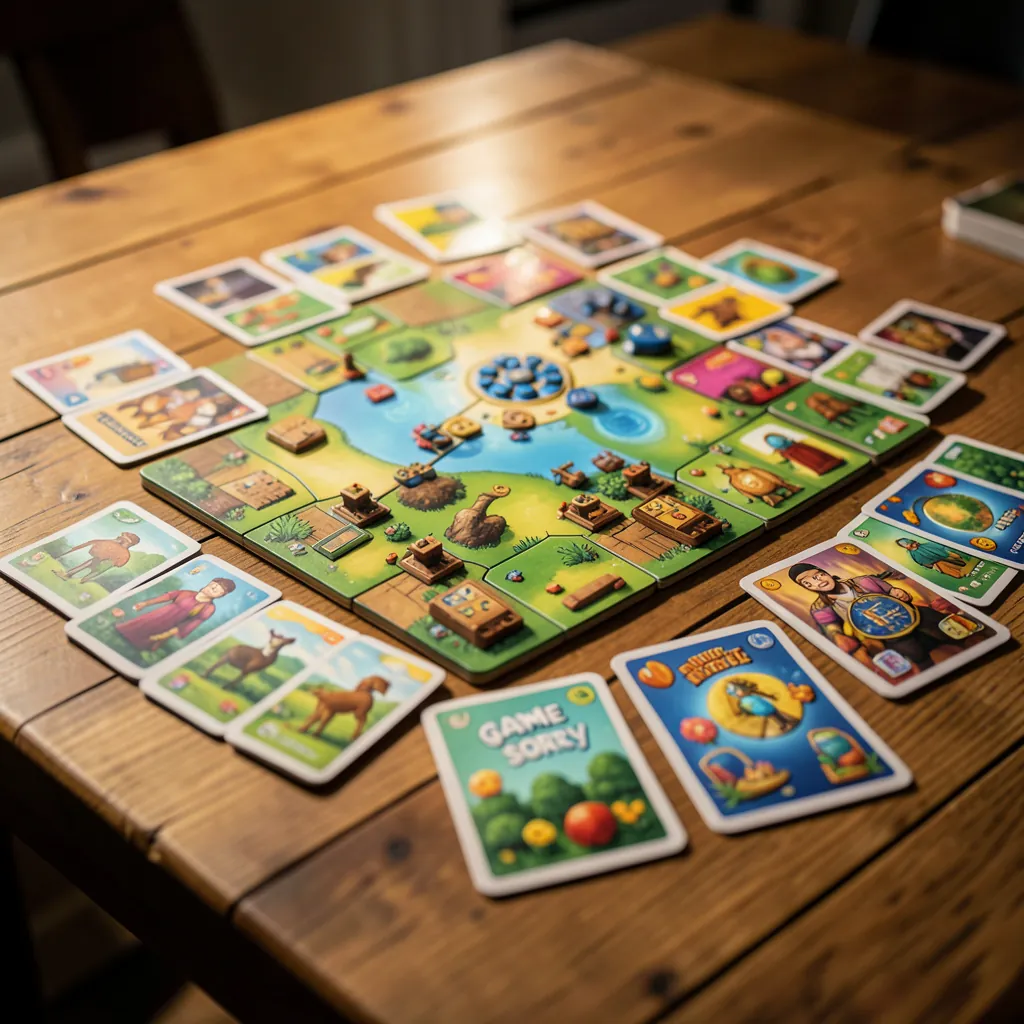
How to Play Sorry!: Complete Rules, Setup, Scoring, and Variations
Contents
🎲 Sorry! is a Hasbro/Parker Brothers board game for 2–4 players, ages 6+, in which each player moves four pawns from Start around the board toward Home. You draw cards to move, bump opponents back, slide, and use Safety Zones; the first player to get all their pawns home by exact count wins.
Players: 2–4 (the requested 3–5 template value is not supported by the served sources)
Play Time: Not stated in the provided sources; setup time is listed as 1–5 minutes (the requested 20–30-minute value is not supported)
Age: 6+ (the requested 10+ template value is not supported)
Difficulty: Easy
Type: Board game with card-driven movement, not a trick-taking card game
Template conflict note: The required quick-facts example listed 3–5 players, 20–30 minutes, 10+, and “trick-taking card game.” The Sorry! sources consistently list 2–4 players and ages 6+, and describe a board game using a 45-card movement deck.
Setup
- Place the Sorry! gameboard where all players can reach it.
- Each player chooses one color and takes the four pawns of that color. Modern Hasbro listings say the game includes 16 pawns total, four per player.
- Place all four of your pawns in your colored Start area.
- Use the 45-card movement deck. The modern deck has five 1 cards and four each of Sorry!, 2, 3, 4, 5, 7, 8, 10, 11, and 12; 6s and 9s are omitted.
- Select one player to go first.
How to Play
- On your turn, draw one card from the movement deck and follow its instruction.
- At the start, all your pawns are in Start. You can move a pawn out only if you draw a 1, 2, or Sorry! card. A 1 or 2 places the pawn on the space directly outside Start; a 2 does not also move it a second space.
- You must move a pawn if a legal move is possible. If more than one legal move is available, choose which one to take. If no legal movement is available, your turn is forfeited.
- Pawns normally move clockwise, but some cards allow backward movement. A pawn may pass over other pawns; each space passed over counts as one space of movement.
- Two pawns cannot occupy the same square. If you land on an opponent’s pawn, bump that pawn back to its own Start.
- You cannot bump your own pawn back to Start. If the only possible move would cause you to bump your own pawn, your pawns stay in place and you lose your turn.
- If a pawn lands at the start of a slide—except a slide of its own color under classic rules—it immediately slides to the last square of the slide. All pawns on the slide, including the sliding player’s pawns, are sent back to their Starts. In the 2013 edition, slide-color rules differ: each slide contains three colors different from that board side’s color.
- The last five squares before Home are the Safety Zone. Only pawns of the matching color may enter. Pawns in a Safety Zone cannot be bumped or switched by an 11 or Sorry! card. If a 4 or 10 forces a pawn backward out of the Safety Zone, it is no longer safe until it re-enters.
- A pawn may enter Home only by exact count. Once a pawn is in Home, it stays there for the rest of the game.
- The first player to get all of their pawns into Home wins.
What does each Sorry! card do?
| Card | Effect | Edition/source notes |
|---|---|---|
| 1 | Move a pawn from Start, or move a pawn 1 space forward. | 2013 edition also allows “move ice” before doing so. |
| 2 | Move a pawn from Start, or move a pawn 2 spaces forward. | Classic rule: draw again at the end of the turn even if the 2 does not enable movement. 2013 edition removes the draw-again rule and adds “move fire.” |
| 3 | Move a pawn 3 spaces forward. | |
| 4 | Move a pawn 4 spaces backward. | |
| 5 | Move a pawn 5 spaces forward. | |
| 7 | Move one pawn 7 spaces forward, or split the 7 spaces between two pawns. | Cannot move a pawn out of Start with a 7. The entire 7 must be used. No backward movement when splitting. |
| 8 | Move a pawn 8 spaces forward. | |
| 10 | Move a pawn 10 spaces forward, or 1 space backward. | If no pawn can move forward 10, one pawn must move back 1. |
| 11 | Move a pawn 11 spaces forward, or switch one of your pawns with an opponent’s pawn. | Cannot switch a pawn in a Safety Zone. Some summaries also state an 11 cannot move a pawn out of Start. If you cannot move 11, you are not forced to switch and may end your turn. |
| 12 | Move a pawn 12 spaces forward. | |
| Sorry! | Take a pawn from Start and place it on a square occupied by an opponent’s pawn, sending that opponent’s pawn back to Start. | Cannot target a pawn in a Safety Zone or Home. If there are no pawns in Start or no legal target, the turn ends. In the 2013 edition, you may instead move one of your own pawns 4 spaces forward; if you cannot, the turn is forfeited. |
Scoring
Classic Sorry! does not use a point total. The winner is the first player to get all of their pawns from Start around the board and into Home, with each pawn entering Home by exact count. Modern Hasbro editions use four pawns per player; some Wikipedia wording notes that older versions used three pawns, while the modern version uses four.
There is also an official “Point-Scoring Sorry!” variant from the 1939 edition. In that version, players are dealt five cards, play one card on their turn, and draw a replacement. At the end, each player scores one point for every pawn they got Home; the winner also scores one point for every opponent pawn that got Home, plus a bonus whose exact amount is truncated in the provided source excerpt.
💡 Strategy Tips
- Split the 7 when it helps you reach a slide. A split 7 can put one pawn on a slide and improve the card’s value. It also can help two pawns enter Home on the same turn if the remaining spaces can be used legally.
- Avoid ending in front of an opponent’s Start. Many cards let that opponent enter play, so parking a pawn there is usually a poor choice.
- Consider leaving your last pawn in Start while you wait for a Sorry! card. The sources describe this as one tactic skilled players use.
- Keep a pawn near your own Start for backward movement. A 4 or 10 can move a pawn backward into or near your Safety Zone without going all the way around the board.
- Attack the apparent leader when you can. Because 11, 4, and Sorry! cards can reverse progress quickly, slowing the leader—even without immediate advancement—can be worth it. Common beginner mistake: forgetting that Home requires exact count or forgetting that a backward 4/10 can pull a pawn out of Safety.
🎲 Variations
- Official point-scoring variant: The 1939 “Point-Scoring Sorry!” uses a five-card hand, replacement draws, and end-game points as described in Scoring.
- Player-count variation: The game is officially marketed for 2–4 players. For 2 players, use two colors, one per player, under the standard rules; the provided sources do not list a separate two-player ruleset.
- Older-edition differences: The first edition had 44 cards, with the extra 1 added later for quicker play. A 1996 Waddingtons board had five of each card. Older boards also had a colored “diamond space” one space back from each Start; that rule was removed in later editions.
- 2013 edition changes: The 2-card “draw again” rule was removed; 1 and 2 cards can involve “move ice” and “move fire”; slides use three colors different from that board side; and a Sorry! card can instead move your own pawn 4 spaces if no Start/target move is available.
- Ancestry wording conflict: Sources describe Sorry! as based on Pachisi and/or Ludo; the common point is that it is a cross-and-circle race game.
- House rules: The provided sources document official variants and edition changes, but they do not document common house rules.
❓ FAQ
How many players can play Sorry!?
2–4 players. The Hasbro product listing and Wikipedia infobox both list 2–4 players.
How do you win Sorry!?
Be the first player to get all your pawns from Start around the board and into Home. Each pawn must enter Home by exact count.
Can you play Sorry! with 2 players?
Yes. The game is marketed for 2–4 players. Use two colors, one per player, under the standard rules; the provided sources do not give a separate 2-player variant.
Is Sorry! hard to learn?
No. It is listed for ages 6+, and customer reviews in the retail sources describe it as easy to follow and easy to play.
How long does a game of Sorry! take?
The provided sources do not state a play time. They list setup time as 1–5 minutes, but they do not support a 20–30-minute figure for Sorry!.
What do you need to play Sorry!?
A Sorry! gameboard, 16 pawns total—four per player in modern editions—and the 45-card movement deck. Retail sources list the game at about $9.99, though prices can vary.
Related guides
- How to Play Sorry! — Complete Rules, Card Guide, Strategy, and Variations
- FLIP Gameplay Guide: How to Play the Digital Memory Game
- Sorry! Game Rules: Setup, How to Play, Scoring, and Variations
- How to Play Pegs and Jokers: Board-and-Peg Card Game Guide