Can You Move Backwards Into the Safety Zone in Sorry? Complete Rules Guide
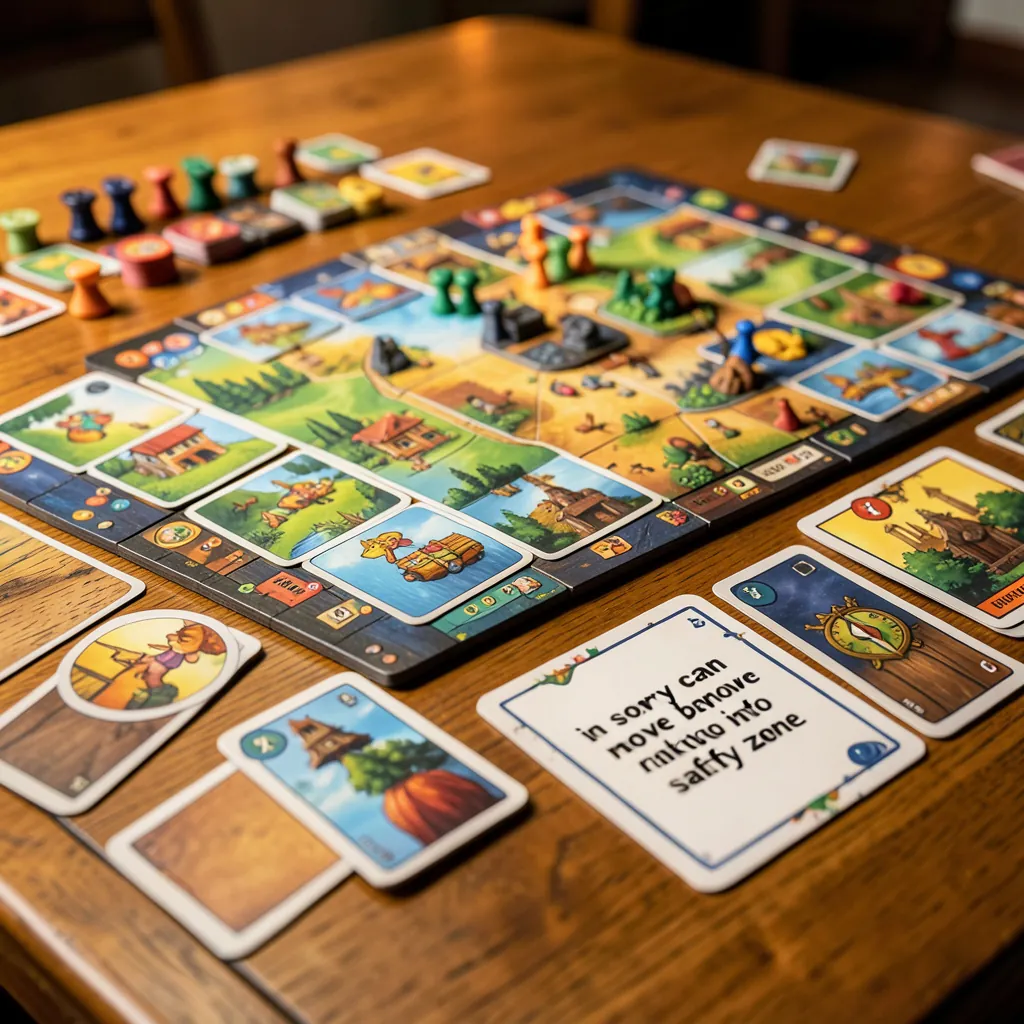
Can You Move Backwards Into the Safety Zone in Sorry? Complete Rules Guide
Contents
🎲 Sorry! is a family race-and-bump board game in which each player tries to move all four pawns from Start to Home first. Under the standard Hasbro rules, you cannot move backwards into your Safety Zone: a 4 or 10 card moves backward, but a pawn must enter its Safety Zone on a forward move through its entry space. You may move backward out of the Safety Zone.
Players: 2–4 (standard cited editions)
Play Time: Not stated in cited rulebooks; commonly about 30–60 minutes
Age: 6+ (Source 1 says Ages 6 to Adult)
Difficulty: Easy — draw a card and follow its move
Type: Family board game with cards / race-and-bump game
Setup
- Pick a color and take that color’s pawns. Most cited rulebooks use 4 pawns per player; Source 4’s A5065 edition uses 3 pawns per player. Place all your pawns on your matching START area.
- Shuffle the Sorry! deck. Place it face down on the draw area, and leave space for a face-up discard pile.
- Choose the first player. The cited sources conflict: Source 1 says pick a player, Source 2 says each player draws and the highest card starts, and Sources 3–4 say the youngest player starts. Use the rule in your edition; play then passes left/clockwise unless a card says otherwise.
- Use the cards included with your edition. Source 1 notes the deck excludes 6s and 9s; Source 2 describes a 44-card deck; Sources 3–4 describe 45-card decks.
Edition differences to check before setup
| Rule/detail | Source 1 | Source 2 (1939) | Source 3 | Source 4 |
|---|---|---|---|---|
| Pawns per player | 4 | 4 | 4 | 3 |
| Players/age | 2–4; Ages 6+ | Not stated in excerpt | 2–4; Ages 6+ | 2–4; Ages 6+ |
| First player | Pick a player | Highest card draw | Youngest player | Youngest player |
| Starting a pawn | 1 or 2 for normal start; SORRY! can take a pawn from START to bump an opponent | 1, 2, or Sorry | 1, 2, or Sorry | Any forward-moving card |
| Slide trigger | Slide on a slide not your color; own color = no slide | Slide on a slide not your color; own color = no slide | Slide on your own color; other color = no slide | Slide on your own color; other color = no slide |
| Enter Safety Zone backward? | No | No | No | No |
| Move backward out of Safety Zone? | Yes | Yes | Yes | Yes |
How to Play
- On your turn, draw the top card from the draw pile and follow its instructions if you can. Place the card face up on the discard pile. If the draw pile runs out, reshuffle the discards and use them again.
- Starting a pawn is edition-dependent. Source 1 allows a normal start with a 1 or 2; its SORRY! card separately takes a pawn from START to an occupied opponent space. Source 2 and Source 3 require a 1, 2, or Sorry card to start. Source 4 says any forward-moving card can start a pawn. Do not mix these rules.
- Move pawns clockwise around the outside track unless a card instructs otherwise. Count every space, including occupied spaces when jumping over your own or another player’s pawn.
- Bumping: If you land on an outside-track space occupied by an opponent’s pawn, send that pawn back to its START area. Two pawns of the same color may never occupy the same space; if your only legal move would land on your own pawn, you forfeit that turn.
- If you can move, you must move, even if the move is bad for you. If you cannot move, forfeit your turn.
- Backward moves: A 4 card moves one pawn backward 4 spaces. The 10 card can move one pawn forward 10 spaces or backward 1 space in Sources 2–4; Source 1 also describes 4 and 10 cards as backward movers. Backward moves can take a pawn out of its Safety Zone, but they cannot put a pawn into the Safety Zone.
- Safety Zone entry: Only you may enter your own color Safety Zone, which Source 2 describes as the 5 colored squares preceding Home. No pawn may enter its Safety Zone by a backward move. A pawn must enter by a forward move through its Safety Zone entry space.
- Backward positioning is allowed, but backward entry is not. A backward move can reposition a pawn so it can enter the Safety Zone sooner on a later forward move. Source 2 gives the example of a pawn on the starting circle opposite its Start moving backward 4 spaces to set up a later forward entry. Source 1 similarly says a pawn moved backward at least two spaces beyond its own START space may later enter its Safety Zone without going all the way around the board.
- Safety Zone entry space: When moving along the outside track, you may not move forward beyond your own Safety Zone entry except to enter the Safety Zone. You may pass the entry space on a backward move, or as the result of a SORRY! or 11-card switch played against you.
- Slides — sources conflict. Source 1 and Source 2 say you slide when you land on a slide triangle that is not your own color; Source 3 and Source 4 say you slide when you land on the triangle showing your own color. Follow your edition’s rulebook. When a slide applies, move to the end of the slide and bump every pawn on the slide, including your own.
- Home: You must bring all pawns into Home by exact count. Once a pawn is Home, it is out of play and is not moved again.
- Winning: The first player to get all their pawns from START to HOME wins. In the 3-pawn edition, that means all 3 pawns.
Key card effects and edition notes
| Card | What it does | Start/Safety Zone notes |
|---|---|---|
| 1 | Start a pawn where allowed, or move one pawn forward 1. | Edition note: Source 3 allows starting only with a 1, 2, or Sorry! card—not any forward card. Source 4 is the source that says any forward-moving card can start a pawn. Do not apply Source 4’s rule to Source 3. |
| 2 | Start a pawn where allowed, or move one pawn forward 2; then draw again. | The extra draw is part of the 2-card rule. |
| 4 | Move one pawn backward 4 spaces. | Cannot enter the Safety Zone backward; can move backward out of it. |
| 10 | Move one pawn forward 10 spaces, or backward 1 space. | The backward option cannot enter the Safety Zone. Source 2 says if you cannot or will not move forward 10, you must move backward 1. |
| 11 | Move one pawn forward 11 spaces, or switch one of your pawns with an opponent’s pawn on the open track. | You may not switch pawns at START, HOME, or in a Safety Zone. If the switch lands on a slide triangle, apply your edition’s slide rule. |
| SORRY! | Take a pawn from START and place it on a space occupied by an opponent; bump that opponent back to START. | Source 1 says forfeit if there is no pawn on START or no opponent pawn you can bump. Sources 3–4 also allow a forward-4 move in some editions if the SORRY! move cannot be used; check your rulebook. |
Scoring
Standard Sorry! does not use points. The winner is simply the first player to get all their pawns from START to HOME by exact count. If you are using the 3-pawn edition, the winner is the first to get all 3 pawns Home.
Source 1 includes an adult point-scoring variation: all players score 5 points for each pawn on HOME. The winner also scores 5 points for each opponent’s pawn not in HOME, plus 25 points if no opponent has more than 2 pawns Home, 50 points if no opponent has more than 1 pawn Home, and 100 points if no opponent’s pawn reached HOME. Source 2 also has a point-scoring variation, but its scoring differs and its excerpt is truncated; do not mix it with Source 1’s 5-point system.
💡 Strategy Tips
- Use 4 and 10 cards to reposition pawns near the Safety Zone entry, but remember the actual entry must be forward. Do not try to back into the Safety Zone.
- Watch the exact count for HOME. A pawn that overshoots Home cannot simply move in; plan earlier forward moves carefully.
- Use the 7-card split to move two pawns, or to bring one pawn Home while using the balance of the 7 on another pawn.
- Use the 11-card switch to disrupt the leader or move a pawn into a better lane, but remember you cannot switch pawns at START, HOME, or in a Safety Zone.
- Common beginner mistake: forgetting that if a legal move exists, you must take it—even if it helps an opponent or leaves you exposed.
🎲 Variations
- 2 players: Standard cited editions support 2–4 players. For 2 players, use two colors and the normal rules; the cited sources do not give a special 2-player rule change.
- Partnership/team Sorry: Red + Yellow are partners, and Green + Blue are partners. You may use a drawn card for your own or your partner’s pawn; SORRY! cards must be used; a 7 may be split among team pawns. The first team to get all eight pawns into their Homes wins.
- Faster game: Source 2 suggests using 3 pawns per player instead of 4. Note that Source 4’s edition already uses 3 pawns as standard.
- Point-scoring adult variation: Source 1’s version deals 5 cards to each player, starts one pawn outside START, and uses the 5-point scoring system above. Source 2 has a different point-scoring variant.
❓ FAQ
Can you move backwards into your Safety Zone in Sorry?
No. The cited rules consistently say no pawn may enter its Safety Zone by a backward move. A 4 or 10 can move a pawn backward, but Safety Zone entry must be a forward move through the entry space.
Can you move backwards out of your Safety Zone in Sorry?
Yes. A pawn may move backward out of its Safety Zone with a backward move, and on later turns it may move back into the Safety Zone as cards permit.
Can a backward move help you enter the Safety Zone faster?
Yes, but only by repositioning. A backward move can place a pawn near its Safety Zone entry so a later forward move can enter; it does not allow backward entry into the Zone.
Can you start a pawn with a Sorry card?
It depends on the edition. Source 2 and Source 3 allow starting with a 1, 2, or Sorry card. Source 1 allows normal starts with 1 or 2, while its SORRY! card can take a pawn from START to bump an opponent. Source 4 allows any forward-moving card to start a pawn.
How many players can play Sorry?
The standard cited editions are for 2–4 players. Some cited rulebooks also list ages 6+.
How do you win Sorry?
Get all your pawns from START to HOME first, using exact count to enter HOME. Standard play has no points; the first player to finish wins.
Related guides
- How to Play Sorry! — Complete Rules, Card Guide, Strategy, and Variations
- FLIP Gameplay Guide: How to Play the Digital Memory Game
- Sorry! Game Rules: Setup, How to Play, Scoring, and Variations
- How to Play Sorry!: Complete Rules, Setup, Scoring, and Variations
- How to Play Pegs and Jokers: Board-and-Peg Card Game Guide