Sequence: How Many Cards for 8 Players and How to Play
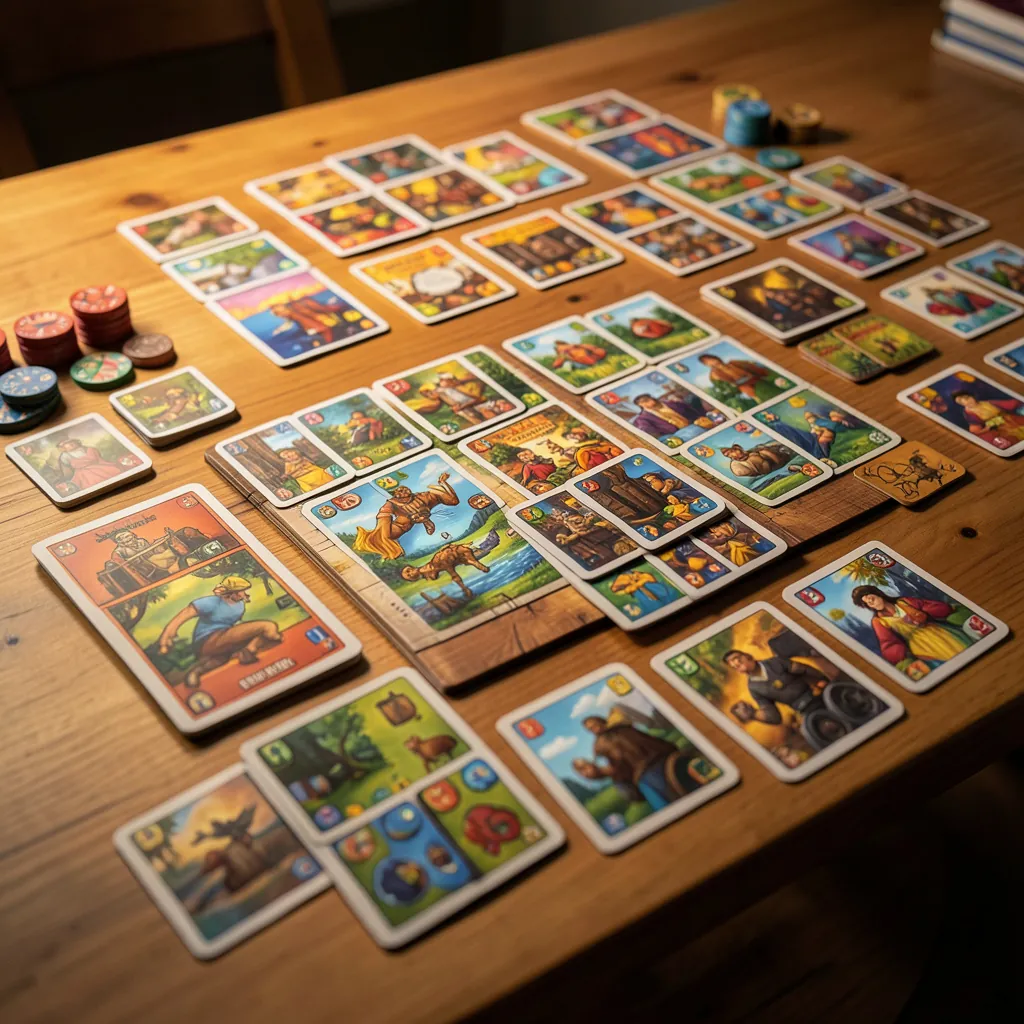
Sequence: How Many Cards for 8 Players and How to Play
Contents
🎲 In the board-and-card game Sequence, 8 players are dealt 4 cards each, according to the deal charts in Sources 1, 2, 3, and 5. Sequence is a strategy game where players or teams place chips on board spaces matching cards from their hand; the goal is to complete the required number of five-chip sequences.
Players: 2-12
Play Time: Not specified in the sources; Source 2 says it is short enough to play a couple of times in an afternoon
Age: 7+ (box age per Source 2)
Difficulty: Easy
Type: Board-and-card strategy game
Setup
- Place the Sequence board on a flat table or floor with room for the draw deck, discard pile, and chips.
- Remove any jokers; the game uses two standard 52-card decks, 104 cards total. Source 1 and Source 3 list the equipment as a board, instructions, 135 poker chips (50 blue, 50 green, 35 red), and two full decks.
- Shuffle the two decks together as the draw pile. Each player or team chooses a chip color; all team members must use the same color. Sources 1, 3, and 4 say red is only used when there are three teams; Source 5 says two players or two teams use blue and green only.
- Seat teams correctly for team play. With two teams, players alternate physical positions with opponents around the board; with three teams, players of a team sit at every third position (Sources 1, 3, 4).
- Deal cards according to the number of players. For the page’s main question: with 8 players, deal 4 cards to each player (Sources 1, 2, 3, 5).
- Place the rest of the deck face down as the draw pile.
- Determine the first player using your edition’s rule. Sources conflict: Sources 1, 3, and 4 describe a low-card draw for dealer and the player to the dealer’s left going first; Source 2 says the lowest card deals and the highest card plays first; Source 5 says the highest card starts.
Cards dealt by player count
| Players | Cards each | Source notes |
|---|---|---|
| 2 | 7 | Sources 1, 2, 3, 5 |
| 3 | 6 | Sources 1, 2, 3, 5 |
| 4 | 6 | Sources 1, 2, 3, 5 |
| 6 | 5 | Sources 1, 2, 3, 5 |
| 8 | 4 | Sources 1, 2, 3, 5; Source 2 describes 8 players as two teams of four |
| 9 | 4 | Sources 1, 2, 3, 5; Source 2 describes three teams of three |
| 10 | 3 | Sources 1, 2, 3, 5; Source 2 describes two teams of five |
| 12 | 3 | Sources 1, 2, 3, 5; Source 2’s 12-player team note is inconsistent, so check your edition |
The sources’ deal chart does not list 5, 7, or 11 players; do not invent a deal count for those counts—use your edition’s rulebook or a supported team setup.
How to Play
- Play proceeds around the board, normally to the left/clockwise after the starting player.
- On your turn, choose one card from your hand and place one of your chips on a matching open space on the board. Most cards appear twice on the board, so choose the more useful open copy (Sources 1, 2, 3, 5).
- You may not place on a space already covered by an opponent’s chip. If both matching spaces are unavailable, you are holding a “dead card.”
- To exchange a dead card: on your turn, discard it, announce that it is dead, draw one replacement, and then take your normal turn. You may exchange only one dead card per turn (Sources 1, 2, 3, 5).
- Jacks are special and do not appear on the board. A Two-Eyed Jack is wild: place a chip on any open space. A One-Eyed Jack removes an opponent’s chip from the board.
- A One-Eyed Jack cannot remove a chip that is part of a completed sequence. Sources 1, 2, 4, and 5 support this; Source 3’s wording is contradictory but also says a completed sequence stands. Source 5 adds that you cannot place your own chip on the same space you just cleared during that same turn.
- Once a Jack is played, it ends the turn after being resolved. Discard the played card, draw a replacement, and pass play.
- After placing or removing a chip, discard the played card face up and draw one replacement card. If you forget to draw before the next player starts, you lose that draw and continue with fewer cards (Sources 1, 3, 4, 5).
- Build a sequence: five chips in a straight horizontal, vertical, or diagonal row. A free corner space counts as a chip of every color, so four chips plus a free corner can complete a sequence (Sources 1, 3, 4, 5).
- Completed sequences are protected and cannot be broken by a One-Eyed Jack. Sources differ slightly on sharing: Source 5 says two intersecting sequences of the same color may share one chip; Source 2 more broadly says a token can be used in more than one sequence; Source 3 notes a 9-chip straight line can count as two sequences by sharing one space.
- In team play, no table talk or coaching is allowed. Source 2 says a guilty team’s members each lose a card for the remainder; Source 5 says team members lose a card to the discard pile.
- If the draw pile runs out, shuffle the discard pile to make a new draw pile (Sources 1, 3, 4, 5).
Scoring
Standard Sequence does not use a running point total. You win by completing the required number of five-chip sequences.
| Situation | Sequences needed to win | Sources |
|---|---|---|
| 2 players or 2 teams | 2 | Sources 2, 5 |
| 3 players or 3 teams | 1 | Sources 2, 5 |
| Older/general wording | 2 | Sources 1, 3 |
Conflict to flag: Source 1 says the game ends when a player or team completes 2 sequences; Source 3 says 2 sequences; Source 2 and Source 5 say 2 sequences for two players/two teams but only 1 sequence for three players/three teams. For standard 8-player team play, Source 2 describes two teams of four, so the two-team threshold of 2 sequences applies.
Source 3 also notes that when 2 sequences are required, they can be achieved in one straight row of 9 chips because one space from the first sequence may be used as part of the second.
💡 Strategy Tips
- Watch both board copies of key cards. Source 2 notes that finding both matching spaces can slow turns, so plan around the more useful copy.
- Save Two-Eyed Jacks for completing a sequence or blocking an opponent’s best line.
- Use One-Eyed Jacks on important opposing chips—but remember they cannot remove chips from completed sequences.
- Use the four free corner spaces; they are wild for all players and can turn four chips into a completed sequence.
- Do not forget to draw. A missed draw permanently reduces your hand and is a common beginner mistake in Sources 1, 3, 4, and 5.
🎲 Variations
- 2-player Sequence: Deal 7 cards each, play individually, and use the two-player winning condition: 2 sequences (Sources 1, 2, 3, 5).
- 8-player Sequence: Source 2 describes 8 players as two teams of four; deal 4 cards each and alternate teammates with opponents around the board.
- 3-player or 3-team Sequence: Source 2 and Source 5 say only 1 sequence is needed to win.
- Official versions: Source 3 lists Sequence – States and Capitals, Sequence Numbers, Sequence 25th Anniversary Edition, Jumbo Sequence, Travel Sequence, Sequence Deluxe Edition, Sequence for Kids, and Sequence Dice.
- Unofficial house variants from Source 3: fill the board and score 1 point per sequence; allow removal of chips from completed sequences; do not reshuffle if the deck runs out; or play adult drinking-game variants. These are not standard rules.
❓ FAQ
How many cards does each player get with 8 players in Sequence?
Four cards each. The deal chart in Sources 1, 2, 3, and 5 lists 8 players at 4 cards each; Source 2 also describes 8 players as two teams of four.
How many players can play Sequence?
Sequence supports 2 to 12 players. Sources 1, 3, and 4 say more than 12 cannot play. Up to 3 players can play individually; larger groups play in teams depending on the edition.
How do you win at Sequence?
Complete the required number of five-chip sequences. For 2 players or 2 teams, Sources 2 and 5 require 2 sequences; for 3 players or 3 teams, they require 1 sequence. Source 1 and Source 3 use a 2-sequence win condition, so check your edition.
Can you play Sequence with 2 players?
Yes. Deal 7 cards to each player, play individually, and use the two-player win condition of 2 sequences (Sources 1, 2, 3, 5).
Is Sequence hard to learn?
No. Source 2 describes the rules as simple enough for everyone to play, and the box age is 7+. The main slowdown is finding the matching card spaces on the board.
How long does a game of Sequence take?
The sources do not give an exact play time. Source 2 says the game length is “pretty good” and short enough to play a couple of times in an afternoon.
Related guides
- How to Play Sorry! — Complete Rules, Card Guide, Strategy, and Variations
- FLIP Gameplay Guide: How to Play the Digital Memory Game
- Sorry! Game Rules: Setup, How to Play, Scoring, and Variations
- How to Play Sorry!: Complete Rules, Setup, Scoring, and Variations
- How to Play Pegs and Jokers: Board-and-Peg Card Game Guide