How to Play Risk: Rules, Setup, Turn Phases and Winning
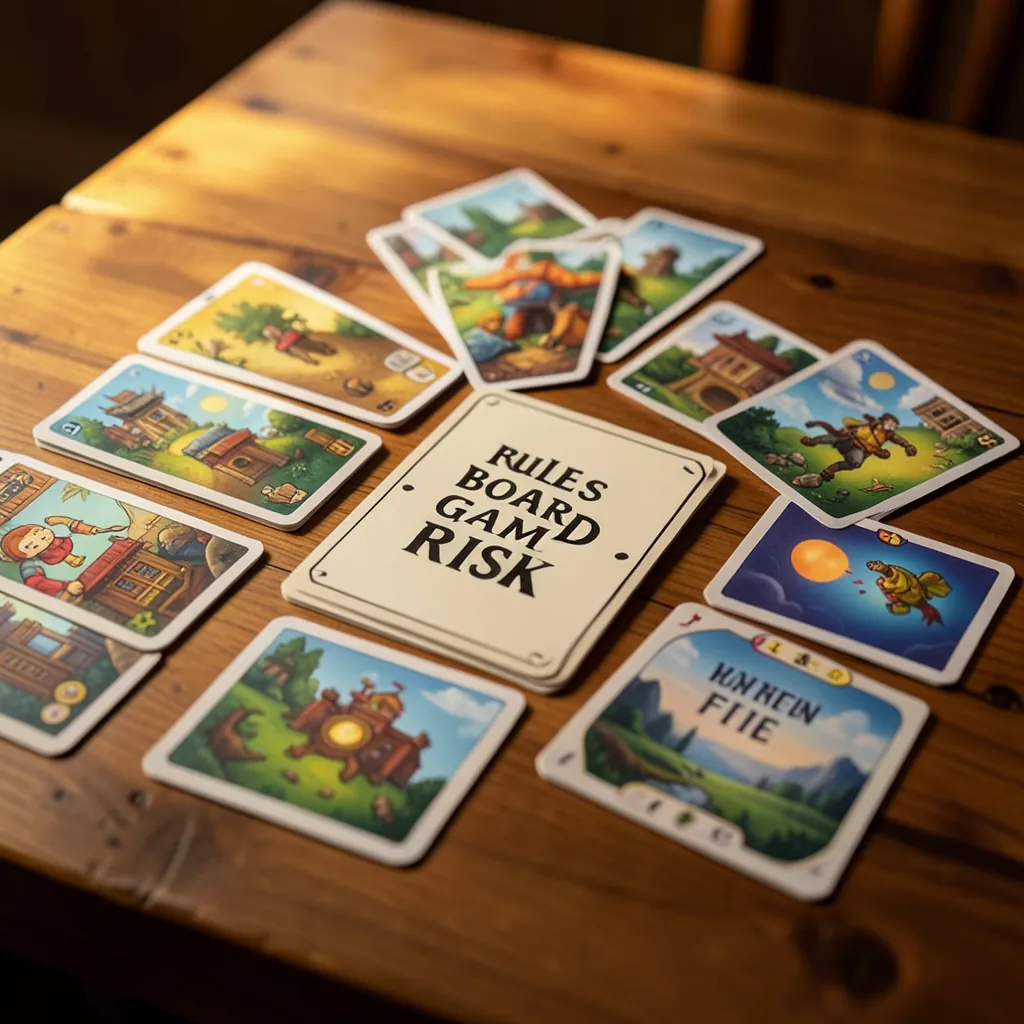
How to Play Risk: Rules, Setup, Turn Phases and Winning
Contents
- What Do You Need to Play Risk?
- Setup
- How to Play
- Scoring
- 💡 Strategy Tips
- 🎲 Variations
- Where Sources Disagree on the Rules
- ❓ FAQ
🎲 Risk is a turn-based strategy board game in which 2–6 players command armies on a world map divided into 42 territories across six continents, fighting dice-rolled battles to capture land and eliminate rivals. The goal is “world domination”: occupy every territory on the board and knock every other player out of the game. French filmmaker Albert Lamorisse invented it in 1957 as La Conquête du Monde; Parker Brothers brought it to the US in 1959.
Players: 2–6 Play Time: 1–3 hours typical (full games can run 1–8 hours) Age: 10+ Difficulty: Medium (simple rules, deep strategy, plus dice luck) Type: Strategy board game (world-domination war game)
What Do You Need to Play Risk?
A standard Risk set contains a world-map board, coloured army pieces (infantry = 1 army, cavalry = 5, artillery = 10), dice and a deck of Risk cards. Source 3 describes standard equipment as five dice in two colours — three for the attacker and two for the defender — while Hasbro’s 60th Anniversary edition lists six dice, 57 Risk cards, 6 plastic armies with 40 infantry, 12 cavalry and 8 artillery each, plus mission cards and a game guide.
| Component | What it does |
|---|---|
| Board | World map split into 42 territories in 6 continents; dashed sea lines connect some regions |
| Infantry / cavalry / artillery | Represent 1 / 5 / 10 armies; you can swap them at any time |
| Dice | Attacker rolls up to 3, defender up to 2 |
| Risk cards | 42–43 territory cards with infantry, cavalry or artillery symbols, plus 2 wild cards |
| Mission cards | Used only in the Secret Mission variant (12 cards per Source 2; 28 per Source 3) |
Setup
- Choose colours and count your starting armies. Each player takes the number of army pieces shown in the table below.
- Claim territories in turn. Players take turns clockwise placing one infantry piece on any unoccupied territory until all 42 territories are claimed.
- Place your remaining armies. Once every territory is claimed, players take turns placing their leftover pieces on their own territories. There is no limit to how many armies can sit on a single territory.
- Prepare the card deck. Remove the secret mission cards (unless you are playing Secret Mission Risk), shuffle the remaining Risk cards and place them face down beside the board as the draw pile.
- Determine who goes first. Source 1 has players roll dice at the very start, with the highest roller placing the first piece and also taking the first turn; Source 3 has players roll a die to set playing order after all armies are placed.
| Players | Starting armies each |
|---|---|
| 2 | 40 |
| 3 | 35 |
| 4 | 30 |
| 5 | 25 |
| 6 | 20 |
Sources 1 and 3 agree exactly on these starting army counts.
How to Play
- Start your turn with reinforcements. Count your territories, divide by 3 and round down; you always receive a minimum of 3 armies regardless of how few territories you hold.
- Add continent bonuses. If you control every territory of a continent, add its bonus armies (see table below).
- Trade in Risk cards (optional, or forced). A valid set is three cards with the same symbol or one of each symbol; a wild card matches any two others. If you hold 5 or more cards at the start of your turn you must trade in a set until you are back under the limit. Place the reinforcement armies on any of your territories.
- Place all reinforcement armies on your own territories before attacking.
- Choose an attack. You may attack any bordering enemy territory, or one connected to yours by a dashed sea line (for example, North Africa to Egypt, or Greenland to Quebec or Iceland). You must have at least 2 armies in the attacking territory.
- Declare your dice. The attacker rolls 1, 2 or 3 dice (one per army committed, always leaving at least one army behind); the defender chooses to resist with 1 or 2 dice, up to the number of armies on the defending territory. Source 3 specifies the defender chooses before the attacker rolls.
- Resolve the roll. Compare the highest attacker die with the highest defender die, then the second-highest pair if both sides rolled two or more. The higher number wins each comparison; ties go to the defender. The loser of each comparison removes one army.
- Repeat or withdraw. You can keep attacking the same territory or call off the assault at any point. Extra attacker dice that have no defender die to match are simply ignored.
- Occupy a conquered territory. If you wipe out all defending armies, you take the territory and must move in at least as many armies as you used in the final round of attack — and at least one army must remain behind in the territory you attacked from.
- Draw a Risk card. If you captured at least one territory this turn, draw one card from the deck. You never draw more than one card per turn.
- Handle eliminations. If you take a player’s last territory, that player is out of the game and you inherit all their Risk cards. If this pushes you over the hand limit, trade in sets immediately and place the armies at once.
- Fortify. Once per turn, move any number of armies from one of your territories to a single adjacent territory you control, leaving at least one army behind. (An alternate rule in Source 3 lets you move through a chain of contiguous friendly territories.)
- Pass clockwise. Play continues to the next player.
Continent bonus table
| Continent | Bonus armies per turn |
|---|---|
| Asia | 7 |
| Europe | 5 |
| North America | 5 |
| Africa | 3 |
| Australia | 2 |
| South America | 2 |
All three rule sources list identical continent bonuses.
Risk card set values
| Set turned in | Armies received |
|---|---|
| 1st | 4 |
| 2nd | 6 |
| 3rd | 8 |
| 4th | 10 |
| 5th | 12 |
| 6th | 15 |
| 7th onward | +5 more than the previous set |
If one of the cards you trade in shows a territory you own, place 2 extra armies on that territory — this bonus applies only once per set.
Scoring
Classic Risk has no point score; victory is decided by elimination. A player is knocked out when their last territory is taken and their final piece removed, and the game ends when one player holds all 42 territories and every opponent is eliminated — there can be only one winner. The nearest thing Risk has to a “score” is the reinforcement economy: territories ÷ 3 (minimum 3), plus continent bonuses, plus card set values. The point-scoring exception is the spin-off Risk: 2210 A.D. (2001), which uses a time limit and a point system rather than total conquest to decide the victor.
💡 Strategy Tips
- Take whole continents, not scattered territories. Owning a full continent delivers bonus armies every single turn — the most efficient way to grow your army, according to both Source 2’s strategy section and the official rulebook tips in Source 3.
- Build outward from a defensible core. Spreading yourself too thin creates one-army territories that invite attack; concentrate your largest stacks on border territories (Source 2, citing Ehsan Honary’s Total Diplomacy).
- Know the map’s weak and strong points. Argentina, Madagascar and Japan are hard to attack; North and East Africa, China, Russia, Southern Europe and the Middle East can be invaded from many directions and are easy targets.
- Watch your opponents’ borders. A buildup of armies on an adjacent territory usually signals an incoming attack — reinforce before it lands.
- Common beginner mistakes: attacking without a plan, leaving borders undermanned after a conquest, hoarding cards until you are forced to cash a weak set, and forgetting that ties go to the defender.
🎲 Variations
- Two-player Risk: fully supported. Each player starts with 40 armies, and the head-to-head game is tighter and more tactical, though it removes the diplomatic chaos of a multiplayer table.
- Secret Mission Risk: each player receives a secret mission card; completing it wins the game outright. Included in the 60th Anniversary edition’s five ways to play.
- Alternate quick setup: deal out the territory cards (minus wilds) to assign starting territories instead of drafting them one at a time.
- Alternate fortify: move armies through any number of contiguous friendly territories rather than just one adjacent one.
- Timed or turn-limited games: house rules that cap turns or play to a clock, to stop games dragging on.
- Educational house rules: players must name a state, province or country — or answer a history question — before placing or attacking.
- Named editions: Castle Risk (Europe only, 1986), Risk: Napoleon Edition (1999, with generals, fortresses and naval units), Risk: 2210 A.D. (2001, timed and point-based).
Where Sources Disagree on the Rules
- Game length: Source 1 gives 1–8 hours, with most games at 1–3 hours; Source 3 gives 1–6 hours.
- Number of Risk cards: Source 2 describes 56 cards (43 territory, 2 wild, 12 mission); Source 3 describes 72 (42 territory, 2 wild, 28 mission); Hasbro’s 60th Anniversary box lists 57 Risk cards. Card counts clearly vary by edition.
- When the first player is decided: Source 1 rolls for it before any pieces are placed; Source 3 rolls after all armies are deployed.
- Forced card trade-in threshold: Source 1 says you must trade a set if you hold 5 or 6 cards at the start of your turn; Source 3 says the obligation begins at 5 cards and continues until you hold fewer than 5.
- Alliances: no source’s rules formally recognise them, but all note that informal alliances are legal and unenforceable — expect betrayal.
❓ FAQ
How many players can play Risk? 2 to 6 players. Two-player games are tense head-to-head matches with 40 armies each; games with 3 or more players add unpredictability and shifting alliances.
How do you win at Risk? Eliminate every other player and hold all 42 territories. A player is eliminated when their last territory is captured, leaving one winner.
Can you play Risk with 2 players? Yes. Use the two-player setup of 40 armies each. No rules change beyond the starting army count, but the game becomes a pure duel without third-party diplomacy.
Is Risk hard to learn? No — the core loop is three steps: place reinforcements, attack with dice, fortify once. The difficulty is strategic rather than procedural; the rules fit on a couple of pages but mastering continent control, card timing and diplomacy takes many games.
How long does a game of Risk take? Plan for 1–3 hours in most cases, but a full game can run much longer. Source 1 cites 1–8 hours and Source 3 cites 1–6 hours, because dice luck and player count swing the length dramatically.
What do you need to play Risk? A Risk board, army pieces in distinguishable colours, five or six dice (up to 3 for the attacker, 2 for the defender) and the Risk card deck. Mission cards are needed only for the Secret Mission variant.
Related guides
- Azul Max Players: How to Play, Setup, Scoring, and Player Count Guide
- Battleship Best Placement: Where to Hide Your Fleet and How to Play
- Battleship Best Strategy: How to Play, Search, and Win More Often
- Battleship Strategy Placement: How to Play, Set Up, and Hide Your Fleet
- Best Battleship Position: How to Play Battleship and Place Your Fleet to Survive