How to Play Ticket to Ride: Setup, Rules, Scoring, Strategy, and FAQ
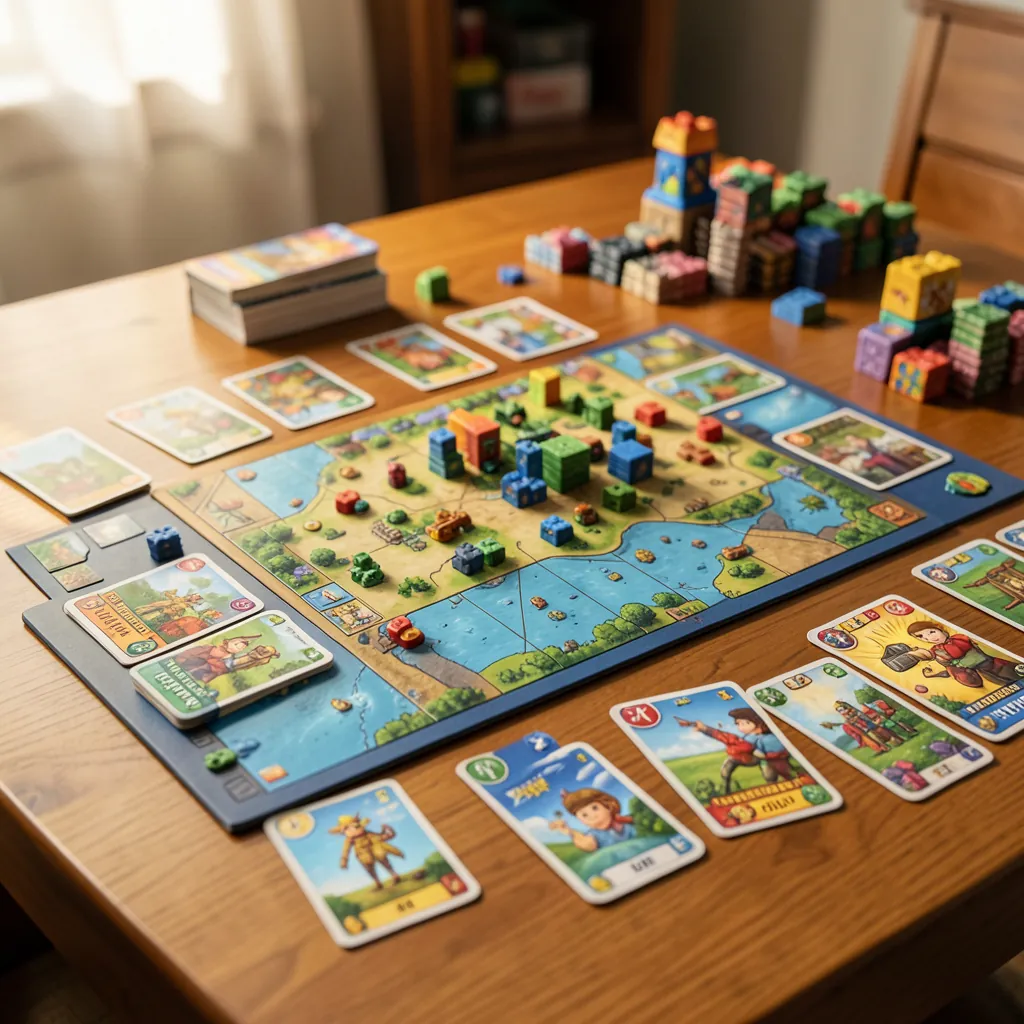
How to Play Ticket to Ride: Setup, Rules, Scoring, Strategy, and FAQ
Contents
🎲 Ticket to Ride is a route-building board game created by Alan R. Moon and first published in 2004 by Days of Wonder, in which players collect colored train-car cards to claim railway routes and complete destination tickets. Your goal is to score the most points by connecting cities, fulfilling tickets, and building the longest continuous train route.
Players: 2-5
Play Time: 30-60 minutes
Age: 8+
Difficulty: Easy
Type: Board game / route-building strategy
Edition note: the base game is commonly listed as 2-5 players, 30-60 minutes, and ages 8+, but Asmodee’s Print-and-Play “Stay at Home” version is listed for 2-4 players, and some sources mention different player counts or ages for related Ticket to Ride products. Check your specific edition before play.
Setup
- Place the game board in the center of the table.
- Each player chooses a color, takes the matching plastic train cars and score marker, and places the score marker on the scoring track.
- Shuffle the train-car deck. Deal 4 train cards to each player. Place the remaining deck beside the board and reveal 5 cards face-up in a row.
- Some rule sets say that if at least 3 face-up cards are Locomotives, the row should be flushed and replaced.
- Shuffle the destination tickets. Deal 3 destination tickets to each player. Each player must keep at least 2 and may discard the unwanted one; unchosen tickets go to the bottom of the destination deck unless your edition says otherwise.
- Choose a starting player. One guide says choose randomly; Asmodee’s Print-and-Play notes that the classic game uses the oldest player, with a different family rule for the print version. Agree on this before starting.
How to Play
-
On your turn, choose exactly one of three actions: draw train cards, claim a route, or draw destination tickets.
-
Draw train cards. Normally draw 2 train cards, either from the 5 face-up cards or from the face-down deck. Locomotives are wild and can stand in for any color. You may take only one face-up Locomotive in a turn; if you take a face-up Locomotive, that is the only card you draw that turn. If you first take a deck card or a colored face-up card, you cannot then take a face-up Locomotive. A Locomotive drawn blindly from the deck counts as one card, and you may still draw a second card.
-
Claim a route. To claim a route, play a set of train cards that matches the route’s color and length, then place that many of your train cars on the route. You score the route’s points immediately. Gray routes can be claimed with any single color of cards. Locomotives can be used as wildcards. Some routes are doubled; in 2- or 3-player games only one of those routes can be claimed, while in 4- or 5-player games both can be claimed by two different players.
-
Draw destination tickets. Draw 3 new destination tickets and keep at least 1; you may keep 2 or all 3. Each ticket shows two cities and a point value. If you connect those cities by the end of the game, you add the ticket’s points. If you do not connect them, you subtract the ticket’s value from your score.
-
Continue taking turns in order. When any player has 2 or fewer train cars left, the end game is triggered. Each player, including the player who triggered the ending, gets one final turn.
-
After the final turns, reveal destination tickets, apply ticket bonuses or penalties, award the longest continuous route bonus, and compare final scores.
Scoring
You score points immediately when you claim a route. The longer the route, the more points it is worth.
| Route length in train cars | Points scored |
|---|---|
| 1 | 1 |
| 2 | 2 |
| 3 | 4 |
| 4 | 7 |
| 5 | 10 |
| 6 | 15 |
At the end of the game:
- Add the value of each completed destination ticket.
- Subtract the value of each incomplete destination ticket.
- Award 10 points to the player with the longest continuous path of train cars on the map.
- The player with the highest final score wins.
Extra unused train cars do not affect your score. Some versions change the end-game bonus: the 1910 variant uses a 15-point Globetrotter bonus for the most completed destination tickets instead of the Longest Route bonus, while the Print-and-Play Stay at Home version says no end-of-game bonus is awarded.
💡 Strategy Tips
- Complete your destination tickets early when possible, before opponents block the routes you need.
- Claim longer routes when you can; a 5-car route scores 10 points and a 6-car route scores 15, which is much more efficient than several short routes.
- Draw extra destination tickets only when you realistically can complete them; uncompleted tickets subtract from your final score.
- Watch opponents’ networks and block key routes when it helps you, but do not neglect your own ticket connections.
- Balance drawing cards with claiming routes. Hoarding cards too long can let opponents claim the spaces you need; also remember that Ticket to Ride has a significant luck element, so even good plans can be disrupted.
🎲 Variations
Base Ticket to Ride is usually a 2-5 player game, but the Print-and-Play Stay at Home version is listed for 2-4 players, and one source mentions 2-6 players for a related product line. For 2-player play, the base game works, but in 2- or 3-player games only one track of a double route can be claimed; one source recommends the USA 1910 expansion for a more balanced 2-player ticket set. The Print-and-Play version adds a special 2-player Family Route rule: a player may claim one or two spaces on the Family Route during their turn, and claiming two spaces scores 2 points.
| Variant | Key rule change |
|---|---|
| 1910 | Uses 1910 destination tickets; the most completed tickets earns a 15-point Globetrotter bonus instead of the 10-point Longest Route bonus. |
| Mega | Combines base-game and 1910 tickets; awards both Longest Route and Globetrotter bonuses; players start with 5 tickets and keep at least 3; when drawing tickets, draw 4 and keep at least 1. |
| Cities | All destination tickets include at least one big city such as Chicago, Dallas, Houston, Los Angeles, Miami, New York, or Seattle; players start with 4 tickets and keep at least 2; when drawing tickets, draw 4 and keep at least 1; no point bonus is awarded. |
| Legendary Characters | Each player receives a special character with special rules at the start of the game. |
| Print-and-Play Stay at Home | 2-4 players; printable board and tickets; uses family roles and Family Tickets; no end-of-game bonus; Family Route rules apply. |
| Team play | One source describes splitting a team’s color into two sets of 27 trains, with teammates sharing a score marker but keeping their train supplies separate. |
❓ FAQ
How many players can play Ticket to Ride?
The base Ticket to Ride board game is commonly listed for 2-5 players. Asmodee’s Print-and-Play Stay at Home version is listed for 2-4 players, and some sources mention other player counts for related Ticket to Ride products, so check your edition’s box or rulebook.
How do you win Ticket to Ride?
Win by having the most points after the final turn. Points come from claimed routes, completed destination tickets, and the 10-point longest continuous route bonus; incomplete destination tickets subtract their value from your score.
Can you play Ticket to Ride with 2 players?
Yes. The base game works with 2 players. In 2- or 3-player games, only one track of a double route can be claimed, and one source recommends the USA 1910 expansion for a more balanced 2-player ticket set. The Print-and-Play version adds a special 2-player Family Route rule.
Is Ticket to Ride hard to learn?
No. It is usually described as easy to learn and beginner-friendly. On each turn you choose one of three actions: draw train cards, claim a route, or draw destination tickets. The main challenge is planning routes and deciding when to take ticket risks.
How long does a game take?
The base Ticket to Ride game is commonly listed at 30-60 minutes. Shorter related products, such as Ticket to Ride First Journey, are listed at about 15-30 minutes, so play time depends on the edition and player count.
What do you need to play Ticket to Ride?
The base game needs the board, train-car cards, destination tickets, plastic train cars, and score markers. One source lists the base deck as 110 train cards: 12 of each train-car type plus 14 Locomotives. The Print-and-Play Stay at Home version requires a printable board and tickets, 32 train cars per person, scoring markers, and a compatible train-car card deck from a Ticket to Ride set or expansion.
Related guides
- How to Play Sorry! — Complete Rules, Card Guide, Strategy, and Variations
- FLIP Gameplay Guide: How to Play the Digital Memory Game
- Sorry! Game Rules: Setup, How to Play, Scoring, and Variations
- How to Play Sorry!: Complete Rules, Setup, Scoring, and Variations
- How to Play Pegs and Jokers: Board-and-Peg Card Game Guide