How Do You Play Ticket to Ride? Complete Rules, Setup, Scoring, and Strategy Guide
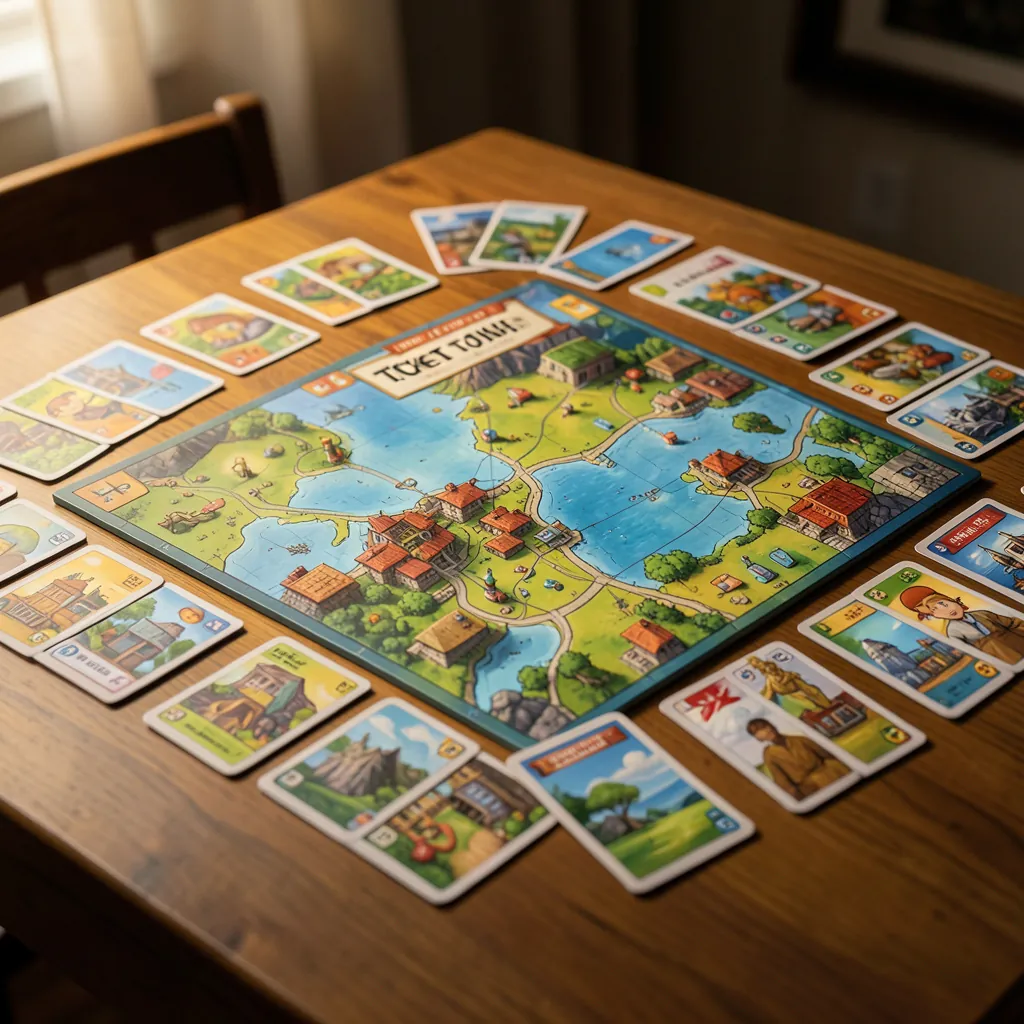
How Do You Play Ticket to Ride? Complete Rules, Setup, Scoring, and Strategy Guide
Contents
🎲 Ticket to Ride is a route-building board game where players collect colored train-car cards to claim railway routes, complete Destination Tickets, and score the most points. The goal is simple: build the best-connected rail network and finish with the highest total after the final round.
Players: 2-5
Play Time: 30-60 minutes
Age: 8+
Difficulty: Easy
Type: Board game / route-building train game
Setup
- Place the board within reach of all players. Put each player’s scoring marker on the Start/0 space of the scoring track.
- Give each player a set of colored plastic train cars and the matching scoring marker. The base game box contains 225 train cars, over 100 train cards, and 30 Destination Tickets, according to the Zavvi product listing.
- Shuffle the Train Car cards. Deal 4 Train Car cards to each player. Place the remaining deck near the board and turn the top 5 cards face-up.
- Shuffle the Destination Tickets and deal starting tickets according to your edition. In the standard base game, deal 3 Destination Tickets to each player and have each player keep at least 2. Returned tickets go back to the bottom of the deck or out of the game as your rulebook directs. Keep your kept tickets secret until final scoring.
- Put the rulebook and any edition-specific components near the board. For example, Emerald City adds Emerald Monorail cards, Drawbridge Tokens, and Bonus cards; Nordic Countries includes ferries and tunnels.
Edition note: Setup differs by version. Nordic Countries deals 5 Destination Tickets and requires keeping at least 2. Emerald City deals 1 long route ticket plus 3 regular tickets, and players keep at least 2 of the 4. Always use the setup in your specific edition’s rulebook.
How to Play
- Choose a first player. The rulebook for your edition may specify how to choose; after that, play proceeds clockwise.
- On your turn, choose exactly one of three actions: draw Train Car cards, claim a route, or draw Destination Tickets.
- Draw Train Car cards. Draw 2 Train Car cards from the face-up row and/or the deck. If you take a face-up Locomotive card, you may not draw a second card that turn. If you draw a Locomotive blindly from the deck, it still counts as one card and you may draw a second card. Locomotives are wild and can substitute for any colored Train Car card.
- Claim a route. Play a set of Train Car cards that matches the route’s color and number of spaces. Gray routes can be claimed with any single color. Place your trains on the route and score its points immediately. You cannot claim an already occupied route. Routes range from 1 to 6 spaces, and longer routes are worth more points.
- Handle double routes correctly. In a 2- or 3-player base game, only one track of a double route can be claimed; the other track is closed. In a 4- or 5-player game, both tracks can be claimed by two different players. The same player may not claim more than one track of a double or triple route.
- Draw Destination Tickets. Draw 3 new Destination Tickets and keep at least 1; you may keep 2 or all 3. Completed tickets add points at the end. Each incomplete kept ticket is subtracted from your final score.
- End your turn. The next player clockwise takes one action.
- Trigger the end game. When any player has 2 or fewer train cars left, the end game is triggered. Each player, including the player who triggered it, gets one final turn.
- Do final scoring. Add completed Destination Tickets, subtract incomplete ones, and award the longest continuous path bonus. Highest total score wins.
Edition-specific route rules: Ferries show Locomotive symbols and require one Locomotive card for each symbol. Emerald City adds Emerald Routes claimable with Emerald Monorail cards, and two Locomotive cards may substitute for one Emerald Monorail card. Drawbridges are special Emerald City routes; use the Emerald City rulebook for their exact resolution.
Scoring
Route points are scored immediately when you claim a route.
| Route length in train cars | Points scored |
|---|---|
| 1 | 1 |
| 2 | 2 |
| 3 | 4 |
| 4 | 7 |
| 5 | 10 |
| 6 | 15 |
At the end of the game:
- Add the printed value of each completed Destination Ticket.
- Subtract the printed value of each incomplete Destination Ticket you kept.
- In the base game, the player with the longest continuous path of train cars gains 10 bonus points.
- The player with the highest total score wins.
Variant scoring note: In the 1910 variant, the Longest Route bonus is replaced by a 15-point Globetrotter bonus for the player who completed the most Destination Tickets. Mega awards both the 10-point Longest Route bonus and the 15-point Globetrotter bonus. Cities awards no point bonus. Emerald City adds its own Bonus cards and scores 1 point for each unused Emerald Monorail card kept at game end.
💡 Strategy Tips
- Do not ignore Destination Tickets. Incomplete tickets are subtracted at the end, so a cheap-looking ticket can become expensive if you forget it.
- Claim valuable long routes when you can. Longer routes score disproportionately more points: a 6-car route is worth 15 points versus 10 for a 5-car route.
- Use Locomotives carefully. They are flexible wildcards, but spending them on short routes can leave you short for ferries, tunnels, or key connections.
- Watch train supply. When an opponent has 2 or fewer trains left, the final round is about to begin. Finish critical tickets before that happens.
- Block in small-player games. In 2- and 3-player base games, only one track of a double route can be claimed, so taking a key route can close off an opponent’s plan.
🎲 Variations
The sources describe official variants rather than house rules. If you use house rules, agree on them before starting.
| Edition / variant | Players | Key setup or rule difference | Bonuses / notes |
|---|---|---|---|
| Base Ticket to Ride | 2-5 | Draw 3 Tickets and keep at least 1 during play | 10 points for longest continuous path |
| 1910 | Uses base player count | Uses 1910 Destination Tickets | Globetrotter bonus: 15 points for most completed tickets instead of Longest Route |
| Mega | Uses base player count | Base + 1910 tickets; start with 5 Tickets and keep at least 3; draw 4 new Tickets and keep at least 1 | Awards both Longest Route and Globetrotter bonuses |
| Cities | Uses base player count | All tickets include at least one big city: Chicago, Dallas, Houston, Los Angeles, Miami, New York, or Seattle; start with 4 Tickets and keep at least 2; draw 4 and keep at least 1 | No point bonus |
| Legendary Characters | Uses base player count | Each player gets a special character with special rules | Character abilities vary |
| Emerald City | 2-4 individual; 2-6 team | Draw 4 Tickets and keep at least 1; uses Emerald Monorail cards, Drawbridges, and Bonus cards | Unused Emerald Monorail cards are worth 1 point each |
| Nordic Countries | Smaller-player edition; source components show 3 scoring markers | Deal 5 Destination Tickets and keep at least 2; includes ferries and tunnels | Standalone Nordic map and rules |
Conflict flag: The sources disagree on player count because they describe different products. Base Ticket to Ride is 2-5 players, while Emerald City is 2-4 players in individual play or 2-6 players in team play. Nordic Countries is a smaller-player standalone edition. Also, Destination Ticket draw counts differ by edition: base play draws 3 and keeps at least 1; Mega, Cities, and Emerald City draw 4 and keep at least 1; Nordic Countries deals 5 at setup and requires keeping at least 2.
❓ FAQ
How many players can play Ticket to Ride?
The base game supports 2-5 players. Expansions and standalone editions vary: Emerald City supports 2-4 individual players or 2-6 team players, and Nordic Countries is a smaller-player edition.
How do you win Ticket to Ride?
You win by having the highest total score after final scoring. Add route points, completed Destination Tickets, and the longest-path bonus; subtract incomplete Destination Tickets.
Can you play Ticket to Ride with 2 players?
Yes, the base game supports 2 players. In 2- and 3-player games, only one track of a double route can be claimed, so the other track is closed.
Is Ticket to Ride hard to learn?
No. It is generally considered easy to learn: the Zavvi listing says it can be learned in under 15 minutes. Each turn is one of three simple actions, though route planning and blocking add strategy.
How long does a game of Ticket to Ride take?
A typical game runs about 30-60 minutes. Actual time depends on player count, edition, and how quickly players take their turns.
What do you need to play Ticket to Ride?
You need the board, plastic train cars, scoring markers, Train Car cards, Destination Tickets, and the rulebook. The base game includes 225 train cars, over 100 train cards, and 30 Destination Tickets. Some expansions require components from a base Ticket to Ride set.
Related guides
- How to Play Sorry! — Complete Rules, Card Guide, Strategy, and Variations
- FLIP Gameplay Guide: How to Play the Digital Memory Game
- Sorry! Game Rules: Setup, How to Play, Scoring, and Variations
- How to Play Sorry!: Complete Rules, Setup, Scoring, and Variations
- How to Play Pegs and Jokers: Board-and-Peg Card Game Guide