How to Play Hasbro Sorry!: Rules, Setup, Scoring, and Variations
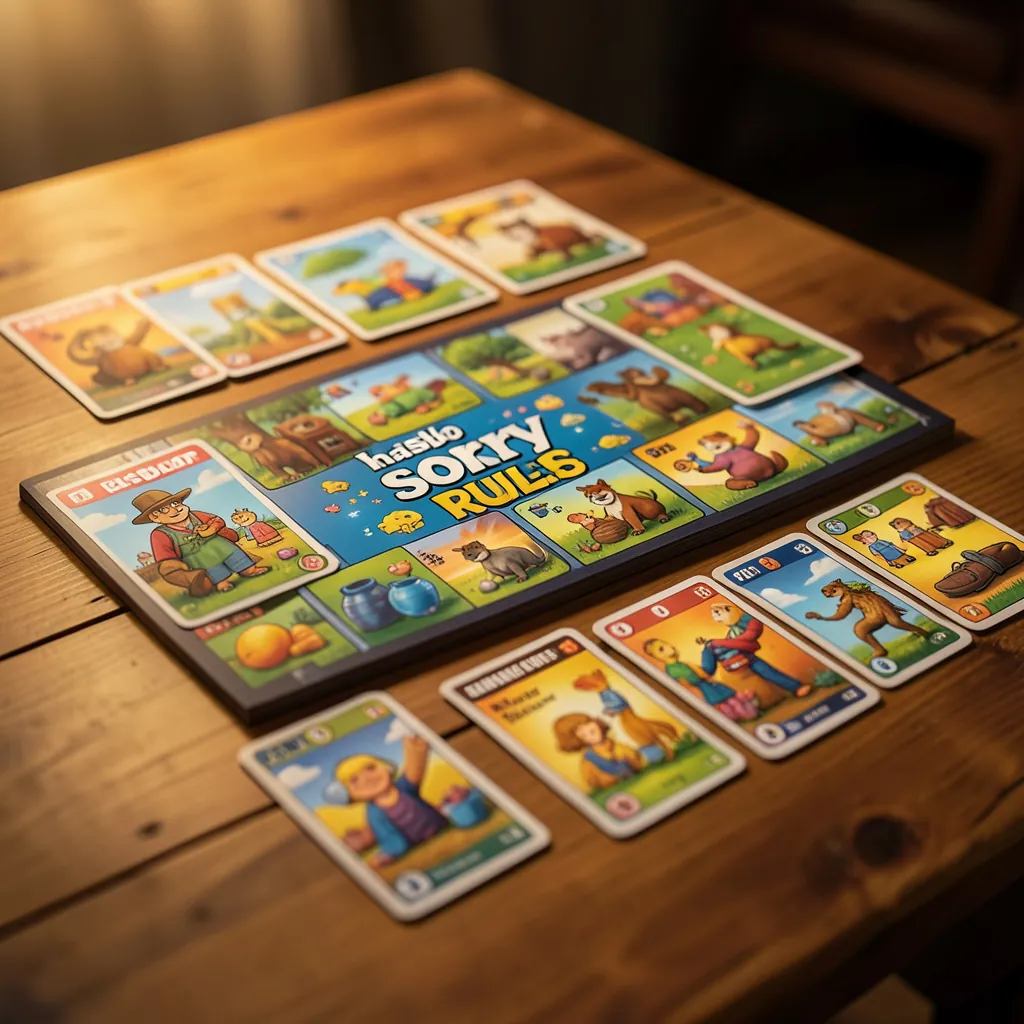
How to Play Hasbro Sorry!: Rules, Setup, Scoring, and Variations
Contents
🎲 Sorry! is a Hasbro family race game: draw cards (or spin in the Road Trip edition), move pawns from Start to Home, and bump opponents back to Start. The goal is to get all your pawns into Home first. Rules vary by edition—current Hasbro standard listings often use three pawns per player, while older/other editions use four.
Players: 2–4
Play Time: Not specified in the cited Hasbro sources
Age: 6+
Difficulty: Easy (Hasbro lists ages 6+)
Type: Family board-and-card race game
Setup
Which Sorry! version are you playing?
| Edition / source | Players | Pawns and win target | Cards or randomizer | Noted extras | Age |
|---|---|---|---|---|---|
| Hasbro Gaming Road Trip Series Sorry! | 2–4 | 16 plastic pawns; first to get all 4 of their own pawns Home | Spinner | Portable case; “Stop Sign” spaces may move a pawn forward or back 2 depending on car speed | 6+ |
| Hasbro Sorry! standard listing | 2–4 | 12 pawns; first to get all 3 of their own pawns Home | 45 cards | — | 6+ |
| Hasbro Sorry! Game | 2–4 | 12 pawns; first to get all 3 of their own pawns Home | 44 cards | 2 power-up tokens | 6+ |
| 1939 U.S. Sorry! rules | Not stated in the excerpt; classic four-color setup | 4 pawns per player; first to get all 4 Home | 44 cards | Partnership Sorry! and Point Scoring Sorry! variants | Not stated |
| Sorry! 1998 video game | Digital game, not a tabletop component list | Standard Sorry! rules | 45 standard cards + 9 “Way Sorry!” cards | Classic and Strategy modes; house rules | Not stated |
The sources conflict on some specs: one Hasbro listing says 45 cards, while another Hasbro listing and the 1939 rules say 44 cards. Current Hasbro standard listings use 3 pawns to win, while the Road Trip edition and 1939 rules use 4. Always use the rulebook and printed cards in your own box when they differ.
Standard card-game setup
- Give each player one color and keep that color’s pawns in its Start area until a card lets you bring one out.
- Shuffle the deck and place it face down in the center of the board.
- In the 1939 rules, each player draws a card to determine the Leader; the highest card is the Leader, and a Sorry! card counts highest. The Leader plays first.
- Do not deal a hand in standard Sorry!; players draw one card on each turn.
- If your edition has power-up tokens, place them as directed by that edition. The cited Hasbro listing names the tokens but does not describe their powers.
- For the Point Scoring variant in the 1939 rules, deal 5 cards to each player, place the rest as a draw pack, and start one pawn out for each player.
How to Play
- On your turn, draw the top card and place it face up, then complete your move before the next player draws. In the Road Trip edition, spin the spinner instead.
- To bring a pawn out of Start in the classic card game, you must draw a 1, 2, or Sorry! card. Place the pawn on the colored circle in front of your Start. If you use a 1 or 2 to Start a pawn, you do not also move it forward that turn.
- Move one pawn the full number shown or make a legal alternate move. Count every square, even occupied ones, and you may jump over pawns. You cannot land on a square occupied by another pawn. If your only legal move would land on your own pawn, you forfeit the move.
- If you land on an opponent’s pawn on a margin square, return that opponent’s pawn to its Start.
- For 3, 5, 8, or 12, move a pawn forward that many spaces. If you cannot move the full number, you forfeit the move.
- For 2, either Start a pawn or move one pawn forward 2; after completing the 2, take the extra draw.
- For 4, move a pawn backward 4. If your only pawn in play is in the Safety Zone, you must move it backward 4.
- For 7, split the 7 between two pawns, counting the full 7 squares. You may use a split 7 to move a pawn Home if another pawn completes the full 7, to return two opponents to Start, to use two slides, or a combination. A 7 cannot Start a pawn and cannot move a pawn backward.
- For 10, move a pawn forward 10 or backward 1. If you cannot or do not wish to move forward 10, you must move backward 1, even from the Safety Zone.
- For 11, move a pawn forward 11 or swap places with an opponent’s pawn on a margin square. If you can do neither and do not wish to swap, forfeit the move.
- Slides: If a pawn ends its move on the colored triangle at the start of a slide, and it is not that pawn’s own color, it must slide to the other end and remove every pawn on the slide—even your own—sending them back to Start. A pawn does not slide when it ends on a triangle of its own color.
- Safety Zone and Home: Only a pawn of the matching color can enter its Safety Zone, and only by a forward move from the entrance square. Opponents cannot enter it. A pawn needs the exact number to move into Home; once in Home it is out of play. If a card would carry your only movable pawn beyond Home, forfeit the move. A 4 or 10 can force a pawn backward out of the Safety Zone through the entrance.
- When the deck is exhausted, reshuffle the discards and continue. The first player to get all required pawns from Start to Home wins.
What does each Sorry! card do?
| Card | Rule |
|---|---|
| 1 | Start a pawn OR move one pawn forward 1. When used to Start, do not also move forward. |
| 2 | Start a pawn OR move one pawn forward 2; then take the extra draw. |
| 3, 5, 8, 12 | Move forward that many spaces; if you cannot move the full number, forfeit. |
| 4 | Move backward 4; special Safety Zone rule applies if your only pawn is there. |
| 7 | Split the 7 between two pawns; cannot Start a pawn or move backward. |
| 10 | Move forward 10 OR backward 1; must move backward 1 if unable or unwilling to move forward 10. |
| 11 | Move forward 11 OR swap with an opponent’s pawn on a margin square; if neither is possible, forfeit. |
| Sorry! | The 1939 rules allow it to Start a Pawn Out and count it highest for the opening draw. Use the printed Sorry! card in your edition for its full bump wording. |
The 1939 pack has no 6 or 9 cards.
Scoring
Standard Sorry! does not use a point total. The winner is the first player to move every one of their pawns from Start to Home: 3 pawns in current Hasbro standard listings, or 4 pawns in the 1939 rules and Road Trip edition. Once a pawn reaches Home, it is out of play and is not moved again.
The 1939 rules also describe a separate “Point Scoring Sorry!” variant with a five-card hand, but the excerpt provided does not include the point values; use that edition’s scoring chart if you play it. In Partnership Sorry!, the first partnership to get all 8 pawns Home wins.
💡 Strategy Tips
- Push pawns that are close to Home. A pawn near its Safety Zone is more valuable than one still near Start.
- Use 7s flexibly. A split 7 can move two pawns, bump two opponents, or help finish a pawn Home if the full 7 is counted.
- Treat the Safety Zone as shelter, not a safe forever spot. Opponents cannot enter, but a 4 or 10 can force you backward out of it.
- Watch slide triangles. Landing on an opponent-colored slide triangle can clear the slide, but it also bumps every pawn on it—including your own.
- Avoid beginner mistakes: remember the extra draw after a 2, remember that a 7 cannot Start a pawn, count every square when jumping, and do not forget that landing on your own pawn is not allowed.
🎲 Variations
- 2-player play: Hasbro lists Sorry! for 2 to 4 players, so two can play; the cited sources do not give a separate two-player rule.
- Faster game: The 1939 rules suggest using 3 pawns per player instead of 4. Current Hasbro standard editions already use 3.
- Road Trip edition: Uses a spinner instead of cards, 16 pawns, a portable click-in case, and Stop Sign spaces that may move a pawn forward or back 2 depending on car speed.
- Partnership Sorry!: Red and Yellow are partners; Green and Blue are partners. A drawn card may be used for your own pawn or your partner’s, and the first partnership to get all 8 pawns Home wins.
- Point Scoring Sorry!: Deal 5 cards to each player, start one pawn out, play one card, then refill to 5. The full point chart is not included in the cited excerpt.
- Way Sorry! digital variation: The 1998 video game adds 9 cards—Happy, Punish, Buddy, Bully, and Way Sorry!—with two each of the first four and one Way Sorry! card. It also offers Classic draw-deck and Strategy hand-of-cards modes.
❓ FAQ
How many players can play Sorry!?
Hasbro lists Sorry! for 2 to 4 players. Older editions may not state the player count in the excerpt, but the classic board uses four colors.
How do you win Sorry!?
Be the first to move all your pawns from Start to Home. Check your edition: current Hasbro standard listings use 3 pawns, while the 1939 rules and Road Trip edition use 4.
Can you play Sorry! with 2 players?
Yes. Hasbro lists the game for 2 to 4 players. The cited sources do not provide a separate two-player rule, so use the standard rules with two colors.
Is Sorry! hard to learn?
No. Hasbro lists it for ages 6+, and it is an easy family game. The trickiest rules are the split 7, slides, and exact counting into Home.
How long does a Sorry! game take?
The cited Hasbro sources do not state a play time. Check your edition’s box or rulebook for an official estimate.
What do you need to play Sorry!?
A standard Hasbro Sorry! set needs a board, pawns, and cards. The cited listings conflict on components: one says 12 pawns and 45 cards, another says 12 pawns, 44 cards, and 2 power-up tokens, and the Road Trip edition uses 16 pawns and a spinner.
Related guides
- How to Play Sorry! — Complete Rules, Card Guide, Strategy, and Variations
- FLIP Gameplay Guide: How to Play the Digital Memory Game
- Sorry! Game Rules: Setup, How to Play, Scoring, and Variations
- How to Play Sorry!: Complete Rules, Setup, Scoring, and Variations
- How to Play Pegs and Jokers: Board-and-Peg Card Game Guide