How to Play Spoons: Rules, Setup, Scoring, and Variations
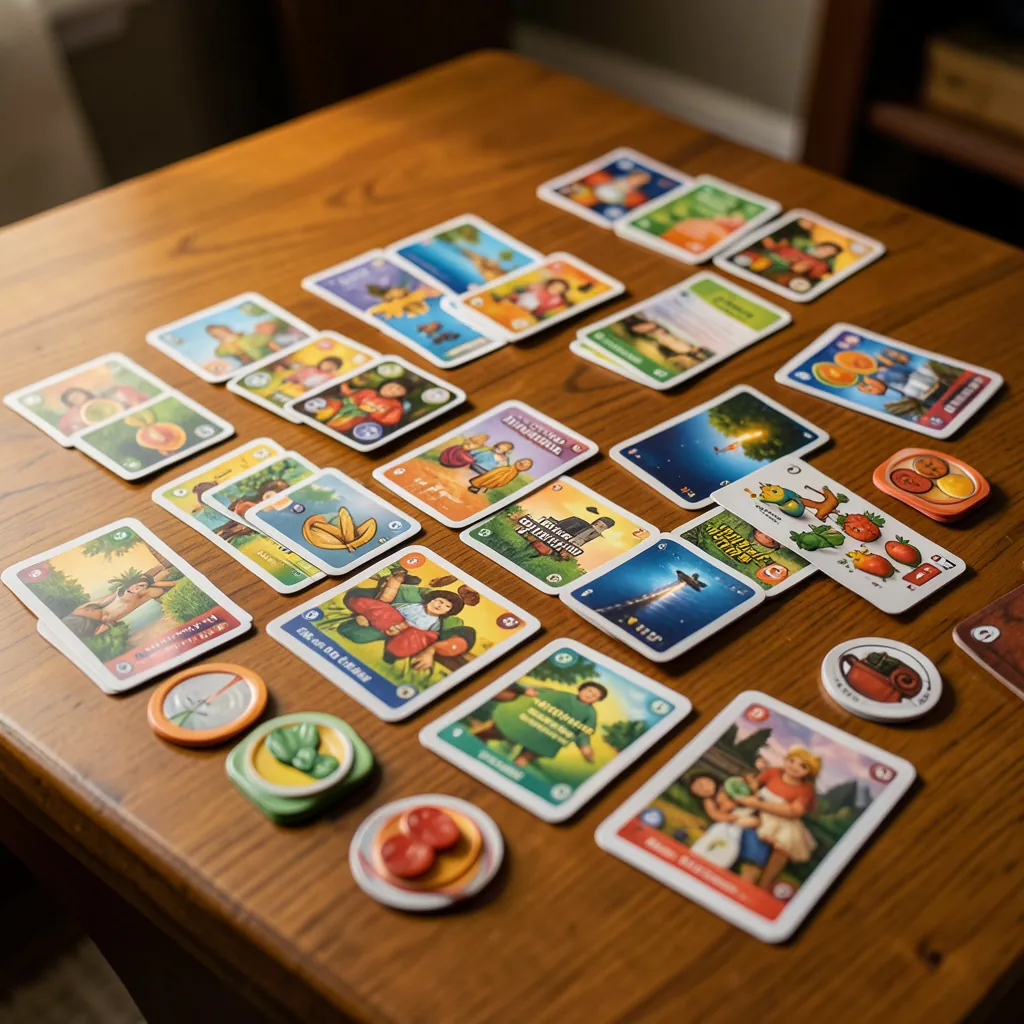
How to Play Spoons: Rules, Setup, Scoring, and Variations
Contents
🃏 Spoons is a fast card game where players pass cards around a circle, race to make a matching hand (usually four of a kind), then grab from a spoon pile that has one fewer spoon than players. The goal is to avoid being the player left without a spoon—or in letter/elimination play, to survive until one player remains; versions differ on runs, letters, points, and “Razzing” powers.
Players: 3–8 (classic; Source 1 recommends 6+)
Play Time: Not specified by sources; rounds are fast, so play to an agreed number of rounds, a spelling word, or 100 points (Source 2)
Age: Not specified by sources; family/kid-friendly in Sources 1 and 5
Difficulty: Easy
Type: Matching/shedding card game (not trick-taking)
Setup
Before dealing, agree on which version you are playing. The sources describe related but different games: classic four-of-a-kind Spoons, letter/elimination Spoons, and a “Razzing” shedding version with special card powers.
Which Spoons version matches your group?
| Feature | Classic Spoons (Sources 1, 3, 5, 7) | Razzing/power Spoons (Source 2) | Letter/conjugation variants (Sources 3, 4, 5) |
|---|---|---|---|
| Players | 3–8 per Source 6; Source 1 says 6+ | Hand-size rules given for 3–4 and 5–6 players | Often 4+; Source 4 is a classroom conjugation variant |
| Cards | One 52-card deck, no jokers | Two 52-card decks shuffled together | One deck; extra decks allowed for large groups (Source 3) |
| Hand size | 4 cards (5 in Source 4 conjugation version) | 5 base; 6 with 5–6 players; 7 with 3–4 players (Source 2 wording) | 4 cards classic; 5 cards in Source 4 |
| Spoons | N−1 | N−1 | N−1 |
| First spoon grab | When a player makes four of a kind; Source 3 also allows a four-card run | Only when a Jack is played | When a player makes the target hand |
| Round end | First spoon grab; one player is left without a spoon | A player runs out of cards | First spoon grab; one player is left without a spoon |
| Scoring/win | Letters S-P-O-O-N-S, immediate elimination, or Source 1’s 5-point no-elimination option | Leftover-card points; fewest points after agreed rounds/100 points wins | Spell S-P-O-O-N-S (or S-P-O-O-N in Source 5); last player wins |
Classic Spoons setup
- Seat players in a circle and place spoons in the center within everyone’s reach. Use one fewer spoon than players: 8 players = 7 spoons; 6 players = 5 spoons (Sources 1 and 5).
- Shuffle one standard 52-card deck without jokers and choose a dealer or leader.
- Deal 4 cards to each player (Sources 1, 3, 5, 7). Put the remaining deck face down as a draw pile.
- Set a discard area for cards passed past the last player. Sources vary on where this pile goes—Source 1 uses a central discard pile, while Source 3 places discards near the dealer to reuse when the draw pile runs out.
- Decide house rules before play: four of a kind only or four of a kind/four-card run; pass left or right; elimination, letters, or points.
Razzing/power Spoons setup (Source 2)
- Shuffle two standard 52-card decks together. Place N−1 spoons in the center.
- Deal 5 cards to each player; Source 2 says deal 6 with 5–6 players and 7 with 3–4 players. Put the rest face down and turn the top card face up to start the discard pile.
- The dealer chooses a Razzing Phrase such as “Doh!” or “Pickles!”.
- Use this version only if you want a shedding/matching game with special powers; it is not the classic four-of-a-kind spoon rush.
How to Play
Classic Spoons (most common)
- The dealer takes the top card from the draw pile. They either keep it and discard one card from their hand, or pass the drawn card face down to the next player. Sources show both left and right passing, so choose one direction and keep it consistent.
- The next player takes the incoming card and makes the same choice: keep-and-discard or pass it on. Every player should keep the same hand size—usually four cards—at all times.
- Continue rapidly around the circle. The last player in the chain discards into a central discard pile (Source 1); other groups place discards near the dealer and reuse that pile when the draw pile runs out (Sources 3 and 5).
- If the draw pile empties, reshuffle or reuse the discard pile and keep playing (Sources 3 and 5).
- As soon as a player has four of a kind—or a four-card run if using Source 3’s house rule—they grab a spoon from the center. They may grab quietly or loudly (Sources 3 and 5).
- After the first spoon is taken, everyone else may grab a spoon; you do not need a matching hand once the rush starts (Source 1). Use one spoon per player.
- The player without a spoon loses the round. In elimination play they are out; in letter play they get an “S” and stay in until eliminated by spelling. Reshuffle and deal the next round with N−1 spoons for remaining players.
- Continue until one player remains or the agreed scoring game ends. Source 1 says the last two players standing win; letter versions say the last player wins—choose one ending before play.
Razzing/power Spoons (Source 2)
- Going clockwise from the dealer, each player either draws a card or plays a card that matches the top discard in suit or rank.
- To play a card, call out its rank and place it face up on the discard pile. You may draw instead even if you can play; if you draw a card that can be played immediately, you may play it.
- The objective is to get rid of all your cards. Once you have one card left, announce that you have one card left.
- King: after playing a King, name another player. They must say the Razzing Phrase and draw two cards. If they also have a King, they can play it and bounce the draw back to you, increasing the draw amount by one.
- Queen: say “Reverse” to reverse the direction of play.
- Jack: everyone yells “Spoons” and grabs a single spoon. Whoever ends up without a spoon must say the Razzing Phrase and draw two cards. If someone grabs two spoons or two people fight over a spoon, they draw instead.
- Ten: say “Repeat”; it is your turn again.
- Eight: call out a new suit, such as “Hearts.” The discard pile is now that suit, regardless of the eight’s actual suit.
- Two: this begins a count phase. Only twos and aces can be played, and each adds 1 or 2 to the count. The first player unable to play an ace or two must say the Razzing Phrase and draw as many cards as the current count.
- Razzing: if a player makes an error, point at them and make a buzzing sound. The razzed player draws a card and says the Razzing Phrase. Errors include not naming the card played, missing or saying the wrong Razzing Phrase, playing out of turn, not announcing one card left, concealing hand size, or razzing someone who did not err or whose error was more than 2 turns ago.
- The round ends when one player runs out of cards. Do not grab spoons at that moment in Source 2’s Razzing rules; spoon-grabbing happens only when a Jack is played. Remaining players score their leftover cards.
Scoring
Classic letter/elimination scoring
- In letter play, the player left without a spoon gets a letter. Sources use S-P-O-O-N-S (Sources 3, 4, and 7) or S-P-O-O-N (Source 5). When a player completes the word, they are out. The last player wins.
- Source 1 uses immediate elimination instead: the player without a spoon is out, and the last two players standing win. Source 6 says the next round uses N−2 spoons and play continues until only one player is left.
- Conflict note: choose either letter accumulation or immediate elimination before starting; the sources do not agree on one universal elimination rule.
Source 1 no-elimination point option
- Award 5 points to every player who grabs a spoon each round. The player without a spoon gets 0 points.
- No one is eliminated. After an agreed number of rounds, the highest total wins. Source 1 does not specify the ending score, so set it before play.
Source 2 Razzing scoring
- When one player runs out of cards, the round ends. Remaining players score points for the cards left in their hands: 10s and 8s = 6 points; face cards = 4 points; 2s = 2 points; everything else = 1 point.
- The dealer moves left and a new round begins. After an agreed ending such as 10 rounds or 100 points, the player with the fewest points wins.
Conflict note: when do you grab spoons?
Classic Spoons starts the first spoon grab when a player completes a matching hand, usually four of a kind. Source 6 describes a different shedding variant where discarding your last card triggers spoon-grabbing. Source 2’s Razzing version conflicts with that: a player running out of cards ends the round, and spoons are grabbed only through the Jack power. Do not mix these triggers.
💡 Strategy Tips
- Keep your hand at the required size—usually four cards in classic Spoons. A common beginner mistake is holding too many cards or passing too slowly.
- Decide fast. The game rewards quick keep-or-pass choices, so pick your discard immediately.
- Watch the spoon pile, not just your cards. The first grab may be quiet, so use peripheral vision.
- Do not announce your matching hand. Keep a neutral expression, then grab a spoon quietly or loudly depending on the group’s style.
- In Razzing Spoons, call out every card name, power, phrase, and “one card left” announcement. False razzing and missed powers give away penalty cards.
🎲 Variations
- Four-card run: Source 3 allows a player to win with four of a kind or four cards in a row, such as 2-3-4-5.
- Large groups: add extra decks and keep one fewer spoon than players; use plastic spoons for rowdy groups (Source 3).
- No elimination: use Source 1’s 5-points-per-spoon-grabber rule and keep everyone playing.
- Spelling variants: use S-P-O-O-N-S (Sources 3, 4, and 7) or S-P-O-O-N (Source 5).
- Razzing/power version: use Source 2’s two-deck shedding game with King, Queen, Jack, Ten, Eight, and Two powers plus leftover-card scoring.
- Classroom/conjugation version: Source 4 deals five cards and asks players to collect all five conjugations of the same verb before grabbing a spoon.
- Movement version: place spoons outside the circle or hide them so players must run or search after someone gets four of a kind (Source 5).
- Player count/hand size: Source 2 scales hand size to 7 cards for 3–4 players and 6 cards for 5–6 players; Source 6 lists 3–8 players for classic Spoons.
❓ FAQ
How many players can play Spoons?
Classic Spoons is commonly listed for 3–8 players (Source 6), though Source 1 recommends 6 or more. Source 2’s Razzing version gives hand-size rules for 3–4 and 5–6 players. You need one fewer spoon than players, and extra decks can help large groups.
How do you win Spoons?
In classic letter/elimination play, avoid being the player without a spoon and be the last player not eliminated; Source 1 also offers a 5-point variant. In Source 2’s Razzing version, the player with the fewest leftover-card points after the agreed rounds or 100 points wins.
Do you grab a spoon when a player runs out of cards?
Not in Source 2’s Razzing rules. There, a player running out of cards ends the round, and spoons are grabbed only when a Jack is played. Source 6 describes a different shedding version where discarding the last card triggers spoon-grabbing; that conflicts with Source 2 and should not be mixed with classic Spoons.
Can you play Spoons with 2 players?
The sources do not give a standard 2-player rule set. Source 6 says the patented variant may be played by two or more, but classic instructions focus on 3–8 players. With N−1 spoons, a two-player game has only one spoon, so you would need a house rule for rounds and elimination.
How long does a game take?
The sources do not state an exact play time. Classic rounds are fast; length depends on whether you play until one player remains, until someone spells S-P-O-O-N-S, for a set number of rounds, or to 100 points in Source 2.
What do you need to play Spoons?
For classic Spoons: one standard 52-card deck without jokers, spoons one fewer than players, and 3–8 players. Source 2’s Razzing version uses two 52-card decks and a chosen Razzing Phrase; Source 4’s classroom version uses five cards per player to collect verb conjugations.
Related guides
- How to Play Phase 10: Rules, Scoring, and Strategy
- How to Play War: Rules for the 2-Player Card Game
- 5 hundred card game
- 🃏 How to Play 500: The Complete Card Game Guide