How to Play Spar: Rules for a Fast Two-Player Card Game
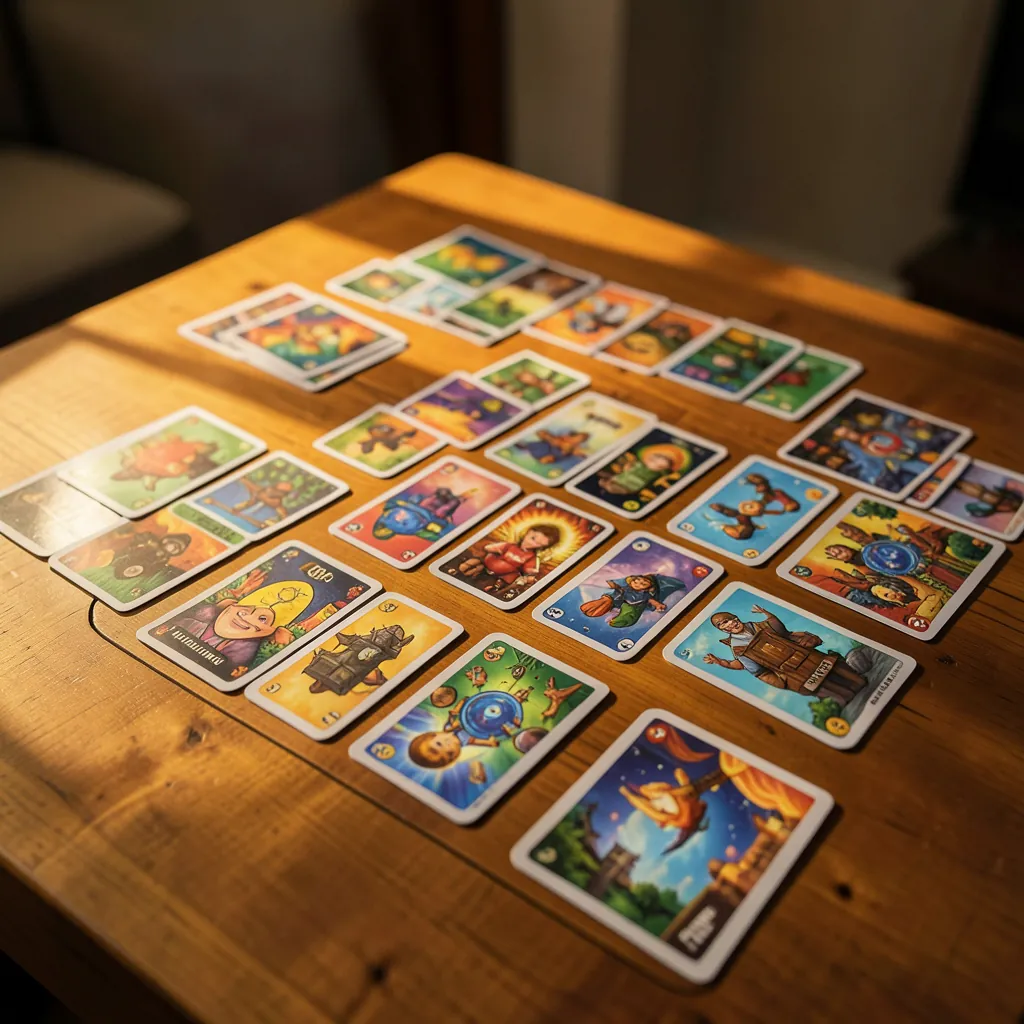
How to Play Spar: Rules for a Fast Two-Player Card Game
Contents
- Setup
- How to Play
- Scoring
- 💡 Strategy Tips
- 🎲 Variations
- How does Spar compare with other fast card games?
- ❓ FAQ
🃏 Spar is a fast, head-to-head card duel played with a standard 52-card deck, built on trumps, rank battles and a unique “parry” that cancels an attack. Players trade attacks and defences in short exchanges, and the goal is simple: win 3 exchange points to take a round, then take the match (best of five rounds, or first to three rounds).
Players: 2 in the base game (3–4 with the multi-player variant) Play Time: Short rounds — the source says a round “fits into a coffee break”; a match runs best of five rounds Age: Family, teens and adults (the source gives no numeric minimum age) Difficulty: Easy — compact rules, with optional layers for depth Type: Trump-based card duel (trick-taking-style exchanges) on a standard 52-card deck
Setup
- Use a standard 52-card deck with no jokers.
- Shuffle the deck thoroughly.
- Deal 6 cards face down to each player.
- Turn the next card face up. Its suit is the trump suit for the round.
- Place the remainder face down as the shared draw pile.
- Choose the first attacker. Either flip a coin, or have the previous round’s dealer let the non-dealer take the first initiative as the attacker.
- Optionally grab pencil and paper to track round scores — the source lists this as optional.
How to Play
Spar is played in exchanges. Each exchange has four steps, repeated until the round ends.
- Initiate. The attacker chooses one card from their hand and plays it face up.
- Respond. The defender must choose one of four options:
- Beat it with a higher card of the same suit, or
- Beat it with any trump (legal only if the attacker did not play a trump), or
- Parry with a card of the exact same rank (any suit) — both cards are discarded and no point is awarded, or
- Concede — if they cannot or choose not to beat the card, they lose the exchange.
- Resolve the exchange.
- If the attacker wins (defender conceded or couldn’t beat the card), the attacker gains 1 exchange point and keeps the initiative.
- If the defender beats the attack, the defender wins the exchange and becomes the attacker for the next exchange.
- If the defender parries, both cards are discarded, the parry succeeds, and the defender becomes the attacker.
- Refill hands. After the exchange resolves, both players draw from the draw pile back up to 6 cards. The winner of the exchange draws first.
Rank order: Ace is high, then King down to 2 (low). A card beats another if it is higher in the same suit, or if it is a trump while the other card is not.
Special mechanics (optional):
- Double Strike: The attacker may play two cards of the same rank as a double strike. The defender must beat both with two higher cards in the corresponding suits, or two trumps, or parry with a pair of the same rank. If the defender fails, the attacker gains 2 exchange points. It’s powerful but costs two cards from hand.
- Reveal Feint: Playing a Jack as an opening attack forces the defender to reveal one random card from their hand before choosing a response.
Scoring
- 1 exchange point for winning an exchange as the attacker (including when the defender concedes).
- 2 exchange points for a successful Double Strike.
- 0 points to either side when an attack is parried — both cards are simply discarded.
- A round ends when one player reaches 3 exchange points, or when the draw pile is exhausted.
- If the deck runs out, the player with more exchange points wins the round. A tie at that point is settled by a sudden-death exchange: each player plays one card, and the higher card wins.
- The match is usually best of five rounds, or first to three rounds — the source uses both formulations.
💡 Strategy Tips
- Count trumps and high ranks. Knowing which power cards remain tells you whether to press an attack or conserve a trump for defence.
- Bait with low cards. Lead small to force the opponent to burn a trump or a high card early; small plays shift the balance later.
- Don’t waste parries. A parry keeps your tempo, so save it for attacks that actually matter rather than conceding cheaply on low-value cards.
- Time your Double Strikes late. Save the two-card play for moments when the defender is unlikely to hold two answers — late-deck pressure is ideal.
- Remember the draw order. The exchange winner draws first, so every won exchange is a small but real card-selection advantage.
- Common beginner mistake: treating every attack as worth winning. Conceding a low-value exchange to keep cards in hand is often the stronger play.
🎲 Variations
- 3–4 players (official variant): Reduce each player’s hand to 4 cards and play in clockwise order. The attacker targets the player on their left as defender, exchange points are tracked individually, and the first to 3 points still wins the round. This makes the game more political — target choice and table dynamics matter.
- Double Strike and Reveal Feint are modular additions; the source recommends starting with the basic 6-card setup, then adding them once players are comfortable.
- 2 players is the base game described above — no changes needed.
- Player-count conflict flagged: the source’s player-count field lists “2, 3, 4, 5+”, but the written variants only describe rules for 3–4 players. No separate 5+ player rules are given, so treat the 5+ listing as unverified rather than inventing a format.
How does Spar compare with other fast card games?
| Game | Players | Play time | What you need | How you win |
|---|---|---|---|---|
| Spar | 2 (3–4 with variant) | Short rounds; match = best of 5 rounds | Standard 52-card deck, no jokers | First to 3 exchange points per round; first to 3 rounds takes the match |
| Falling (James Ernest / Cheapass Games) | 4–8 (1 dealer + 3–7 players) | ~90 seconds per game | Custom deck: Ground, Rider and Action cards | Last player to receive a Ground card wins |
| Speed (aka Spit / Slam) | 2 | Not stated in source | Standard deck; jokers optional as wilds | First to play all your cards |
| Hyper Jinx! | 2–6 | 30–60 (per listing) | Each player has their own deck | Clear your Jinx! pile and shout “JINX!” |
| Nine Lives | 2–4 | ~10 minutes | 54-card poker deck | Last player left with cards |
| PAIRZI (TENZI) | 2–6 | Not stated in source | 60 multi-colored + 60 yellow Critter Cards, 6 pairs of dice | First to find matching pairs of Critter Cards |
Note: Hyper Jinx!’s listing presents “30-60 / 2-6 / 14+” in an unlabeled requirements box; they are read here as play time, player count and minimum age.
❓ FAQ
How many players can play Spar? Two players in the base game. A written variant supports 3–4 players with a reduced 4-card hand played clockwise. The source’s player-count field also mentions “5+”, but no 5+ rules are provided.
How do you win at Spar? Win exchanges to earn exchange points; the first player to 3 exchange points wins the round. Take the match by winning the best of five rounds (or first to three rounds, depending on the agreed format).
Can you play Spar with 2 players? Yes — 2 players is the base game, not a variant. You each get 6 cards, one card is turned up to set trump, and the rest forms the draw pile.
Is Spar hard to learn? No. It uses familiar mechanics — trumps, rank comparisons and a same-rank parry — and the source calls it “compact by design.” Optional Double Strike and Reveal Feint add depth once you know the basics.
How long does a game of Spar take? Rounds are deliberately short, with the source noting a round “fits into a coffee break.” A full match runs up to five rounds, so expect a session rather than a single hand.
What do you need to play Spar? One standard 52-card deck with no jokers, two players (or 3–4 for the variant), and optionally pencil and paper to track round scores.
Related guides
- How to Play Phase 10: Rules, Scoring, and Strategy
- How to Play War: Rules for the 2-Player Card Game
- 5 hundred card game
- 🃏 How to Play 500: The Complete Card Game Guide
- 500 Card Game Rules: How to Play Five Hundred