What Is the Card Game Speed? Rules, Setup, and How to Play
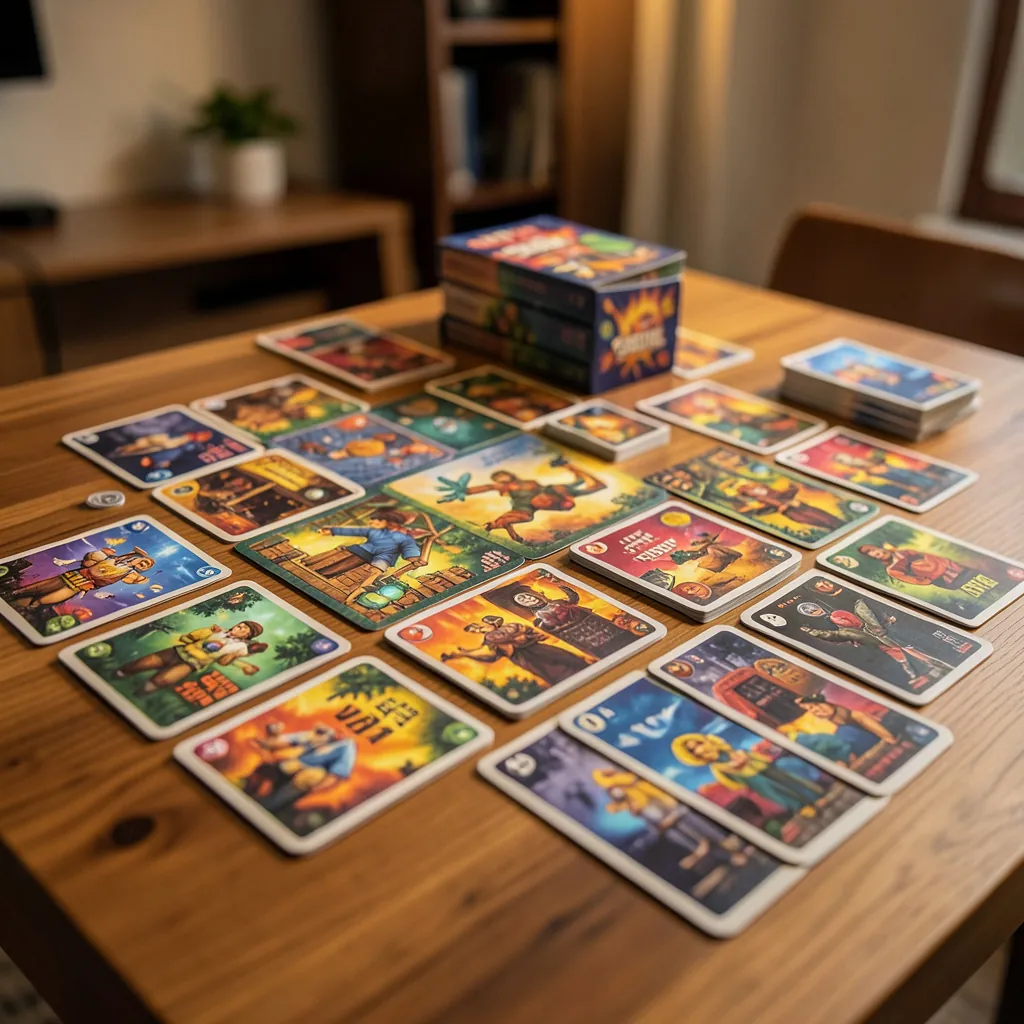
What Is the Card Game Speed? Rules, Setup, and How to Play
Contents
🃏 Speed is a fast, non-turn-based shedding card game in which two players race to empty a five-card hand and a 15-card draw pile using a standard 52-card deck. Players simultaneously place cards one rank above or below the two center piles; the first to shed all cards and call “Speed” wins the round.
Players: 2 in standard play; 3–4 player variants are described (Source 1 also says 2+)
Play Time: Fast-paced; no fixed length, often played best two out of three
Age: 10+ in Source 3; Source 1 lists a 5–100 age range
Difficulty: Easy to learn, but speed and quick counting matter
Type: Shedding-type card game
Setup
The standard two-player layout is usually described as a 5-15-5-1-1 setup: each player has a five-card hand and a 15-card draw pile, with two five-card replacement piles and two one-card center piles between them. Sources use different names for these piles, so the table below translates the common terms.
| Setup element | Standard two-player version | Source notes / conflicts |
|---|---|---|
| Deck | Standard 52-card deck | Sources 3–5 |
| Each player’s hand | 5 cards | Sources 1, 3, 4, 5 |
| Each player’s draw/stock pile | 15 cards face down | Sources 1, 3, 4, 5; Source 4 says use 16 if jokers are included |
| Replacement piles | Two 5-card piles face down between players | Sources 3–5 |
| Center play piles | Two 1-card piles face down between players | Sources 3–5; Source 1 also describes flipping center cards to begin |
| Standard player count | Usually 2 | Source 3 lists 2; Source 1 says 2+ and describes 3–4 player variants |
Setup steps
- Shuffle a standard 52-card deck.
- Deal each player 5 cards for their hand.
- Deal each player 15 cards face down as their draw pile.
- From the remaining 12 cards, form a row between the players: 5-card pile, 1-card pile, 1-card pile, 5-card pile, all face down. Source 3 describes this as the 5-1-1-5 pattern.
- Each player picks up their five-card hand. The draw pile and replacement piles stay face down.
- To begin, turn up the two center one-card piles; players often flip one each simultaneously.
Source conflicts to settle before play
- Same-number plays: Source 1 allows cards that are one rank above, one rank below, or the same number; most app-style rules in Sources 3–5 describe only one rank higher or lower. Agree before starting.
- “Spit” and “Slam” naming: Sources 4–5 call Speed “Spit” or “Slam,” while Source 1 treats Spit as a related but distinct game with a different tableau layout.
- Player count and age: Source 3 presents Speed as a two-player game for ages 10+, while Source 1 lists 2+ players and a 5–100 age range.
How to Play
- Start together. Turn up the two center cards, and both players begin at the same time. Speed is not turn-based.
- Play a legal card. On either center pile, play a card that is one rank higher or lower than the top card. For example, on a 5 you can play a 4 or a 6; on a Queen you can play a Jack or a King. Aces loop: an Ace can be played on a King or a 2, and a 2 can be played on an Ace. Source 1 also allows same-number matches as an optional rule.
- Play one card at a time. Only one card can be placed per play. Source 1 also says to use only one hand and not to shuffle or delay the game. If you have a legal card, you are expected to play it.
- Refill your hand. Whenever your hand drops below five cards, draw from your face-down draw pile back up to five, if possible. When your draw pile is empty, you stop refilling.
- When both players are stuck. If neither player can play, turn over one card from each five-card replacement pile onto the center piles and continue.
- If the replacement piles run out. The sources describe reshuffling the two center piles separately and using them as new replacement piles; terminology differs, so agree on the reset method before playing.
- Win the round. Empty both your hand and your draw pile, then call “Speed!” Source 1 says that if a player fails to make the agreed call, they must take one of the center stacks as a new draw pile and resume playing.
Scoring
Speed normally has no point scoring; it is a round-win game. The first player to get rid of every card in their hand and draw pile wins the round when they call “Speed.” Source 1 describes a common match format of best two out of three, and Source 3 suggests best two out of three or a tournament-style rotation if more players want to play with one deck. No source gives numeric point values, so there is no standard point chart to add.
💡 Strategy Tips
- Arrange your hand in playable order, not just ascending order. Source 1 gives the example of ordering 4, 5, 6, 5, 6 rather than 4, 5, 5, 6, 6.
- Practice one-handed play if you are using Source 1’s one-hand rule, and avoid wasting time reshuffling your hand during the round.
- Block your opponent when you can infer their cards. Source 1 notes that if a Jack is showing and you know your opponent has a King, playing a 10 is often better than playing a Queen, because the Queen would let the King be played.
- Save jokers for stuck moments or missing links. Source 1 says jokers are wild but cannot be the last card a player puts down.
- Common beginner mistakes: pausing to reorganize, forgetting the Ace loop, failing to refill to five cards, and forgetting to call “Speed” at the end.
🎲 Variations
- Two-player standard: Use the 5-card hand, 15-card draw pile, two 5-card replacement piles, and two center piles.
- Three-player variant: Source 1 says to give each player five side-pile cards, place three cards face down in the center, and deal the extra cards evenly as draw piles.
- Four-player variant: Source 1 says two decks shuffled together can make the game more interesting for quicker or more experienced players; one deck can be used for slower, younger, or new players.
- More than four players: Source 1 notes this is possible but quickly becomes confusing because of the distance and amount of action.
- Jokers as wilds: Sources 4–5 say to use jokers as wild cards and give each draw pile 16 cards. Source 1 adds that anything can be played on a joker and that a joker cannot be the final card.
- Verbal-win variant: Source 1 describes a rule where once either player runs out, both players may hit the stack and say “Speed”; the first to do so wins.
❓ FAQ
How many players can play Speed?
Standard Speed is for 2 players. Source 1 says 2+ and describes 3- and 4-player variants; more than four players is possible but confusing.
How do you win Speed?
Be the first to empty your hand and draw pile, then call “Speed.” A match is often best two out of three; the sources do not use a point score.
Can you play Speed with 2 players?
Yes. Two players are the standard setup: each player gets a five-card hand and a 15-card draw pile, with two five-card replacement piles and two center piles between them.
Is Speed hard to learn, and how long does a game take?
Speed is easy to learn but fast to play. There is no fixed game length in the sources; a round lasts until one player sheds all cards, and matches are often best two out of three.
What do you need to play Speed?
A standard 52-card deck and two players for standard play. Jokers are optional wild cards; Sources 4–5 say to use 16-card draw piles if jokers are included.
Are same-number cards allowed in Speed?
Sources conflict. Source 1 allows same-number matches and stacking same numbers; Sources 3–5 describe only one rank higher or lower. Agree on this house rule before starting.
Related guides
- How to Play Phase 10: Rules, Scoring, and Strategy
- How to Play War: Rules for the 2-Player Card Game
- 5 hundred card game
- 🃏 How to Play 500: The Complete Card Game Guide
- 500 Card Game Rules: How to Play Five Hundred