How to Play War (Battle): Rules, Scoring, Variations, and War-Themed Playing Cards
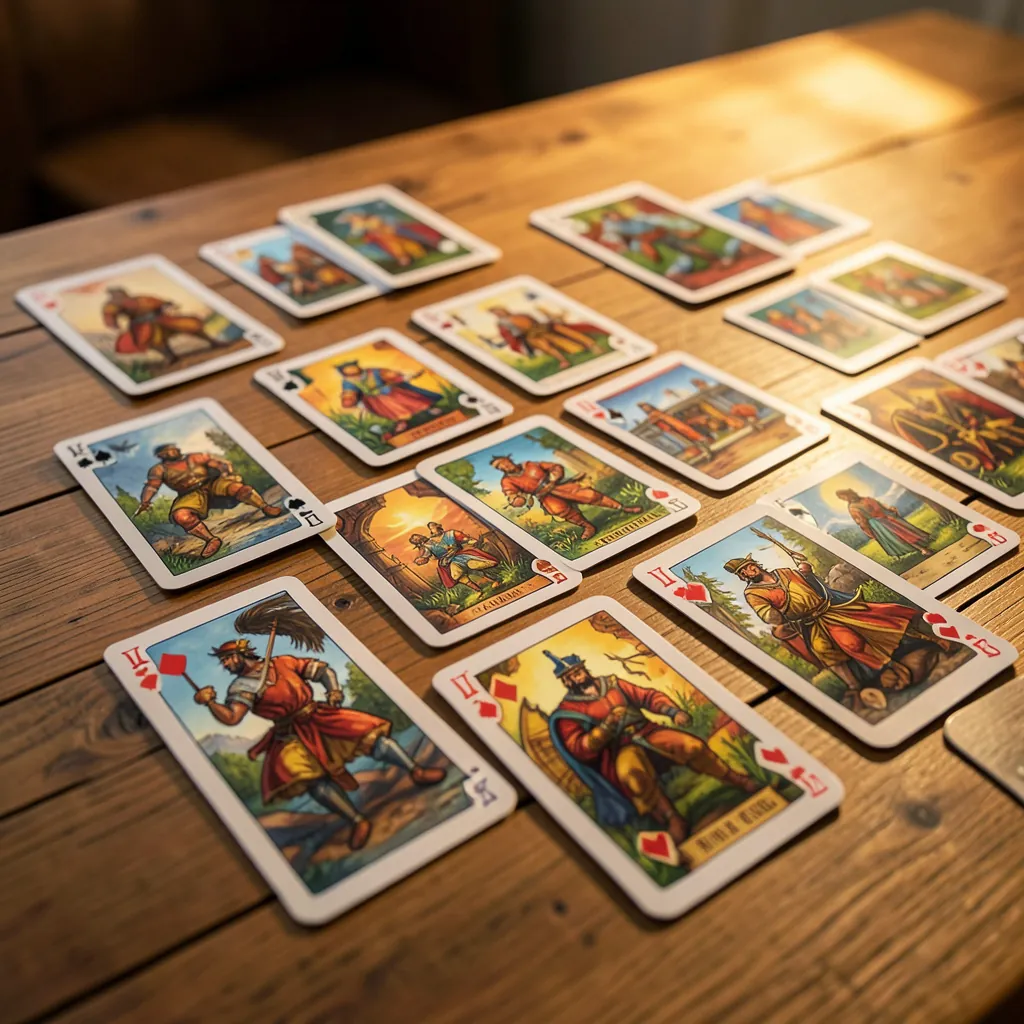
How to Play War (Battle): Rules, Scoring, Variations, and War-Themed Playing Cards
Contents
🃏 War (also called Battle in the United Kingdom) is a simple comparing card game usually played with a standard 52-card deck, in which players reveal cards and the higher rank wins the cards. The goal is to collect all of the cards. Most standard rules use two players, though some sources describe multiplayer versions for up to 12 players.
Players: 2 in standard rules; some sources describe 2–12
Play Time: 10–40 minutes
Age: Any age (often played by children)
Difficulty: Easy
Type: Catching-type card game
Setup
- Shuffle a standard 52-card French deck. Jokers are not typically used in standard War.
- For standard two-player War, divide the deck evenly: 26 cards per player, face down.
- For multiplayer play, Wikipedia states that in a three-player game each player receives 17 cards, while in a four-player game each receives 13. NCESC more broadly says War can be played by 2–12 players and that each player receives an equal number of cards, but because 52 does not divide evenly by every possible player count, the sources do not fully specify what happens to leftover cards. Treat this as a source conflict and agree on a house rule before dealing.
- Each player places their cards in a face-down stack in front of them. Players do not look at their cards.
- Before starting, agree on house rules for the unclear cases: what happens if a player runs out of cards during a war, and in what order won cards are returned to the bottom of the stack. Sources vary or are unclear on these points.
How to Play
- Both players simultaneously turn over the top card of their stack. This is called a “battle.”
- Compare the ranks. The standard high-to-low order is A, K, Q, J, 10, 9, 8, 7, 6, 5, 4, 3, 2. Aces are high, and suits are ignored. One FAQ-style source confusingly says an ace is “worth 1” while also calling it the highest card; for standard War, use the ace as the highest rank, not as a low card.
- The player with the higher card takes both cards played and places them at the bottom of their stack.
- If the two cards are equal in value, it is a “war.” Each player places the next card from their stack face down, then another card face up.
- The owner of the higher face-up card wins the war and adds all cards on the table to the bottom of their stack.
- If the face-up cards are equal again, repeat the war procedure: another card face down, then another face up, until one face-up card is higher.
- Continue battles until one player has all the cards. If a player runs out of cards during a war, sources conflict: some variants say that player immediately loses; others allow the player to play the last card face-up for the remainder of the war or replay the game from the beginning. Agree on this before play.
How does multiplayer War work?
In multiplayer War, each player reveals a card simultaneously, just as in the two-player version. If the highest cards played are tied, a war occurs; all players—including players who were not tied—play one face-down card and then one face-up card, and the highest card at the end of the war takes all cards played. A player with no cards is eliminated, and play continues until one player has collected all the cards.
Scoring
Standard War does not use points. A battle or war is won by having the higher rank, and the winner transfers the cards played to the bottom of their stack. You win by collecting all the cards. In multiplayer War, players are eliminated when they run out of cards, and the last player with all the cards wins. Some variants differ: in the German Bettelmann/Tod und Leben variants, the player with the most cards at the end wins, and Casino War uses wagers and payouts rather than points.
💡 Strategy Tips
- Agree on the rules before the first flip: card ranking, tie procedure, running-out rule, and how won cards are returned to the bottom.
- Shuffle thoroughly at the start; NCESC explicitly says the deck should be shuffled, and Wikipedia notes that the order in which won cards are returned can affect the outcome if players track cards.
- Remember that aces are high and suits do not break ties. Common beginner mistakes include treating 2 as high, using jokers, or expecting suits to decide a tied battle.
- Do not expect deep strategy in standard War. Wikipedia notes that the basic game has no choices and high chance; Greg Costikyan is cited as observing that it may not qualify as a game under some definitions.
- If you play a variant such as Prisoners of War, decide in advance when prisoners may be played and how captured face-down cards are handled.
🎲 Variations
War has many recorded variants, and sources do not agree on all player-count details. Common options include:
- Two-player standard: 26 cards each; the usual version.
- Multiplayer War: Wikipedia gives 17 cards each for 3 players and 13 each for 4 players; NCESC says 2–12 players. Exact leftover-card handling is not fully specified.
- Three cards: Many play with three cards face down during a war.
- Prisoners of War: Usually played with more than two players. A battle winner may take one opponent card as a “prisoner”; a player may later play that prisoner instead of drawing, but losing with it costs an extra card. War winners may also capture a face-down card.
- Automatic War: Laying down a two of any suit declares a war.
- Peace: The opposite of War; the lowest card wins.
- Underdog: The losing player of a war steals the victory if one of their three discard cards is a Jack.
- Bettelmann / Tod und Leben: German variants using a 32-card Skat pack for 2 players, 16 cards each; the player with the most cards at the end wins.
- Casino War: A simple variation played for money in casinos.
- Patent-described multi-card War: A U.S. patent describes wagering-style War options with multi-card war hands, separate comparisons, and ties treated as a push, win, or loss depending on house rules. This is not standard casual War.
How do War versions and related war-themed decks compare?
| Source-supported option | Players / format | Key facts |
|---|---|---|
| Standard War / Battle | 2 | 52-card deck; 26 cards each; aces high, suits ignored; tie triggers war; win all cards; 10–40 minutes. |
| Multiplayer War | 2–12 per NCESC; examples: 3 players 17 cards, 4 players 13 cards | All reveal simultaneously; ties can trigger a war involving all players; eliminated when out of cards. Exact dealing for every player count is not fully specified. |
| Patent/casino War | Wagering game; not standard casual play | Uses “war base wagers,” war hands, and multi-card comparisons; ties may be a push, player win, or player loss depending on house rules. |
| Euchim War Game | Not standard War | Australian WWI-themed set c.1915–1916 with 50 picture cards, five suits (“Fleet,” “Navy,” “Army,” “Field,” “Allies”), a rule card, and a booklet for six games. |
| Melbert Cary, War Cards: A Proclusion + Yankee Division deck | Not a rule set | 1937 book, number 250 of 250 copies, on playing-card history commemorating wars and battles; offered with a 1933 26th Yankee Division deck, 52 + J + EC, commemorating the November 11, 1918 armistice. |
❓ FAQ
How many players can play War?
Standard War is usually a two-player game, with 26 cards each. Multiplayer sources say War can be played by 2–12 players; Wikipedia gives 17 cards each for 3 players and 13 each for 4 players. Exact dealing for every player count is not fully specified in these sources.
How do you win War?
Collect all the cards. Standard War has no points; each battle or war transfers cards to the winner’s stack. In multiplayer, play continues until one player has all the cards.
Can you play War with 2 players?
Yes. Two players is the standard version: shuffle a 52-card deck, deal 26 cards to each player, and reveal cards simultaneously.
Is War hard to learn?
No. It is simple and often played by children. The basic game uses counting and card ranks; chance is high, and the standard rules offer little or no decision-making.
How long does a game take?
Wikipedia lists 10–40 minutes. Actual time varies with the number of ties, the exact variant, and the number of players.
What do you need to play War?
A standard 52-card deck; jokers are not typically used. Two players are standard, but multiplayer versions exist if you agree on a player count and dealing method.
Related guides
- How to Play Phase 10: Rules, Scoring, and Strategy
- How to Play War: Rules for the 2-Player Card Game
- 5 hundred card game
- 🃏 How to Play 500: The Complete Card Game Guide
- 500 Card Game Rules: How to Play Five Hundred