How to Play Sushi Go! (and Sushi Go Party!)
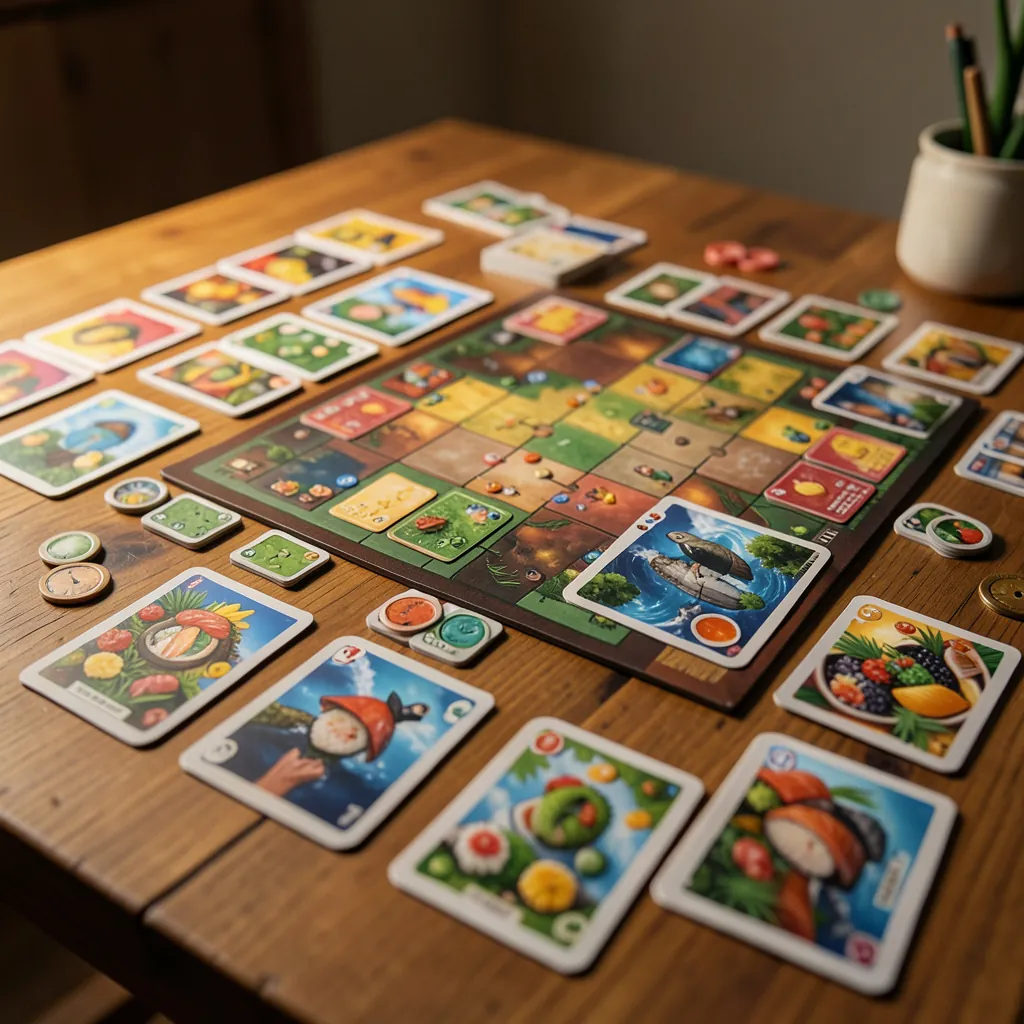
How to Play Sushi Go! (and Sushi Go Party!)
Contents
🃏 Sushi Go! is a pick-and-pass card game for 2–5 players (Sushi Go Party! expands this to 2–8) in which you draft sushi cards over three rounds and score the best combinations. Your goal is to finish with the most points after three rounds by collecting sets, pairs, and high-value cards while denying useful cards to opponents.
Players: 2–5 (Sushi Go!); 2–8 (Sushi Go Party!)
Play Time: About 15 minutes (Sushi Go!); about 30 minutes (Sushi Go Party!)
Age: 8+
Difficulty: Easy
Type: Pick-and-pass card game
Setup
Which version are you setting up?
| Feature | Sushi Go! | Sushi Go Party! |
|---|---|---|
| Players | 2–5 | 2–8 |
| Typical play time | About 15 minutes | About 30 minutes |
| Age | 8+ | 8+ |
| Core mechanic | Pick-and-pass drafting | Pick-and-pass drafting |
| Customization | Fixed deck | Choose a menu from more than 20 dishes |
| Scoring | Use paper/scorekeeping | Includes board, pawns, and score track |
| Components | Travel-friendly tin/card game | 181 cards, 22 menu tiles, 8 wooden pawns, 1 game board, rules |
- Choose your version. In Sushi Go!, use the fixed deck. In Sushi Go Party!, choose a menu from the available dishes; the rulebook includes recommended menus for different player counts and experience levels.
- Shuffle the deck.
- Deal each player a starting hand as directed by your edition’s rulebook. The sources here describe dealing “a hand” but do not specify a fixed starting-hand size.
- In Sushi Go Party!, place the game board and give each player a wooden pawn for the score track. In Sushi Go!, prepare a way to record scores, since the original does not include the Party score track.
- Leave space in front of each player for face-up kept cards. As cards are collected, group cards of the same type/color together.
How to Play
- The game is played over three rounds.
- At the start of a round, each player holds a hand of cards.
- All players simultaneously choose 1 card from their hand to keep and place it face down in front of them.
- When everyone has chosen, all players reveal their chosen cards face up.
- Pass the remaining hand face down to the player on your left. The sources also describe the hands as moving clockwise around the table; use one consistent direction.
Source note: Source 2 says “pass to the player on your left,” while Source 1 says “pass clockwise.” These are describing the same pass direction, but follow your rulebook if the wording differs. - Pick up the new hand you received. The next turn begins with a smaller hand.
- Repeat the choose-reveal-pass cycle until all cards have been chosen and there are no cards left to pass.
- Keep your chosen cards face up in front of you until the end of the round. They are scored at the end of that round.
- After scoring the round, reshuffle and play the next round. After the third round, score end-of-game cards such as desserts/pudding, then total the points.
Scoring
You score the face-up cards you collected during each round. Some cards score points individually, some score for sets, and some score at the end of the game. The winner is the player with the highest total after three rounds.
| Card / item | How it scores |
|---|---|
| Maki rolls | Sources conflict: Source 1 says the player with the most maki scores 4 points; Source 5 says the player with the most maki scores 6 points. Check your edition’s rulebook. |
| Tempura | A pair is worth 5 points; a single tempura card is useless. |
| Nigiri | Worth 1–3 points, and a wasabi card can triple its value. |
| Sashimi | A full set scores 10 points; if you have only 1 or 2, you score 0 for that set. |
| Pudding / dessert | At the end of the game, most pudding scores +6 points, and least pudding scores −6 points. Desserts are scored at the end of the game/third round. |
| Other cards | Some give 1, 2, or 3 points; others score for collecting sets or give end-of-game bonuses. |
Winning: After three rounds, add up each player’s score. The highest total wins and is the “Sushi master.”
💡 Strategy Tips
- Draft to deny, not just to collect. Think about what useful card you are passing to the next player, especially late in a round.
- Track what has already gone around. You cannot know every card you will receive, but you can estimate whether another tempura, sashimi, or high-value nigiri is likely to come back.
- Commit to set completion. A single tempura is useless, and incomplete sashimi scores nothing, so avoid collecting half-finished sets unless you have a realistic path to finish them.
- Use wasabi on high-value nigiri. Wasabi triples a nigiri card’s value, so pairing it with a stronger nigiri is usually better than using it on a low-value one.
- Do not ignore dessert/pudding. The end-game pudding swing is +6 for most and −6 for least, so it can change the winner.
Common beginner mistake: taking immediate points without considering whether a set is still achievable, or forgetting that the cards you pass are helping someone else.
🎲 Variations
- Player count: Original Sushi Go! supports 2–5 players. Sushi Go Party! supports 2–8 players.
- 2-player rules: Original Sushi Go! includes 2-player rules, but the sources here do not spell out the exact changes. Use the 2-player section of your rulebook.
- Party menus: Sushi Go Party! lets you customize the menu from more than 20 dishes. The manual includes recommended menus for groups such as 2 players, 8 players, aggressive players, non-gamers, and experienced players.
- House rules: These sources do not give formal house rules. The main supported variation is changing the Sushi Go Party! menu.
- Official spin-offs: Sushi Roll (2019) turns the game into a dice version, and Sushi Go!: Spin Some for Dim Sum (2023) is a 2–6 player spin-off with a rotating table mechanism.
❓ FAQ
How many players can play Sushi Go?
Sushi Go! supports 2–5 players. Sushi Go Party! supports 2–8 players.
How do you win Sushi Go?
The player with the highest total score after three rounds wins.
Can you play Sushi Go with 2 players?
Yes. Original Sushi Go! supports 2 players and includes 2-player rules; Sushi Go Party! also supports 2 players. Use the 2-player rules in your edition’s rulebook.
Is Sushi Go hard to learn?
No. It is an easy pick-and-pass game. The rules may look slightly daunting at first, but players usually understand them after one round.
How long does a game take?
About 15 minutes for Sushi Go! and about 30 minutes for Sushi Go Party!.
What do you need to play?
For Sushi Go!, you need the card deck and a way to keep score. Sushi Go Party! includes 181 cards, 22 menu tiles, 8 wooden pawns, 1 game board, and the rules.
Related guides
- How to Play Phase 10: Rules, Scoring, and Strategy
- How to Play War: Rules for the 2-Player Card Game
- 5 hundred card game
- 🃏 How to Play 500: The Complete Card Game Guide
- 500 Card Game Rules: How to Play Five Hundred