How to Play Speed Swap Chaos: Rules, Setup, Scoring, and Strategy for the Speed Swap Card Game
How to Play Speed Swap Chaos: Rules, Setup, Scoring, and Strategy for the Speed Swap Card Game
Contents
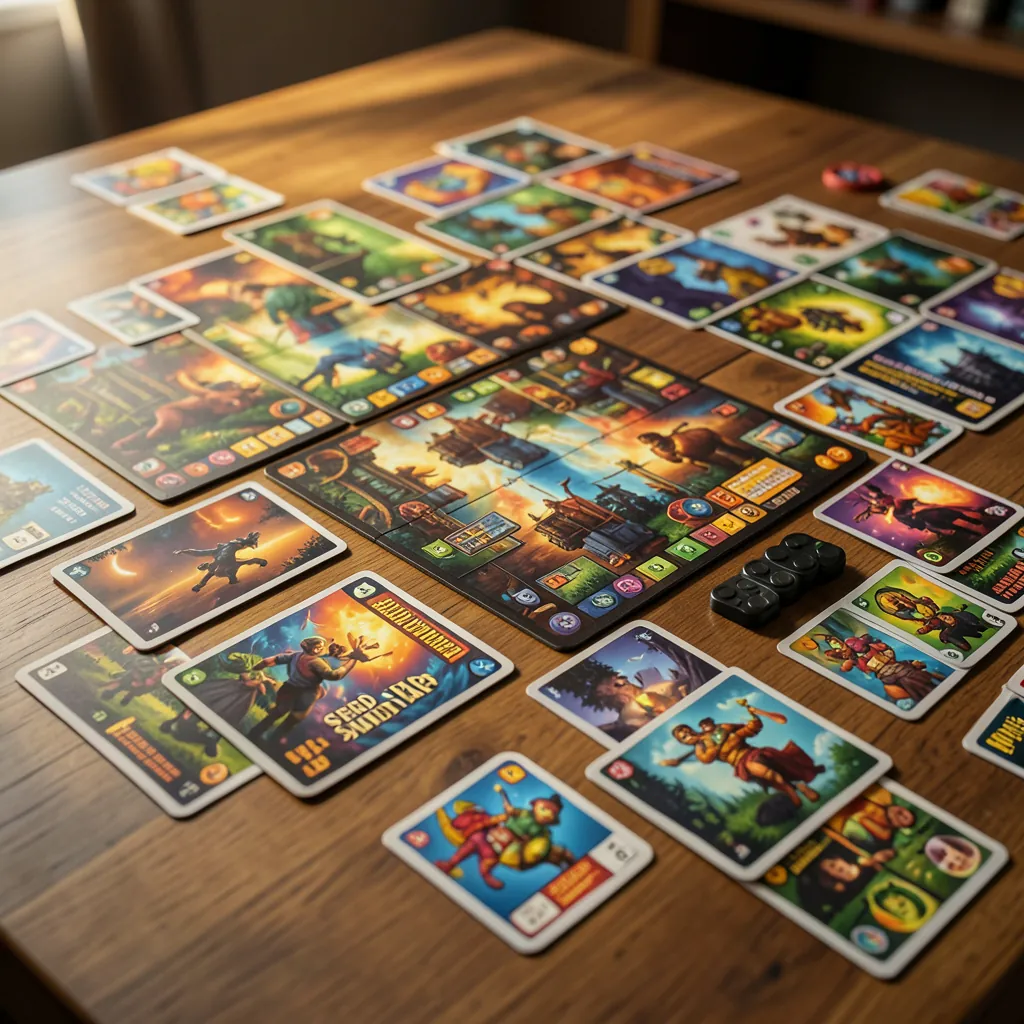
🃏 Speed Swap Chaos is a real-time card game in which every player plays at once — no turns, no waiting — racing to place cards in numerical order on a central pile. The goal is simple: be the first to empty your hand, but a SWAP! card can force everyone to exchange hands mid-race. It’s published by Brooke & Joy Games for 2–6 players, ages 8+.
Players: 2–6 Play Time: ~10 minutes (individual rounds run about 2 minutes) Age: 8+ (publisher’s rating; reviewers report younger children playing) Difficulty: Easy — publisher says learn in under 2–3 minutes Type: Real-time, no-turn sequencing card game
Setup
At a glance: specs and where the sources disagree
| Spec | Publisher listing (Source 1) | Independent review (Source 2) | Conflict / note |
|---|---|---|---|
| Players | 2–6 | Not stated | — |
| Age | Ages 8+ | “players of all ages and skill levels” | Reviewers report playing with kids aged 4–7, below the printed 8+ |
| Time to learn | “Under 2 minutes” (bullet) and “under 3 minutes” (product description) | “Very easy to teach/play” | Source 1 contradicts itself on learn time |
| Play time | ~10 minutes total; rounds of about 2 minutes | Fast, chaotic rounds | Consistent |
| Price | $9.99 USD | — | Listing price at time of capture |
| Designer | Three sisters; women-owned small business donating 5% of net profits to kids | Created by @brookeandjoygames | Consistent |
Setting up the deck and table
- Shuffle the full deck, including the number cards and the SWAP! cards. Source 2 notes the cards also carry playful theme words such as “palace,” “kingdom,” and “wonderful.”
- Deal each player a hand. The sources do not specify how many cards each player receives — use the deal printed in your copy of the rules.
- Create the central pile that all players will add to. Source 1 describes the core action as racing “to place cards in order in a central pile,” but the sources do not state the exact starting card or starting number.
- Check that everyone can see both their own hand and the top of the central pile, since play is simultaneous and fast.
- Agree on how many rounds you’ll play before starting (the publisher frames the game as fast rounds inside a ~10-minute session).
What the sources do NOT specify
To avoid teaching a wrong rule, note that the available sources are a product listing and a short review, not a full rulebook. They do not document: the exact deal size, whether there is a separate draw pile, the starting number on the central pile, whether the sequence runs upward only or wraps around, or tie-breaking. Follow the printed rules in the box for those details.
How to Play
The core rules, step by step
- Everyone plays at once. There are no turns and no downtime — Source 1 states the game is built around “no turns, everyone plays at once.”
- Play a card only if it is the next number. Source 2 explains you play your cards “as fast as you can but only if it’s the next number” — that is, the card must continue the numerical sequence on the central pile.
- Race to place cards in order. Source 1’s step 1 is literally “race to place cards in order in a central pile.”
- When a SWAP! card appears, everyone swaps hands immediately. Source 1: “when a SWAP appears, everyone swaps hands.” Source 2: “If a swap is played, quickly swap your hand and start playing numbers again.”
- Resume the race from your new hand. After the swap, look for the next number in your newly acquired cards and keep playing the sequence.
- Keep going until someone runs out. Source 1’s step 3: “Get rid of your cards first and win.” The SWAP! mechanic is designed to keep the race even, so “no one can ever fall too far behind.”
- Repeat rounds as time allows. Each round runs about 2 minutes, and the publisher describes a full session as roughly 10 minutes.
Quick reference: what happens when
| Situation | What you do | Source |
|---|---|---|
| It’s “your turn” | There are no turns — all players act simultaneously | Source 1 |
| You want to play a card | It must be the next number in the sequence | Source 2 |
| A SWAP! card is played | Everyone swaps hands, then continues the number sequence | Sources 1 & 2 |
| You have no cards left | You win the round | Source 1 |
Scoring
The sources describe no point values. Winning is binary at the round level: the first player to get rid of all their cards wins (Source 1). Nothing in the available material describes a score pad, penalty points, or a tiebreaker.
If you play multiple rounds, the only scoring method the sources support is tracking round wins — the player with the most round wins after your agreed number of rounds is the overall winner. Any point system beyond that would be a house rule, not an official rule.
💡 Strategy Tips
- Stay calm during swaps. Source 2 names this as the key to winning: “staying calm even when the game gets hectic — especially during those pivotal swap moments.”
- Don’t get attached to a sorted hand. Because a SWAP! can take your hand at any moment, treat every hand as temporary and re-scan instantly for the next number after a swap.
- Watch the central pile, not just your cards. The game rewards “pattern recognition and quick decision-making” (Source 2), which means tracking the current number on the pile at all times.
- Don’t hoard playable cards. Since the only way to win is to empty your hand, play the next number the instant you spot it.
- Mix ages and skill levels deliberately. Reviewers report success playing with grandchildren aged 7–15, with kids aged 4 and 6, and with groups of adults of differing language abilities — the number sequence does the teaching.
Common beginner mistakes: waiting for a turn that doesn’t exist, freezing after a swap instead of immediately hunting for the next number, and trying to play a card that doesn’t continue the sequence.
🎲 Variations
- Two players: Officially supported — the publisher lists a 2–6 player range.
- Full table (up to 6): Also within the publisher’s stated range; the “no turns” design means more players means more chaos, not more waiting.
- Playing with younger children: The printed age is 8+, but reviewers describe 4-, 5-, 6-, and 7-year-olds playing successfully. This is a real-world accommodation, not a publisher rule.
- Mixed-language groups: Reviewers specifically call it “great for playing with people of different language abilities,” since the core action is number sequencing.
- House rules: The sources document no official variants beyond player count. Any added scoring, hand-size changes, or swap restrictions should be labeled as unofficial house rules.
❓ FAQ
How many players can play Speed Swap Chaos? 2–6 players, per the publisher’s listing. The no-turn format means everyone plays at the same time regardless of player count.
How do you win at Speed Swap Chaos? Be the first player to get rid of all your cards. Play only the next number in the sequence, and keep racing until your hand is empty.
Can you play Speed Swap Chaos with 2 players? Yes. The publisher lists a 2–6 player range, so two-player games are officially supported.
Is Speed Swap Chaos hard to learn? No. The publisher calls it easy to learn and gives the learning time as “under 2 minutes” in one place and “under 3 minutes” in another — a minor inconsistency in the listing itself. Reviewers consistently describe it as very easy to teach.
How long does a game take? Rounds run about 2 minutes, and the publisher describes roughly 10 minutes of total play. Reviewers mention fitting it into 10–15 minute gaps.
What do you need to play? The Speed Swap Chaos deck (number cards plus SWAP! cards), 2–6 players, and a flat surface for the central pile. The listing price at the time of capture was $9.99.
Source note: the source set also included a Yu-Gi-Oh! “Speed Spell” card entry, the word game Swap Four, and the set-collecting game Piles! — all different games. They were excluded from the rules above to avoid mixing mechanics.
Related guides
- How to Play Phase 10: Rules, Scoring, and Strategy
- How to Play War: Rules for the 2-Player Card Game
- 5 hundred card game
- 🃏 How to Play 500: The Complete Card Game Guide