How to Play Speed: Rules, Setup, Scoring, and Variations for the Fast Card Game
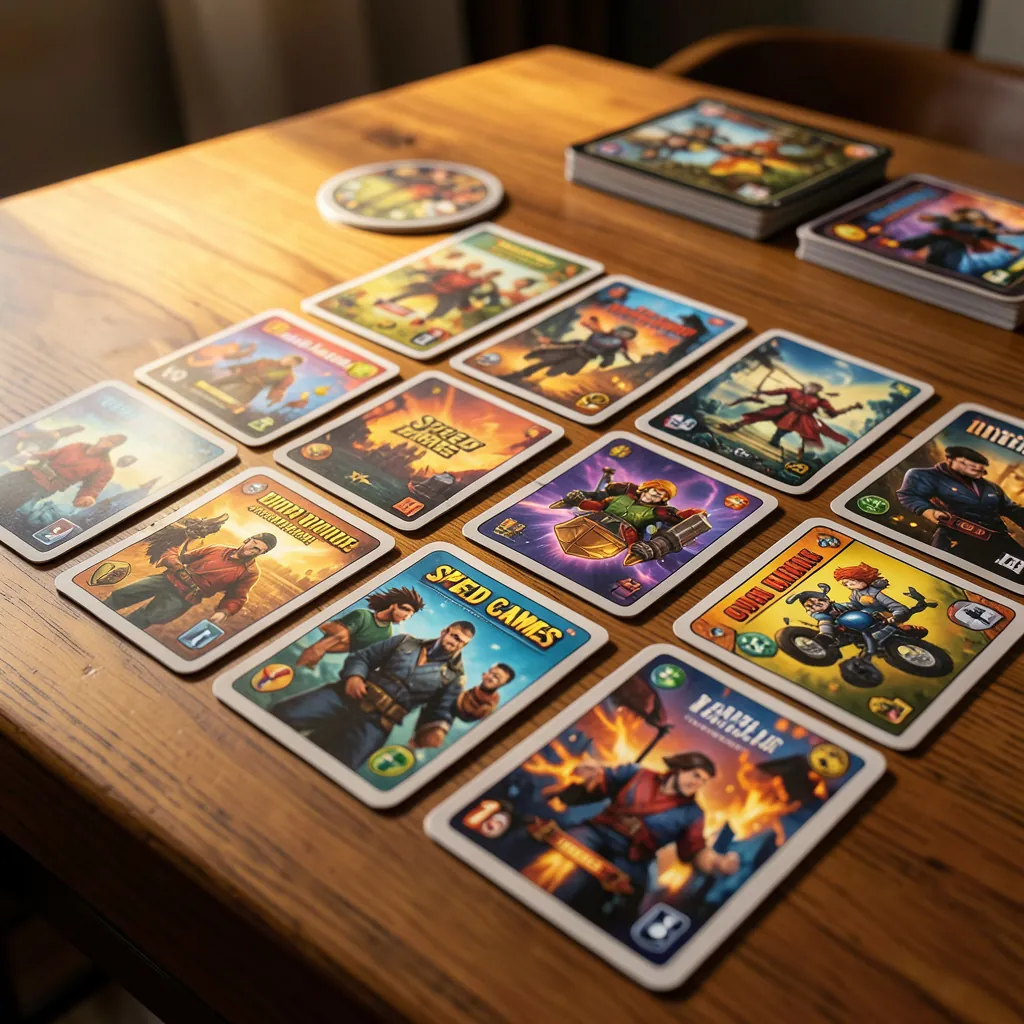
How to Play Speed: Rules, Setup, Scoring, and Variations for the Fast Card Game
Contents
🃏 Speed is a fast shedding card game for two players (with 3–4+ variants) in which each player starts with a 20-card pile, holds 5 cards, and races to play cards one rank higher or lower onto the center piles. The goal is to empty your hand and draw pile first and shout “Speed.” The rules below follow the common tutorial version and flag where traditional sources disagree.
Players: 2 standard; 3–4+ with variants (Source 4)
Play Time: Fast/any time; no fixed timer (Source 4)
Age: 5–100 (Source 4)
Difficulty: Easy to learn (Source 1); skills include speed, memorization, and counting (Source 4)
Type: Shedding-type card game (Source 4)
Setup
- Use a standard 52-card deck. For the basic Instagram-style version, remove the jokers (Source 1). Source 4 notes that jokers can be used as wild cards in a variant.
- Shuffle the deck.
- For the common two-player game, deal each player 20 cards face down (Source 1). Each player places 5 of those cards into their hand and leaves the other 15 face down as their draw pile (Sources 1 and 4).
- In the center, place four face-down piles: two outer piles with 5 cards each and two inner piles with 1 card each (Source 1).
- Alternative center setup from Source 1: deal two face-down stacks of 6 cards each in the center, leaving space between them for cards to be flipped.
- Leave enough table space between the center piles so both players can play quickly and reach the piles.
For 3- and 4-player setup, see Variations.
How to Play
- Start the round by flipping the two inner center cards face up at the same time. Play begins immediately (Source 1).
- There are no turns. Both players race to play cards from their hands onto either center pile (Source 1).
- A legal card must be exactly one rank higher or one rank lower than the top card on that center pile. Suits are ignored (Source 1).
- The ranks loop: an Ace can be played on a King or a 2, and a King or a 2 can be played on an Ace (Sources 1 and 4).
- Play only one card at a time. You may not lay down multiple cards at once (Source 1). Source 4 adds that you should use only one hand and should not shuffle or delay.
- After playing a card from your hand, refill your hand back up to 5 cards from your draw pile (Source 1). If your draw pile is empty, continue with fewer cards.
- If you have a legal card you can play, you must play it. You cannot save it for later (Source 1).
- If both players are stuck and cannot play, each player simultaneously flips one card from an outer face-down side stack onto a center pile (Source 1).
- If the outer side stacks run out, refresh the center piles. Source 1 says to flip the face-up center piles over to reveal new ones; Source 4 says to shuffle the central stacks individually and place them face-down as new side piles. Agree on one house rule before play.
- The first player to run out of cards in both their hand and draw pile shouts “Speed” and wins (Sources 1 and 4). Source 4 adds that if the player forgets the agreed winning signal, they must take one central stack as a new draw pile and resume playing.
What rules conflict between the sources?
- Player count: The Instagram tutorials in Source 1 mainly describe two-player Speed. Source 4 says Speed can be played with 2+ players and gives 3- and 4-player variants.
- Jokers: Source 1 says remove the jokers for the basic game. Source 4 allows jokers as wild cards in a variant.
- Same-rank plays: Source 1 says play only one rank higher or one rank lower. Source 4 says “one number above, one number below, or the same number” and mentions Doubles rules. Check house rules before playing.
- Center setup: Source 1 gives both the 4-pile setup (5/5/1/1) and the two 6-card stack setup. Source 4’s setup is less explicit about the center layout.
- When side stacks run out: Source 1 says flip the center piles to reveal new ones. Source 4 says shuffle the central stacks individually and use them as new face-down side piles.
Scoring
Basic Speed does not use point scoring. It is a race game: the winner is the first player to empty their hand and draw pile and call “Speed” (Sources 1 and 4). Source 4 says if you empty your cards but fail to say “Speed” or perform the agreed signal, you must take one central stack as a draw pile and continue. Source 4 also notes that Speed is typically played as a best-two-out-of-three match.
💡 Strategy Tips
- Arrange your hand for quick play. Source 4 suggests ordering cards by playable sequence rather than plain ascending order—for example, 4, 5, 6, 5, 6 can be faster to play than 4, 5, 5, 6, 6.
- Do not save legal cards. If you can play, you must play; holding a card is not allowed in standard rules (Source 1).
- Use blocking when you know an opponent’s card. Source 4 says if you know your opponent has a King and the center shows a Jack, playing a 10 may be better than playing a Queen, because the Queen gives them a play.
- Keep moving and avoid delays. Source 4 says players must not hesitate to shuffle cards or otherwise delay the game.
- Common beginner mistakes: trying to play multiple cards at once, forgetting to refill to 5, forgetting the Ace–King–2 loop, and failing to shout “Speed” after emptying your cards.
🎲 Variations
- Jokers wild: Source 4 allows jokers as wild cards. A joker can represent a needed rank, but it cannot be the last card you play. If a joker is on top, anything can be played on it.
- Same-rank or Doubles rules: Source 4 mentions playing the same number and “Doubles” rules, while Source 1 says only one higher or one lower. Treat this as a house-rule variant.
- 3-player Speed: Source 4 says to give each player five side-pile cards, place three cards face down in the center, and deal the extra cards evenly as draw piles.
- 4-player Speed: Source 4 recommends using two decks shuffled together for quicker or more experienced players. With new, slow, or young players, one deck may be used to slow the game down.
- California Speed / California Spit: Source 1 calls California Speed a two-player racing card game; Source 4 describes California Spit with half the deck per player, five face-up cards between players, matching numbers, and covering groups. It is related to Speed but not identical.
- Djeco Myster Travel: This is not standard Speed. It is an observation-and-speed card game with 54 cards, aimed at ages 4–12, where players race to find the “odd one out”; the winner is the player who wins the most cards (Sources 2 and 3).
How does standard Speed compare with other “speed” card games in the sources?
| Game / source | What it is | Players | Cards / setup | Goal | Conflict or note |
|---|---|---|---|---|---|
| Speed (Sources 1, 4) | Shedding race with center play piles | 2 standard; Source 4 says 2+ | Standard 52-card deck; common tutorial deals 20 cards per player and 12 center cards; jokers removed in Source 1 | Empty hand and draw pile and shout “Speed” | Setup, joker, and same-rank rules differ between sources |
| California Speed / California Spit (Sources 1, 4) | Two-player racing/shedding variant | 2 | Source 4: half deck each, five face-up cards per player between them; Source 1 calls it Double/Super Speed | Run out of cards; Source 4 describes matching numbers and covering groups | Related to Speed but not identical |
| Djeco Myster Travel (Sources 2, 3) | Observation-and-speed card game, not standard Speed | Not stated in sources | 54 cards + rules; age 4–12 | Fastest to find the odd one out; most cards wins | Price conflict: Source 2 lists $112.00; Source 3 lists $19.00 |
| Pepys Series “SPEED” (Source 5) | Vintage commercial card game with speedway rider/ship cards | Not stated | Rules say 44 cards; listed copy has 41 and is missing 3 ship cards | Not fully stated in the listing | Collector/edition note, not a complete standard-deck rules source |
❓ FAQ
How many players can play Speed?
Two players is the standard setup in the Instagram tutorials, but Source 4 says Speed can be played with 2+ players and gives 3- and 4-player variants. For 4 players, Source 4 recommends two decks.
How do you win at Speed?
Empty your hand and draw pile first and shout “Speed” or the agreed winning signal. If you forget, Source 4 says you must take one central stack as a new draw pile and continue.
Can you play Speed with 2 players?
Yes. Speed is primarily described as a two-player game in Source 1. Deal 20 cards to each player, set up the center piles, and race to empty your cards.
Is Speed hard to learn?
No. It is easy to learn, but it requires speed, memorization, and counting (Source 4). The no-turns, must-play format takes a little practice.
How long does a game take?
The sources do not give a fixed time. Source 4 says playing time is “any time,” while Source 1 describes it as a quick, fast-paced game. Actual length depends on player speed and the variant.
What do you need to play Speed?
You need a standard 52-card deck. Source 1 says remove the jokers for the basic game; Source 4’s 4-player variant recommends two decks.
Related guides
- How to Play Phase 10: Rules, Scoring, and Strategy
- How to Play War: Rules for the 2-Player Card Game
- 5 hundred card game