Skip-Bo Rules for 3 Players: Setup, Gameplay, Scoring, and Variations
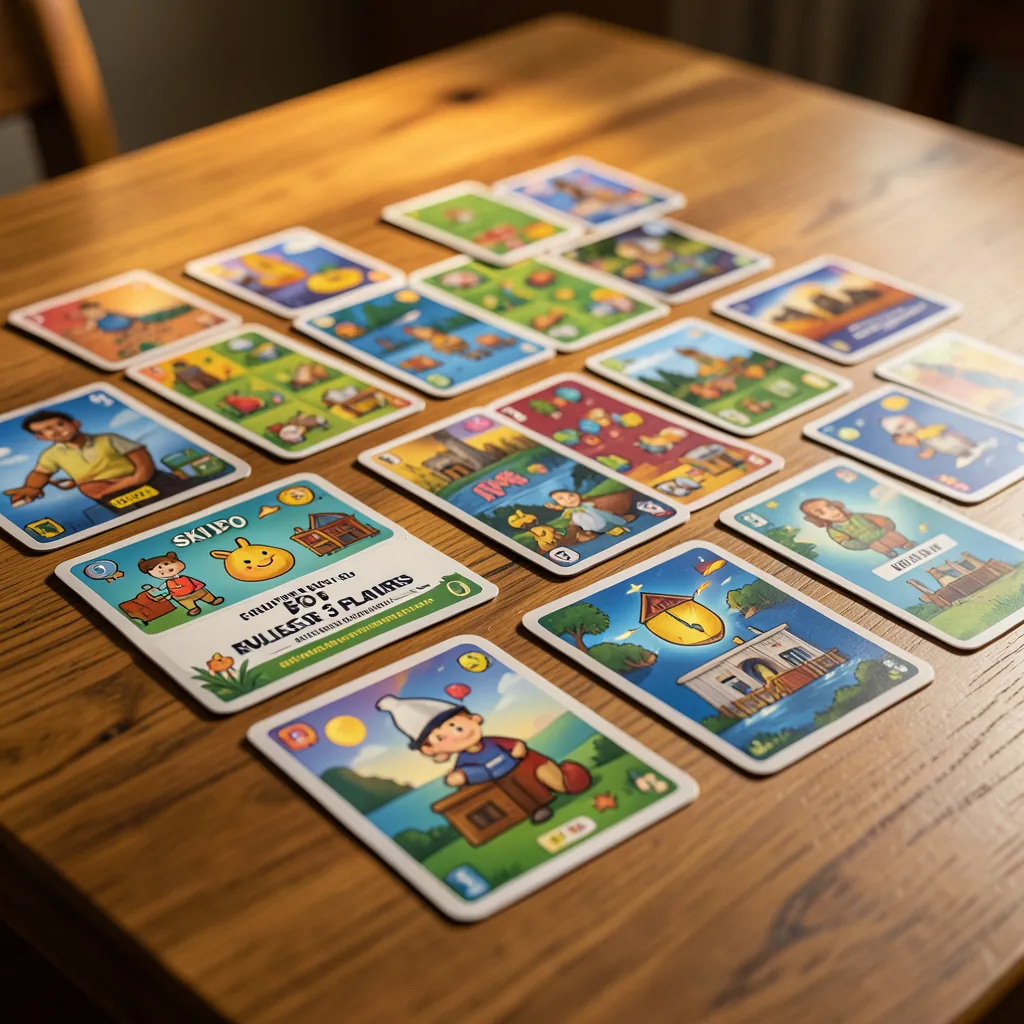
Skip-Bo Rules for 3 Players: Setup, Gameplay, Scoring, and Variations
Contents
🃏 Skip-Bo is a sequencing card game—a commercial Spite and Malice variant—where players race to empty their Stock pile by playing cards in numerical order, 1 through 12, onto shared Build piles. For 3 players, the common setup is a 30-card Stock pile per player plus a 5-card hand; the first player to play out their entire Stock pile wins. Sources differ on some details, so conflicts are flagged below.
Players: 2–6 (3 players supported; several sources list 2–4 for individual play)
Play Time: Varies by Stock-pile size; sources do not give a fixed time
Age: 7+
Difficulty: Easy to learn sequencing rules; younger players may need help
Type: Sequencing card game (Spite and Malice variant)
Setup
How Do You Set Up a 3-Player Skip-Bo Game?
- Shuffle the Skip-Bo deck. Physical Mattel-style sources describe 162 cards: 144 numbered cards (1–12) and 18 Skip-Bo wild cards. Source 1’s digital/manual version describes a different card set (216 numbered + 27 Skip-Bo), so use the card count that came with your deck. If using regular cards, Source 2 says use three decks including jokers: Ace = 1, 2–10 = 2–10, Jack = 11, Queen = 12, King/Joker = Skip-Bo.
- Choose a dealer and deal the Stock piles. For a standard 3-player game, Sources 2, 4, and 5 support dealing 30 cards face down to each player as their Stock pile. For a faster game, deal 10–15 cards instead (Source 2; Source 5’s short game uses 10; Source 3 says 10–30). Source 1’s digital version lets players choose 5, 10, 20, or 30 Stock cards.
- Turn the top Stock card face up. Each player flips only the top card of their Stock pile; do not look through the rest. (Sources 4 and 5)
- Deal the starting hand—or not—depending on the variant. Most tabletop guides deal each player a 5-card hand in addition to the 30-card Stock pile (Sources 2 and 4). Sources 3 and 5 instead describe the first player drawing 5 cards at the start of the first turn. Do not do both; if you dealt 5 cards, that is your starting hand.
- Make the Draw pile. Place the remaining deck face down in the center. (Sources 4 and 5)
- Leave space for piles. Up to four shared Build piles go in the center; each player can create up to four personal Discard piles. Build and Discard piles start empty/imaginary until played. (Source 5)
- Agree on the starting player. Most rules say the player to the dealer’s left starts (Sources 3 and 5); Wikipedia/Source 4 says the middle-aged player goes first. Pick one before play.
How Do the Sources Compare for 3-Player Setup?
| Rule detail | Common 3-player rule | Source conflict or variation |
|---|---|---|
| Players | 3 players is supported as an individual game | Most sources list 2–4 individual players; Source 5 lists 2–6; Source 4 allows 6+ in teams |
| Stock pile | 30 cards each in standard 2–4 player games (Sources 2, 4, 5) | Source 1 allows 5/10/20/30; Source 3 allows 10–30; Source 2 recommends 10–15 for faster play; Source 5’s short game uses 10 |
| Starting hand | 5 cards (Sources 2 and 4) | Sources 3 and 5 describe drawing 5 at the start of the first turn instead; use one method only |
| Wild Skip-Bo cards | Can start a Build pile or act as any number (Sources 4 and 5) | Source 2 says you cannot play two wilds in a row and cannot use one as a 12; treat as a house rule unless your rulebook says it |
| Build piles | Up to 4 shared piles; start with 1 or Skip-Bo; build 1–12 (Sources 1, 4, 5) | No major conflict |
| Discard piles | Up to 4 per player; only top card playable; discarding ends turn (Sources 1, 4, 5) | No major conflict |
| Draw pile | Remaining deck in center; completed Build piles reshuffle when Draw pile empties (Sources 3, 4, 5) | Source 1’s digital card count differs |
How to Play
- Start with exactly 5 cards in hand. If Setup already dealt you a 5-card hand, do not draw 5 more on your first turn—draw only enough to bring your hand to 5. If you are using the Sources 3/5 variant where no initial hand was dealt, draw 5 now. On later turns, refill only to 5. (This corrects the common mistake of taking 10 cards initially.)
- Play cards to shared Build piles in order. A Build pile must start with a 1 or a Skip-Bo wild card, then increase by one each time: 1, 2, 3 … 12. You may play from your hand, the top card of your Stock pile, or the top card of any of your Discard piles. Card colors do not matter. (Sources 1, 4, and 5)
- Use Skip-Bo cards as wilds. A Skip-Bo card may start a Build pile or stand in for any number. Source 2 adds a house rule that you cannot play two Skip-Bo cards in a row and cannot use one as a 12; other sources do not state that restriction, so check your rulebook.
- Keep going while you have valid plays. You may play multiple cards in one turn. If you play all 5 cards from your hand, draw 5 more and continue. (Sources 3, 4, and 5)
- Only use the top cards of Stock and Discard piles. The Stock pile has only its top card face up, and only the top card of each Discard pile can be played; you cannot search through a Discard pile. (Sources 1 and 5)
- Complete and remove 12 piles. When a Build pile reaches 12, remove it from the play area; that space can be used to start a new pile. When the Draw pile runs out, shuffle completed Build piles to make a new Draw pile. (Sources 4 and 5)
- End your turn by discarding one card from your hand. If you cannot play or choose not to play more, place one hand card onto one of your up to four Discard piles. That discard ends your turn. (Sources 1, 3, and 5)
- Play passes to the next player. The next player then draws up to 5 cards and takes their turn. (Sources 4 and 5)
- Win the round. The first player to play all cards from their Stock pile wins. (Sources 3, 4, and 5)
Scoring
- Single round: The first player to empty their Stock pile wins; no points are required. (Sources 4 and 5)
- Multi-round scoring: The winner scores 25 points for winning plus 5 points for each card remaining in opponents’ Stock piles. Example: if you win with opponents at 4 and 7 cards left, you score 25 + (4 + 7) × 5 = 80 points. The first player to reach 500 points wins. (Sources 3, 4, and 5)
- Source conflict: Source 1’s digital/manual version uses a different score: turns needed to win divided by the starting Stock-pile size, with lower scores better. This is not the standard tabletop scoring system.
💡 Strategy Tips
- Prioritize your Stock pile. Since emptying the Stock pile wins, play a Stock card whenever it is legal; use hand and Discard cards mainly to set up the next Stock card. (Source 5)
- Keep multiple Build piles open. Up to four shared Build piles can be active, so start new piles with 1s or Skip-Bo wilds when possible. This gives you more places to play if one pile gets too far ahead.
- Treat Discard piles as short-term storage. Only the top card of each Discard pile is playable, so avoid burying numbers you expect to need soon. Since discarding ends your turn, choose the discard carefully. (Sources 1 and 5)
- Refill to 5—not 5 extra. A common beginner mistake is drawing 5 more at the start of every turn. At the start of a turn, draw only enough to bring your hand back to 5; if you already have 5, draw none.
- Use wilds for key gaps. Save Skip-Bo cards for starting a Build pile or bridging a gap that unlocks your Stock pile. If your table uses Source 2’s no-two-wilds-in-a-row rule, plan around that restriction.
🎲 Variations
- Shorter 3-player game: Deal 10–15 Stock cards instead of 30. Source 2 recommends 10–15 for faster play; Source 5’s short game uses 10; Source 3 allows 10–30.
- 5–6 players: Deal 20 Stock cards per player instead of 30. (Sources 2 and 5)
- 2 players: Skip-Bo supports 2-player play in Sources 3, 4, and 5. Use the same rules, with 30-card Stock piles or a shorter 10–15 card game.
- Digital/Source 1 variant: Players may choose 5, 10, 20, or 30 Stock cards, and scoring is turns divided by starting Stock size.
- Wild-card house rule: Source 2 says you cannot play two Skip-Bo wilds in a row and cannot use one as a 12; Sources 4 and 5 describe Skip-Bo as playable as any number. Agree which rule you are using before play.
- Starting-player conflict: Most sources say the player to the dealer’s left starts; Source 4 says the middle-aged player goes first. Pick one before play.
- Partnerships: Sources 4 and 5 describe partnership rules, but they are written for even teams. They do not provide a specific 3-player partnership rule, so 3-player games are usually individual.
❓ FAQ
How many players can play Skip-Bo?
Skip-Bo supports 2–6 players in Source 5, while several sources list 2–4 for individual play. A 3-player game is well supported; use 30-card Stock piles for the standard game or 10–15 for a faster game.
How do you win at Skip-Bo?
The first player to play all cards from their Stock pile wins the round. If you play multiple rounds with scoring, the first player to reach 500 points wins. (Sources 3, 4, and 5)
Can you play Skip-Bo with 2 players?
Yes. Two players is within the 2–4 individual-player range in Sources 3, 4, and 5. Use the same rules, with 30-card Stock piles or a shorter 10–15 card game.
Is Skip-Bo hard to learn?
No—it is an easy sequencing game rated 7+ in Sources 2 and 5. Younger players may need help managing the Stock, Draw, Build, and Discard piles.
How long does a Skip-Bo game take?
The sources do not give a fixed play time. Game length depends on the Stock-pile size; 30 cards takes longer, while 10–15 cards is recommended for faster play.
What do you need to play Skip-Bo with 3 players?
A 162-card Skip-Bo deck—144 numbered cards plus 18 Skip-Bo wilds—per Sources 4 and 5, or three regular decks including jokers per Source 2. You also need space for up to four shared Build piles and up to four Discard piles per player.
Related guides
- How to Play Phase 10: Rules, Scoring, and Strategy
- How to Play War: Rules for the 2-Player Card Game
- 5 hundred card game
- 🃏 How to Play 500: The Complete Card Game Guide
- 500 Card Game Rules: How to Play Five Hundred