Skip-Bo Rules for 4 Players: Setup, Gameplay, Scoring & FAQ
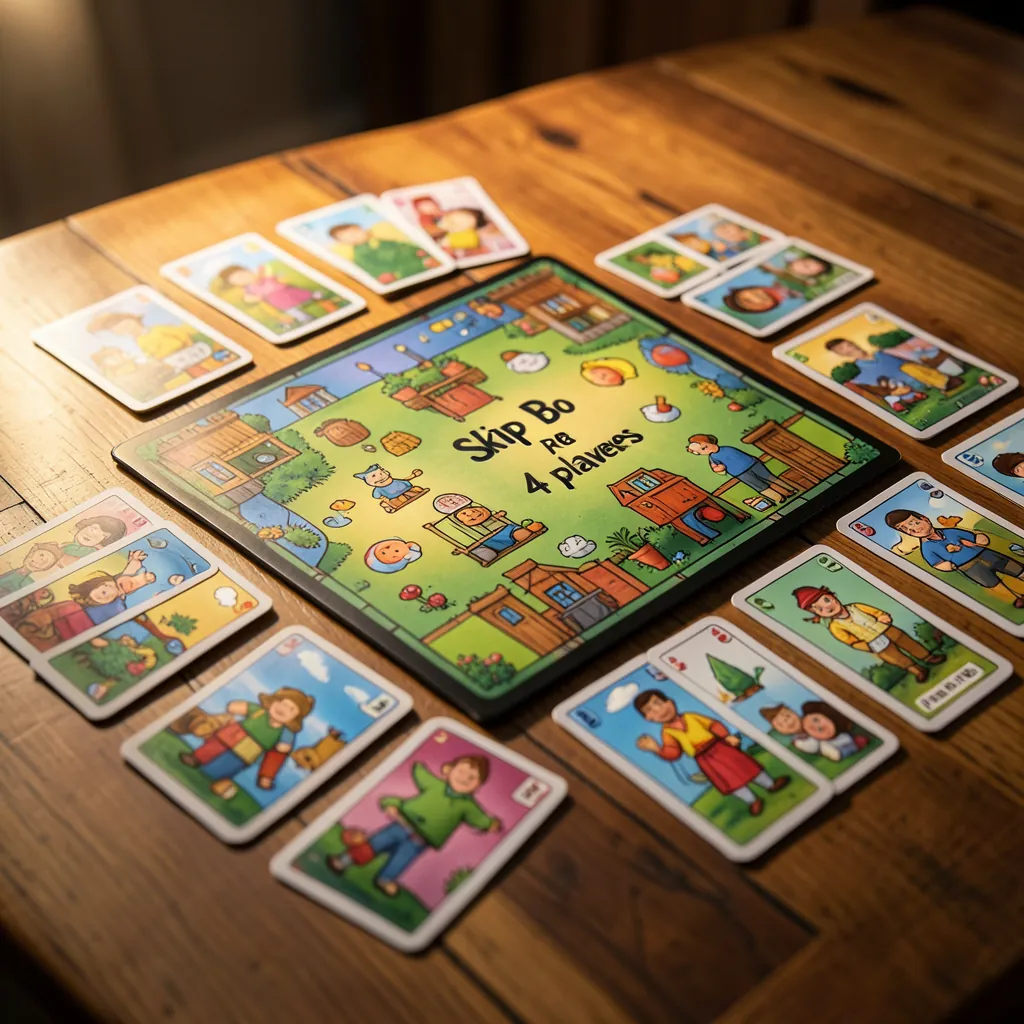
Skip-Bo Rules for 4 Players: Setup, Gameplay, Scoring & FAQ
Contents
🃏 Skip-Bo is a sequencing card game for 2–4 individual players (up to 6 in some versions/teams) in which you race to empty your stockpile by building shared piles from 1 to 12. With 4 players, deal 30 cards each as a stockpile, 5 cards to each hand, then take turns playing valid number cards or Skip-Bo wilds and discarding one card to end your turn.
Players: 2–4 individuals; up to 6 in some editions/team variants (sources conflict)
Play Time: Not fixed in the sources; fast-paced, and shorter if you use fewer stockpile cards
Age: 7+ per one source; family-friendly, though younger players may need help
Difficulty: Easy
Type: Sequencing card game, not a trick-taking game
Setup
- Choose a dealer and deal the stockpiles. For a standard 4-player game, the most consistent source rule is 30 cards per player for the stockpile, placed face down with only the top card turned face up. Sources also allow faster games with smaller stockpiles, such as 10–15 cards or a chosen 5/10/20/30 cards.
- Deal the starting hand. Each player gets 5 cards in hand. The rest of the deck becomes the common face-down draw pile in the center.
- Create the shared play area. Leave room in the center for up to 4 shared build piles and the draw pile. Each player also needs space for their own stockpile and up to 4 personal discard piles.
- Agree on the first player before starting. The sources conflict here: Wikipedia says the middle-aged player goes first, Parenting Hub says youngest to oldest, and Lodige says the player to the left of the dealer starts. Pick one method before play.
4-player setup comparison by source
| Source | 4-player stockpile | Hand size | First-player / note |
|---|---|---|---|
| Wikipedia | 30 cards | 5 | Middle-aged player goes first |
| Gaming Pedia | 30 cards; 10–15 for faster play | 5 | Mentions youngest first in a Skip-Bo Junior context; 5–6 players get 20 cards |
| Uni Basel manual | Choose 5, 10, 20, or 30 | 5 | Digital implementation; can be played with more than 4 |
| Parenting Hub | 30 cards for 2–4 players | Not stated | Played youngest to oldest |
| Lodige | 10–30 cards depending on preference | 5 | Player to the left of the dealer starts |
Rule conflicts to agree on before play
- Player count: Some sources say 2–4 individual players; others allow up to 6, and Wikipedia allows 6+ in teams with no more than 3 partnerships.
- Stockpile size: 30 cards is the common 4-player setup, but several sources allow smaller stockpiles for faster games.
- First player: “Middle age,” “youngest,” and “left of dealer” all appear in the sources.
- Skip-Bo wild restrictions: Most sources say a Skip-Bo card can substitute for any number. One source says you cannot play two Skip-Bo cards in a row, must cover a Skip-Bo with a number card, and cannot use it as a 12. Agree before play.
How to Play
- Know the goal. Be the first player to play every card from your own stockpile.
- Start your turn by drawing to 5 cards. At the beginning of each turn, draw until you have 5 cards in hand, if the draw pile has enough cards.
- Play cards to the shared build piles. There can be up to 4 build piles. Each build pile starts with a 1 or a Skip-Bo wild, then continues in exact ascending order: 1, 2, 3, and so on up to 12.
- Use cards from three places. On your turn, you may play the next valid card from your hand, the top card of your stockpile, or the top card of any of your own discard piles. Only the top card of a stockpile or discard pile is available.
- Keep playing while you can. Your turn continues as long as you can legally add cards to build piles. If you play all 5 cards from your hand, draw 5 more and keep going.
- Handle completed build piles. When a build pile reaches 12, remove it from the play area. The space can be used for a new build pile, and completed piles can later be shuffled back into the draw pile when it runs out.
- Use Skip-Bo wilds carefully. A Skip-Bo card may be played as any number, including as a 1 to start a build pile. Note the source conflict above about whether two Skip-Bo cards can be played in a row or whether a Skip-Bo can be used as a 12.
- End your turn by discarding exactly one card. When you cannot or choose not to play more cards, discard one card to one of your own discard piles. You may have up to 4 discard piles, and only the top card of each is playable later. Discarding ends your turn.
- Pass to the next player. Play continues to the next player, generally to the left. If the draw pile runs out, shuffle completed build piles to make a new draw pile.
- Win the round. The first player to play the last card from their stockpile wins the round.
Scoring
- Single round: The first player to empty their stockpile wins. No points are required unless you are playing multiple rounds.
- Optional multi-round scoring: The winner gets 25 points for winning plus 5 points for each card remaining in every opponent’s stockpile. The first player to reach 500 points wins.
- Digital-version scoring: The Uni Basel implementation uses a different formula: turns needed to win divided by the starting stockpile size, with lower scores being better. That is specific to that digital version, not standard tabletop scoring.
💡 Strategy Tips
- Plan backward from your stockpile top card. Look at the number you need to expose next, then use your hand and discard piles to build toward it. A common beginner mistake is playing convenient cards without improving access to the stockpile.
- Keep discard piles organized. Only the top card of each discard pile can be played, so avoid burying a number you expect to need soon.
- Use Skip-Bo wilds as bridges, not automatic discards. Save them for gaps that unblock your stockpile or keep a strong turn going.
- Try to empty your hand when it is safe. Playing all 5 hand cards lets you draw 5 more and continue, which can create a long productive turn.
- Check every legal source before discarding. Beginners often discard too quickly and forget they could have played the top card of their stockpile or one of their discard piles first.
🎲 Variations
- Faster 4-player game: Use fewer stockpile cards. Sources allow 10–15 cards for faster play, or a chosen stockpile of 5, 10, 20, or 30 cards.
- 5–6 players: Gaming Pedia and Parenting Hub say 5 or more players get 20-card stockpiles. Wikipedia instead describes 6+ players as team play with no more than 3 partnerships.
- Partnerships: In the Wikipedia partnership variant, each partnership has two stockpiles and eight discard piles total. The active player may use their partner’s stock and discard piles, and partners must remain silent.
- 2 players: Sources allow 2–4 individual players, so 2-player Skip-Bo uses the standard rules. The sources do not give a separate 2-player rule set.
- Regular-deck alternative: Gaming Pedia and Wikipedia say Skip-Bo can be simulated with three regular decks including jokers: Ace = 1, 2–10 = face value, Jack = 11, Queen = 12, and King/Joker = Skip-Bo. Lodige instead lists Ace after Queen, so confirm the mapping before using regular cards.
- Wild-card house rules: Some groups forbid two Skip-Bo cards in a row or using a Skip-Bo as 12, as noted in Gaming Pedia; other sources treat Skip-Bo as any number. Decide as a table before starting.
❓ FAQ
How many cards do you deal in Skip-Bo with 4 players?
For a standard 4-player game, deal 30 cards per player for the stockpile and 5 cards per player for the hand; the rest becomes the draw pile. Sources also allow faster games with smaller stockpiles such as 10–15 cards or a chosen 5/10/20/30 cards.
How do you win Skip-Bo?
The first player to play all cards from their stockpile wins the round. If you use multi-round scoring, the winner scores 25 points plus 5 points for each card left in opponents’ stockpiles, and the first player to 500 points wins.
Can you play Skip-Bo with 2 players?
Yes. Multiple sources list Skip-Bo as a 2–4 player game, so 2 players can use the standard rules. The supplied sources do not give a separate 2-player rule set.
Is Skip-Bo hard to learn?
No. Sources describe it as easy to understand and a straightforward sequencing game, especially for players who know their numbers. One source rates it 7+ but notes younger children may need help.
How long does a 4-player game take?
The supplied sources do not state a fixed play time; one source calls it fast-paced. For a shorter game, use a smaller stockpile, such as 10–15 cards or another agreed lower number.
What do you need to play Skip-Bo?
You need a Skip-Bo deck and space for a draw pile, up to 4 shared build piles, and each player’s stockpile and discard piles. Wikipedia and Parenting Hub list the official deck as 162 cards: twelve each of 1–12 plus 18 Skip-Bo wilds. A regular-deck substitute is possible, but the sources conflict on the exact Ace/King/Joker mapping.
Related guides
- How to Play Phase 10: Rules, Scoring, and Strategy
- How to Play War: Rules for the 2-Player Card Game
- 5 hundred card game
- 🃏 How to Play 500: The Complete Card Game Guide
- 500 Card Game Rules: How to Play Five Hundred