How to Play Rook: Complete Rules, Scoring, and Variations
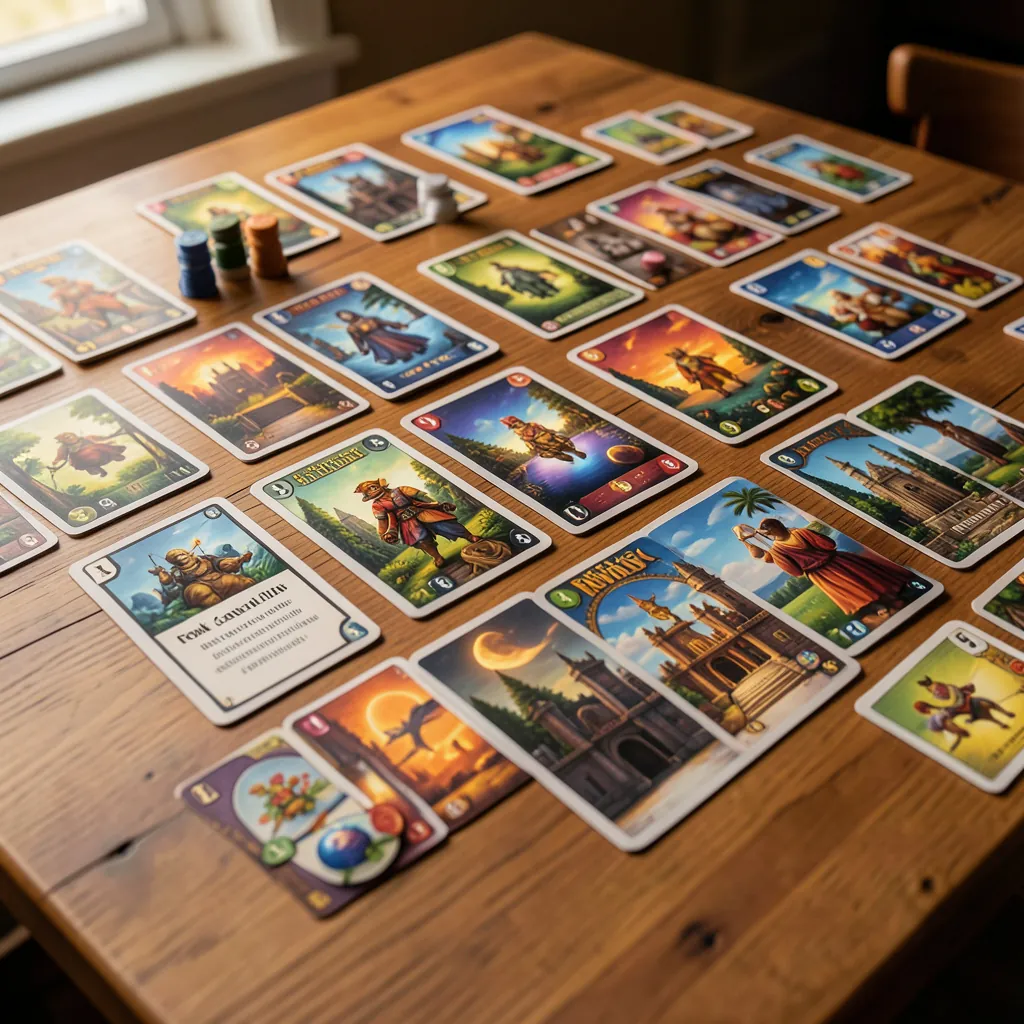
How to Play Rook: Complete Rules, Scoring, and Variations
Contents
🃏 Rook is a trick-taking card game published by Parker Brothers in 1906 (today Hasbro and Winning Moves) that uses a 57-card deck in four colors — red, yellow, green and black — numbered 1 to 14, plus the wild Rook Bird. The goal is to win tricks containing “counter” cards (5s, 10s, 14s and the Rook Bird) and be the first partnership to reach 300 points.
Players: 2–6 (standard partnership game uses 4) Play Time: 10–60 minutes per round Age: 8+ Difficulty: Easy to learn, moderate strategy Type: Trick-taking card game
Setup
- Choose partners (4-player game). Draw cards if you wish — the two high cards play against the two low cards — and partners sit opposite each other. Players must keep their hands secret from everyone, including their partner.
- Choose the dealer. Players draw cards for the first deal; highest card deals. The deal rotates to the left on each subsequent hand.
- Build the deck. Start with the 56 numbered cards (1–14 in each of four colors) and remove all 1s, 2s, 3s and 4s. That leaves 40 cards. Add the Rook Bird card for 41. Decide before play whether the Rook Bird is included — the tournament rules allow either, and without it the deck totals 100 points instead of 120.
- Shuffle and cut. The dealer shuffles and offers the cut to the player on the right.
- Deal. Deal 9 cards face down to each player, plus a face-down nest in the center of the table, apart from any player’s hand. (Sources differ only in style: Hasbro and Wikipedia deal all cards one at a time with a 5-card nest; Winning Moves deals the nest one card at a time after each round of player cards, giving a 4-card nest — 5 cards when the Rook Bird is used.)
- Handle misdeals. If any card ranked 10 or higher is exposed during the deal, a redeal is required. If a lower card is exposed, any player may demand a new deal.
- Appoint a scorekeeper with paper or the score pad. Record the high bidder, the bid, the trump color and each side’s running score.
How to Play
- Bid for the right to name trump. Bidding starts with the player to the dealer’s left and continues clockwise. The opening bid must be at least 70 points, and all bids must be divisible by 5 (70, 75, 80 …). The maximum is 120 — the total value of all counters in the deck when the Rook Bird is used. You may pass; a player who passes may not bid again that hand. At any point a player holding no counters may call for a redeal.
- The high bidder becomes the declarer and takes the nest. He or she adds the nest cards to his or her hand, then sets aside the same number of cards face down to form a new nest. You may bury counters in the nest for strategic purposes.
- The declarer names the trump color. Any card of the trump color beats any card of the other three colors.
- The first lead. The player to the left of the dealer — who may or may not be the declarer — leads any card of any color face up to the center of the table.
- Follow suit. Play moves clockwise and each player plays one card face up. If you have a card of the color led, you must play that color. If you cannot follow suit, you may play any card — including a trump or a counter of another color.
- Trump (“ruff”) wins. The highest card of the color led takes the trick, unless the trick is trumped, in which case the highest trump takes it.
- The Rook Bird beats everything. The Rook Bird is the highest trump no matter which color is trump, and it is the only card that may be played at any time regardless of the color led and regardless of the other cards in your hand. If the Rook Bird is led, every other player must play a trump if they have one. If trump is led and you have no other trump, you must play the Rook Bird.
- Take the trick and lead next. The winner of a trick places it face down in front of him or her and leads any card to the next trick. Tricks may not be reviewed until the hand is complete.
- The last trick captures the nest. The player who takes the final trick of the hand also wins the buried nest and scores any counters in it.
- Watch the renege rule. If a player fails to follow suit, the error may be corrected before the next trick is taken. If it is discovered later, the hand ends and the offending side is set back the full amount of the bid, regardless of which side made the bid; opponents keep the counters they captured before the error.
Scoring
Only certain cards — “counters” — have value. All other cards are worth nothing, and captured tricks have no separate value.
| Counter card | Point value |
|---|---|
| Each 5 | 5 points |
| Each 10 | 10 points |
| Each 14 | 10 points |
| Rook Bird | 20 points |
| Total in deck | 120 (100 without the Rook Bird) |
Partners add their counters together for a joint score each hand.
What happens if the declarer misses the bid?
If the declaring partnership captures fewer points than it bid, it loses the full amount of the bid and scores none of the counters it captured. Example: bid 80, captured 75 → score minus 80 (0 − 80 = −80). Scores can therefore go negative. If the partnership had 140 points and failed an 80 bid, the new score is 60.
The defending partnership always scores the counters it captured, whether or not the declarer made the bid.
How do you win?
The first partnership to reach 300 points at the end of a hand wins. If both sides pass 300 in the same hand, the higher total wins; if there is a tie, play another hand.
⚠️ Conflict between sources: penalty and card values
- Failed-bid penalty: Winning Moves, Hasbro’s Classic rules and Wikipedia deduct the full bid and award no counters. Hasbro’s Intermediate Game rules instead say the bidder simply “scores zero points for the hand” with no deduction. Both are official at different times — agree on one before you start.
- Counter values: Hasbro’s 100th Anniversary Beginner and Intermediate games use simplified “stars” (each 5 = 1, each 10 = 2, each 14 = 2, Rook Bird = 4) with target scores of 40 and 50 respectively. The Classic, Tournament and Wikipedia rules use 5/10/10/20 with a target of 300.
- Rook Bird’s rank: Hasbro calls it “the 20 of trump,” Winning Moves calls it “the equivalent of the 14 of Trump,” and another Parker edition calls it the “15 of trump.” The descriptions differ, but the mechanic does not: it beats every other card in play.
💡 Strategy Tips
- Bid only what your hand can back up. A missed bid costs the full bid and forfeits your counters — that swing decides games. Counters are worth a fixed 120 points, so 70–80 bids should reflect real control of at least one color plus a trump or two.
- Use the nest to create a void. Burying every card of one color lets you ruff that color later — a classic Kentucky Discard tactic. Winning Moves explicitly permits burying counters in the nest too.
- Think twice about “eggs” in the nest. Because the last-trick winner takes the nest, burying an unprotected 10 or 5 is only wise if you expect your side to take the final trick.
- Track the 14s, 10s and 5s. There are only twelve counters in a 41-card deck; knowing which have fallen tells you exactly how many points remain and whether your bid is safe.
- Common beginner mistakes: forgetting the mandatory follow-suit rule (a late-discovered renege ends the hand and costs the bid), playing the Rook Bird early “just to win a trick” instead of saving it for a counter-heavy trick or the final trick, and reviewing captured tricks mid-hand — which is not allowed.
🎲 Variations
| Variant | Players | Trump decided by | Nest | Winning score |
|---|---|---|---|---|
| Beginner Game (Hasbro) | 4 individual | Top card of the nest is turned up | 5 cards, not used in play | 40 |
| Intermediate Game (Hasbro) | 4 individual | Bidding (star values) | 5 cards, won by highest bidder | 50 |
| Classic / Tournament Rook (“Kentucky Discard”) | 4 in partnerships | Bidding from 70 in steps of 5 | 5 cards (4 without the Rook Bird) | 300 |
| Wild Bird | 2–4 | Cut card (bottom card of cut) | 1 card (4 players), 2 cards (3 players), draw pile (2 players) | Four chips in a row |
| Club Rook | 4 or 6 in partnerships | No trump — rummy-style melding | None | 5,000 |
Beginner Game. Skip bidding and the nest entirely: turn over the top card of the nest (if it’s the Rook Bird, put it on the bottom and turn another) and that color is trump. Deal all 41 cards one at a time including a 5-card nest, which is left face up as a trump reminder. First player to 40 points wins; ties are replayed.
Intermediate Game. Same as Beginner but with simplified bidding: each player makes one bid in stars for the right to call trump and win the nest. The bidder must score at least the bid or scores zero for the hand. Play to 50.
Wild Bird (2–4 players). Each player takes a Wild Bird score card and chips; taking a trick lets you cover matching spaces. The Rook Bird wins any trick and lets you remove one chip from an opponent’s card. First to four in a row horizontally, vertically or diagonally wins for the partnership. Tournament play often uses best-of-5 or best-of-7 rounds.
Wild Bird for 2 players. Remove 1s–4s and add the Rook Bird (41 cards), cut for trump, deal 13 cards each and place the rest as a draw pile. After each trick both players draw one card, winner first; the last-trick winner takes the final draw card. You must still win a card in a trick to score it.
Wild Bird for 3 or 4 individuals. Identical to the partnership game, but no partners; the nest holds 2 cards (3 players) or 1 card (4 players).
Club Rook (1957 Parker rules). A completely different, rummy-style game using two Rook decks: deal 13 cards each, draw two and discard one per turn, and meld sequences or matching sets (1s and 2s are wild). Seven-card “Rookies” score 1,200 (sequence), 800 (natural) or 400 (regular). Partnerships race to 5,000 points.
House rules from the official sources. After every four hands, one partnership swaps seats to change the play order. Improper discarding to the nest, or any comment that could affect a partner’s play, costs 40 points.
❓ FAQ
How many players can play Rook? Rook supports 2 to 6 players. The standard and tournament game is 4 players in two partnerships sitting opposite each other; Hasbro’s individual games are also written for 4. Six-player partnership play appears in Club Rook using three decks.
How do you win at Rook? Capture counters (5s, 10s, 14s and the Rook Bird) in tricks and be the first partnership to reach 300 points at the end of a hand. If both sides pass 300 in the same hand, the higher total wins; a tie means another hand.
Can you play Rook with 2 players? Yes. The sources detail a 2-player version of Wild Bird — deal 13 cards each from a 41-card deck with a draw pile, both players drawing after every trick. Full partnership Rook is designed for four, so 2-player trick-taking usually adapts those rules.
Is Rook hard to learn? No. If you already know trick-taking games, the core loop takes one hand to learn. Hasbro’s Beginner Game deliberately removes bidding and the nest so new players can learn follow-suit and trumping first; bidding is added in the Intermediate and Classic games.
How long does a game of Rook take? A single round runs about 10–60 minutes depending on the variant. A full game to 300 points typically spans several hands, so a complete partnership game often runs 30–60 minutes.
What do you need to play? One Rook deck (57 cards: 56 numbered cards plus the Rook Bird), from which you remove the 1s–4s to leave 40 or 41 cards, plus a score pad and pencil. Two decks are needed only for Club Rook.
Related guides
- How to Play Phase 10: Rules, Scoring, and Strategy
- How to Play War: Rules for the 2-Player Card Game
- 5 hundred card game
- 🃏 How to Play 500: The Complete Card Game Guide