How to Play Rummy: Complete Rules, Scoring, and Strategy Guide
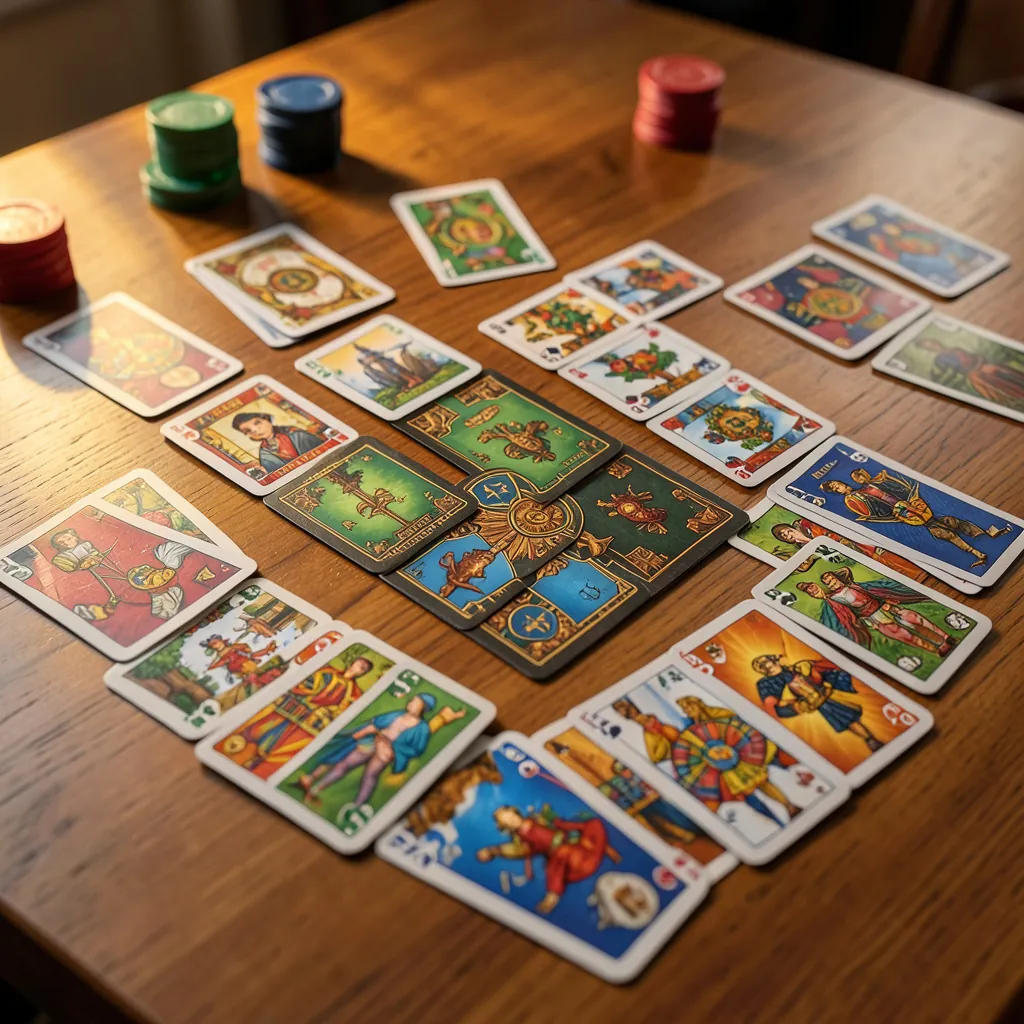
How to Play Rummy: Complete Rules, Scoring, and Strategy Guide
Contents
🃏 Rummy is a classic card game where players race to form their entire hand into valid combinations—sets of matching ranks and runs of consecutive suits—before opponents do. The goal is simple: be the first to meld all your cards and go out, leaving opponents with penalty points for their unmelded cards.
Players: 2-6 Play Time: 20-30 minutes Age: 10+ Difficulty: Easy Type: Matching card game
Setup
Setting up rummy requires just a standard deck of cards and a few simple preparations:
- Choose the deck: Use one 52-card deck for 2-5 players. For 6 or more players, use two decks (104 cards). Jokers are optional and can be added as wild cards.
- Determine the deal: The number of cards dealt varies by player count:
- 2 players: 10 cards each
- 3-4 players: 7 cards each
- 5-6 players: 6 cards each
- When using two decks with 4-7 players: 10 cards each
- Deal the cards: The dealer gives one card at a time face-down, beginning with the player on the left.
- Form the stock: Place all remaining undealt cards face-down in the center of the table to form the stock pile.
- Start the discard pile: Turn the top card of the stock face-up and place it beside the stock to begin the discard pile.
- Designate a scorer: Have paper and pencil ready to track cumulative scores across multiple hands.
How to Play
The core gameplay of rummy follows a simple draw-meld-discard pattern:
-
Determine turn order: The player to the left of the dealer plays first. Play continues clockwise around the table.
-
Draw a card: On your turn, draw either the top card from the stock pile OR the top card from the discard pile. Add it to your hand.
-
Form melds (optional): You may lay down any valid combinations from your hand onto the table face-up. Valid melds include:
- Sets: Three or four cards of the same rank (e.g., 7♥ 7♦ 7♣)
- Runs: Three or more consecutive cards of the same suit (e.g., 5♠ 6♠ 7♠)
- Ace rule: Aces can be high (Q-K-A) or low (A-2-3), but not both in the same sequence
- Jokers: Jokers and designated wild cards can substitute for any card in a meld
-
Lay off cards (optional): You may add individual cards from your hand to any melds already on the table, regardless of who played them. For example, if a set of three 8s is showing, you can add the fourth 8.
-
Discard one card: End your turn by placing one card face-up onto the discard pile. If you drew from the discard pile this turn, you may not discard that same card back.
-
Continue play: The next player to the left takes their turn following the same steps.
-
Go out: When you have melded all cards in your hand (or all but one, which you discard), you win the hand. You can go out by melding your final card, laying off your last card to an existing meld, or discarding your last card.
-
Stock exhaustion: If the stock runs out before anyone goes out, turn the discard pile over (without shuffling) to form a new stock and continue play.
Special Rule: Going “Rummy”
If you get rid of all cards in your hand at once—without having previously melded or laid off any cards—you achieve “rummy.” In this case, every other player pays double the normal penalty.
Scoring
Scoring in rummy penalizes players for cards left in their hands:
| Card Type | Point Value |
|---|---|
| 2 through 10 | Face value (e.g., 5 = 5 points) |
| Jack, Queen, King | 10 points each |
| Ace | 1 point (or 11 if used in Q-K-A run) |
| Jokers/Wild cards | 15 points each |
How scoring works:
- When a player goes out, all other players reveal their remaining cards and count the point values.
- The winner collects points from each opponent based on that opponent’s unmelded cards. Cards in completed melds still count against you if you haven’t laid them down.
- With multiple players, the winner adds up points owed from all opponents.
- The first player to reach 100 points (or 250 for a longer game) wins the match.
💡 Strategy Tips
-
Prioritize runs over sets: A run can be extended at either end, giving you two opportunities to complete it (drawing the card above or below). A set only has one possible completing card for each missing rank.
-
Watch the discard pile carefully: Track what opponents discard—it reveals what they don’t need and helps you predict safe discards.
-
Meld early with high-value cards: Get face cards and jokers out of your hand quickly. Holding a king (10 points) or joker (15 points) is risky if opponents go out first.
-
Don’t split pairs unnecessarily: Two of a kind gives you a reasonable chance at completing a set. Only break up pairs when you have a clearly better option elsewhere.
-
Avoid giving away information: When you pick up a card you don’t want from the stock, add it to your hand first, then discard—don’t immediately throw it back, which signals to opponents what you’re collecting.
Common beginner mistakes: Discarding cards that fit opponents’ visible melds, holding too many high-value cards late in the game, and forgetting to lay off cards to existing melds before discarding.
🎲 Variations
Rummy has dozens of popular variations:
- Gin Rummy: The two-player version where you knock when unmatched cards total 10 points or less. Melds stay hidden until the hand ends.
- Contract Rummy: Each deal requires a specific “contract” (like two sets and a run) that gets progressively harder over multiple deals.
- Canasta: A partnership game using two decks where melds of seven or more cards score bonuses.
- Kalookie: Basic rummy played with 104 cards (two decks) plus jokers.
- Two-player rummy: Each player receives 10 cards; otherwise the rules remain the same.
- Wild card variation: Designate 2s as wild cards, or use jokers as wild. A player who takes a wild card from a table meld must replace it with the natural card it represents.
House rule note: Some groups play that the first player to go out ends the hand immediately, while others allow remaining players one final turn to lay off cards.
❓ FAQ
How many players can play rummy? With a single 52-card deck, 2-5 players can play. For 6 or more players, use two decks and deal 10 cards each to 4-7 players. Rummy works best with 3-5 players, as two-player games often use Gin Rummy rules instead.
How do you win at rummy? You win a hand by being the first to meld all your cards (or all but one, which you discard). You win the overall game by being the first to reach 100 points (or 250 for longer games) based on opponents’ remaining card values.
Can you play rummy with 2 players? Yes. Each player receives 10 cards. The two-player version is often played as Gin Rummy, where melds stay hidden until a player knocks with 10 or fewer points in unmatched cards.
Is rummy hard to learn? No—rummy is considered an easy game to learn. The basic rules can be explained in a few minutes: draw a card, form sets and runs, discard one card. Strategy takes longer to master.
How long does a game of rummy take? A single hand typically takes 5-10 minutes. A full game to 100 points usually lasts 20-30 minutes, depending on the number of players and how quickly hands complete.
What do you need to play rummy? You need one or two standard 52-card decks (depending on player count), optional jokers for wild cards, and paper and pencil for keeping score.
Related guides
- How to Play Phase 10: Rules, Scoring, and Strategy
- How to Play War: Rules for the 2-Player Card Game