Phase 10 Levels: How to Play, Score, and Win the Rummy-Style Card Game
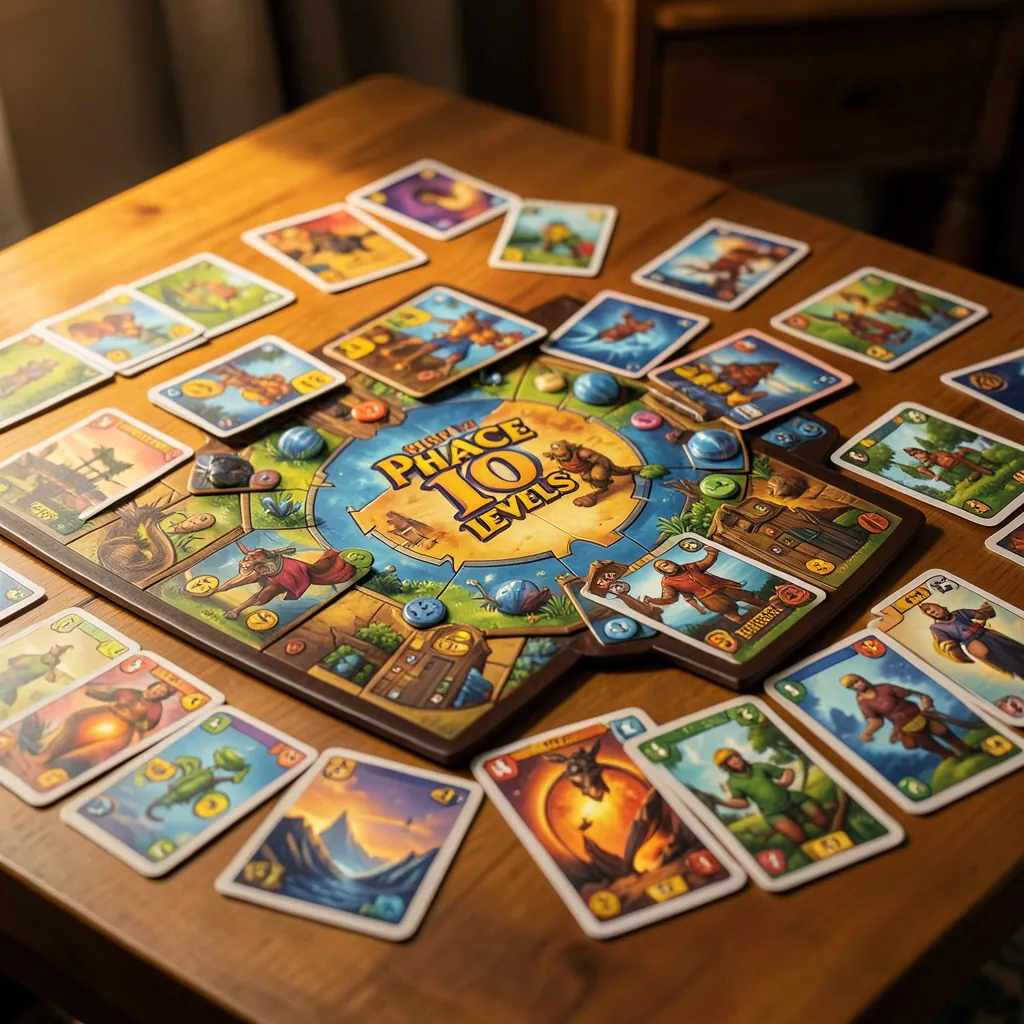
Phase 10 Levels: How to Play, Score, and Win the Rummy-Style Card Game
Contents
🃏 Phase 10 is a rummy-style card game in which players race through 10 specific “phases,” completing each combination in order before moving to the next. The first player to complete all 10 phases wins; if multiple players finish Phase 10 in the same round, the lowest total score wins. Use the phase list and rules below to play accurately.
Players: 2–6 (Mattel 40th Anniversary and Noble Knight)
Play Time: 30–60 minutes (Noble Knight; the museum articles do not list a play time)
Age: 7+ (Mattel and Noble Knight for the 40th Anniversary edition)
Difficulty: Easy to learn, with luck and strategy (Mattel notes a combination of luck and strategy)
Type: Rummy-style card game (not trick-taking)
Source conflict note: The cited museum articles do not give player count, age, or play time. Mattel and Noble Knight list 2–6 players and age 7+, while Noble Knight lists 30–60 minutes. These source-backed values conflict with the unsourced “3–5 players / 20–30 minutes / 10+ / trick-taking” quick-fact example; Phase 10 is rummy-style, not trick-taking.
Setup
From the Mattel instruction sheet:
- Choose a dealer.
- Give each player a Phase Reference Board (lists all 10 phases) and a Phase Tracker.
- Slide each tracker to point to Phase 1.
- Shuffle the deck and deal 10 cards face down to each player. Keep your hand hidden.
- Put the remaining deck face down in the center as the draw pile.
- Flip the top card of the draw pile next to it to start the discard pile.
- The player to the dealer’s left starts; play continues clockwise.
How to Play
Each turn follows the same four steps from the instruction sheet.
- Draw one card. Take the top card of the draw pile or the top card of the discard pile and add it to your hand.
- Lay down your current phase if you can. A phase is a set, run, or color combination. You must have the entire phase in hand before placing it face up. You may lay down only one combination per round. Phases must be completed in order from 1 to 10; you cannot move to the next phase until your current one is placed. You get credit for completing a phase as soon as you place it.
- Hit existing combinations. After your own phase is on the table, you can add matching cards from your hand to any valid combination on the table—yours or another player’s. You may hit only on your turn, and you may play as many legal hit cards as you can.
- Discard one card. End your turn by placing one card face up on the discard pile.
- Go out to end the round. Once your phase is down, get rid of all remaining cards by hitting and/or discarding your last card. The first player to go out wins the round. That player—and every other player who completed their phase before the round ended—moves their tracker to the next phase. Players who did not complete their phase repeat the same phase next round.
What counts as a set, run, or color?
- Set: two or more cards with the same number, regardless of color. For example, three 7s. The two sets in Phase 1 may even use the same number, such as three 10s and three more 10s.
- Run/sequence: four or more numbered cards in consecutive order, regardless of color. Example: 3-4-5-6.
- Color: cards of one color, with no numerical order required. Example: seven red cards.
What are the 10 Phase 10 levels?
| Phase | Requirement |
|---|---|
| 1 | 2 sets of 3 |
| 2 | 1 set of 3 + 1 run of 4 |
| 3 | 1 set of 4 + 1 run of 4 |
| 4 | 1 run of 7 |
| 5 | 1 run of 8 |
| 6 | 1 run of 9 |
| 7 | 2 sets of 4 |
| 8 | 7 cards of one color |
| 9 | 1 set of 5 + 1 set of 2 |
| 10 | 1 set of 5 + 1 set of 3 |
The museum article also highlights that Phase 1 is two sets of three, Phase 6 is one run of nine, and Phase 8 is seven cards of one color; the full ordered list above comes from the Mattel instruction sheet.
How do Wild and Skip cards work?
- Wild cards can replace a number card or stand in for any color. You may use as many Wilds as you want in a phase, as long as at least one numbered card is included. Once a Wild is played into a phase, it stays there for the rest of the round. If the dealer starts the discard pile with a Wild, the first player may take it.
- Skip cards make another player lose a turn. On your turn, place the Skip in front of the chosen player instead of on the discard pile; that player’s next turn is skipped. Playing a Skip counts as your discard and ends your turn. A Skip cannot be used in a phase, cannot be taken from the discard pile, and cannot be played against a player who already has a Skip in front of them. If the dealer starts the discard pile with a Skip, the first player’s first turn is automatically skipped.
Scoring
At the end of each round, the player who went out scores 0. Every other player scores the cards left in their hand; cards already on the table do not count.
| Card left in hand | Points |
|---|---|
| Numbered card 1–9 | 5 |
| Numbered card 10–12 | 10 |
| Skip card | 15 |
| Wild card | 25 |
Keep a running total on paper. The first player to complete Phase 10 at the end of a round wins the game. If two or more players complete Phase 10 in the same round, the player with the lowest total score wins. If those players tie, they replay Phase 10 and the first to go out wins. After scoring, the player to the dealer’s left becomes the new dealer; collect, shuffle, and start the next round.
💡 Strategy Tips
- Lay down your phase as soon as it is complete. You cannot hit until your own phase is on the table, and you only get to lay down one combination per round.
- Hit aggressively after your phase is down. Add legal cards to any set, run, or color on the table—including opponents’ combinations—to reduce the cards left in your hand.
- Use Wilds carefully. They are flexible, but a Wild left in hand costs 25 points; once played, a Wild cannot be removed for the rest of the round.
- Save Skip cards for a threat. A Skip can delay a player who is close to going out, but it counts as your discard and cannot be used in a phase.
- Common beginner mistake: assuming everyone is on the same phase. Players who fail to complete their phase repeat it, so track each player’s phase and remember that phases must be completed in order.
🎲 Variations
- Player count: Mattel and Noble Knight list the 40th Anniversary deck for 2–6 players. The cited rules do not include a separate 2-player variant, so 2-player games use the standard rules.
- Published variants: The museum article mentions Phase 10 Masters, Phase 10 Twist, a Phase 10 dice game that resembles Yahtzee, and the Phase 10: World Tour mobile game.
- 40th Anniversary Edition: Mattel lists it as released in 2022 with a keepsake box, special cards, and a letter from creator Kenneth R. Johnson. Noble Knight lists the publish year as 2021; that date conflicts with Mattel’s 2022 release listing.
- House rules: The cited instruction sheet has a variations heading, but the provided source text does not include specific house-rule details, so this guide does not invent any.
❓ FAQ
How many players can play Phase 10? 2–6 players. Mattel and Noble Knight list the 40th Anniversary deck for 2–6 players; the museum articles do not give a player count.
Can you play Phase 10 with 2 players? Yes. The deck is listed for 2–6 players, and the cited rules do not provide a separate 2-player rule set, so use the standard rules.
How do you win Phase 10? Be the first player to complete Phase 10 at the end of a round. If multiple players complete Phase 10 in the same round, the lowest total score wins; a tie is replayed as Phase 10, with the first player out winning.
Is Phase 10 hard to learn? It is easy to learn because each turn is draw, lay down a phase if possible, hit, and discard. The challenge is the strict phase order and managing cards that carry point penalties.
How long does a game take? Noble Knight lists 30–60 minutes for the 40th Anniversary edition. The museum articles do not give a play time, and the instruction sheet does not state a fixed duration.
What do you need to play Phase 10? The cited instruction sheet lists 108 cards: 96 numbered cards (two decks of 1–12 in green, yellow, orange, and red), 8 Wild cards, and 4 Skip cards, plus 6 Phase Reference Boards and 6 Phase Trackers. You also need paper and pencil for scoring.
Related guides
- How to Play War: Rules for the 2-Player Card Game
- 5 hundred card game
- 🃏 How to Play 500: The Complete Card Game Guide