How to Play the Mancala Marble Game: Rules, Setup, Scoring, and Variations
How to Play the Mancala Marble Game: Rules, Setup, Scoring, and Variations
Contents
🎲 To play the mancala marble game, set up a two-row, six-pit board with a store at each end, put 3 or 4 marbles in each pit, then take turns scooping all marbles from one of your pits and sowing them one by one around the board. The goal is to collect the most marbles in your store; extra turns and captures help you win.
Players: 2 (or 2 teams)
Play Time: Not stated in the sources (short turn-based game)
Age: 6+ (Toys R Us product; app stores may list 4+)
Difficulty: Easy
Type: Count-and-capture board game (mancala family; Kalah/Oware-like)
Setup
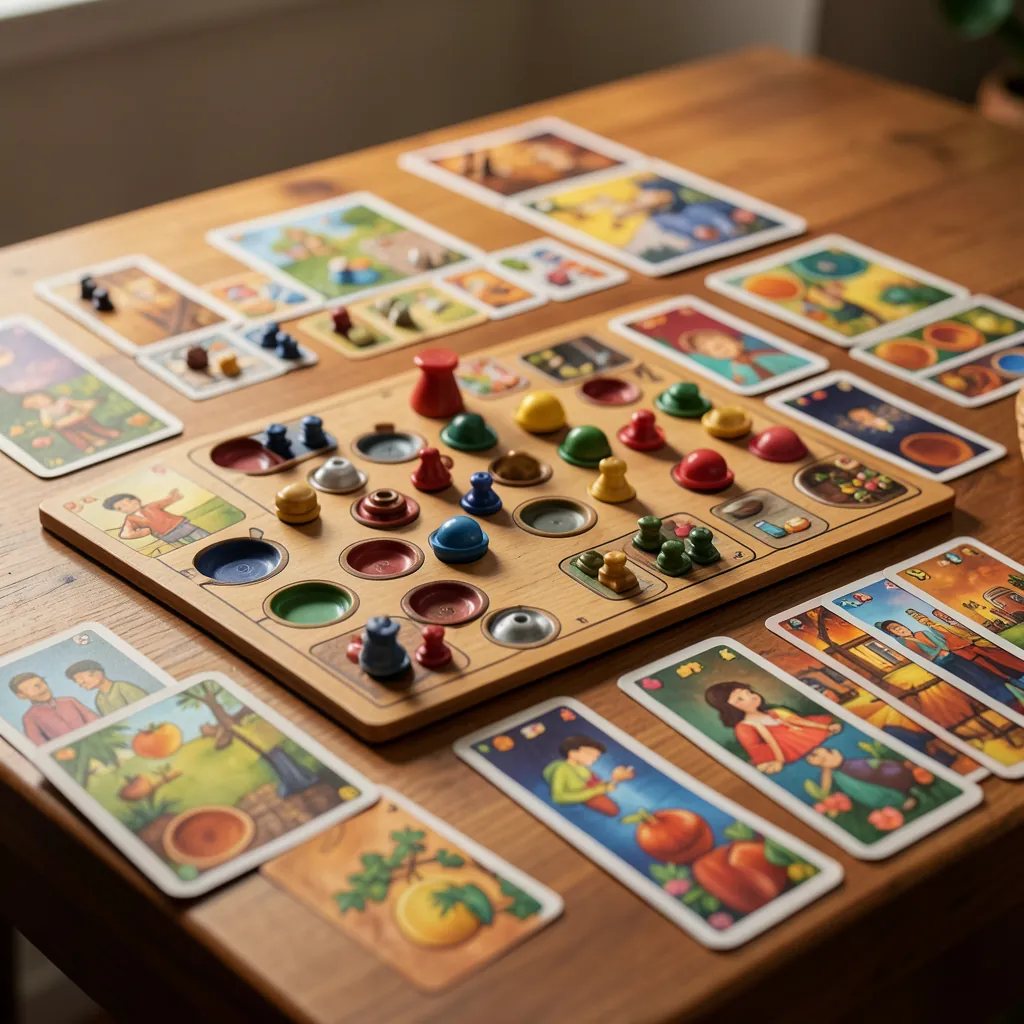
Mancala is a family of count-and-capture games, not one single game; Source 1 notes over 200 variants and boards ranging from 2 holes to 160 holes. This guide follows the common two-row, six-pits-per-side marble version described by the British Museum, East Baton Rouge Parish Library, and the Mancala apps.
- Use a board with two rows of six small pits and one larger store at each end.
- Sit opposite your opponent; each player controls the six pits on their side.
- Leave both stores empty at the start.
- Put 4 marbles per pit for the 48-marble version used by Sources 2 and 3, or 3 marbles per pit for the 36-marker beginner version used by Source 6. Source 6 also says more confident players can try 4 per cup.
| Source/version | Board | Pieces | Setup | Players / age |
|---|---|---|---|---|
| East Baton Rouge Parish Library | 2 rows × 6 holes + 2 stores | 48 stones, beads, beans, marbles, shells, or coins | 4 stones in each of the 12 holes | 2-player rules |
| Google Play “Mancala” app | 2 rows × 6 pits + 2 stores | Marbles | 4 marbles per hole | 2-player rules |
| British Museum / Oware beginner | Egg-carton 2×6 board + 2 stores | 36 marbles or small markers | 3 markers per cup; optional 4 | 2 players or teams |
| Toys R Us “Ancient Strategy Mancala” | Solid wood board | Decorated marble pieces | Not specified | 2 players; age 6+; $19.99 |
| Apple “Mancala: Marbles & Seeds” app | 2×6 board + stores | Marbles/seeds | Not specified | 2 players; app rating 4+ |
Conflict note: Setup varies by source. The library and Google Play rules use 4 marbles per pit; the British Museum beginner rules use 3 per cup. Both are source-supported, so choose one and state it before play.
How to Play
- On your turn, choose one of the six pits on your side and pick up all the marbles in it.
- Moving in the board’s set direction—sources describe this as counter-clockwise/anticlockwise, while the British Museum’s beginner wording says start with the next cup to your right—drop one marble into each following pit.
- Include your own store when you pass it, but skip your opponent’s store.
- If your last marble lands in your own store, take another turn.
- If your last marble lands in an empty pit on your side, capture that marble plus all marbles in the opposite pit and place them in your store.
- If your last marble lands anywhere else, your turn ends and play passes to your opponent.
- The game ends when all six pits on one side of the board are empty.
- Under the written rules in Sources 2, 3, 5, and 6, the player who still has marbles on their side adds those remaining marbles to their store; then each player counts their store.
Conflict note: Source 3’s written app rules say the player with remaining marbles gets them, but a Google Play review disputes that end-of-game rule and says it is not how they play in real life. Treat this as a house-rule disagreement, not a settled universal rule.
Scoring
- The winner is the player with the most marbles in their store at the end.
- Captured marbles and extra-turn marbles go into your store during play.
- At the end, remaining marbles on one side are added to that player’s store under the written rules used by the library, British Museum, and app sources.
- The sources do not state a standard tie-breaker, so agree on one before play if needed.
💡 Strategy Tips
- Plan for extra turns: Try to finish your last marble in your own store so you can move again.
- Use the first-move tip from Source 3: If you go first, start with the pit four pits away from your store so your last marble lands in your store and gives you a bonus turn.
- Watch empty pits: Ending in an empty pit on your side can capture the opposite pile, so check the opposite pit before scooping.
- Avoid careless gifts: Counting ahead helps you avoid leaving a large pile directly opposite an empty pit your opponent can use.
- Remember the skip rule: A common beginner mistake is dropping a marble into the opponent’s store; skip it and keep sowing.
🎲 Variations
- 2-player standard: The sources describe a two-player game; British Museum also allows two teams.
- 3 vs 4 marbles per pit: Use 3 per pit for the beginner 36-marker version, or 4 per pit for the 48-marble version.
- Player count note: None of the sources describes a standard 3–5 player version of this two-row board; the source-supported count is 2 players or 2 teams.
- Family-name variants: Mancala is also known as Kalah, Awele, Oware, and Bao in different versions; Source 1 lists Bao, Congkak, and Kalai among many variants.
- Board-size variants: Source 1 notes extreme boards such as Tchaiba with 160 holes and 320 seeds, and Nano waar with only 2 holes and 8 seeds.
- End-rule house rule: Some players dispute the “remaining marbles go to the other player” ending, as shown in a Source 3 review; agree before playing whether to use the written rule or a house rule.
❓ FAQ
How many players can play the mancala marble game?
Two players is the standard in the sources; the British Museum also allows two teams. Sources do not support a standard 3–5 player version of this two-row board.
How do you win at mancala?
Collect the most marbles in your store by the end of the game. Captures and extra turns help you build that total.
Can you play mancala with 2 players?
Yes. Two players is the normal setup, and the British Museum version also allows two teams.
Is mancala hard to learn?
No. The basic rules are easy to learn, but the game has enough strategy to stay interesting; Source 4 describes it as “simple rules and complex strategies.”
How long does a game take?
The sources do not state a fixed play time. It is a short turn-based game, so agree on a target number of games or playing time if needed.
What do you need to play?
A two-row, six-pit board with two stores, plus 36 or 48 marbles or small markers. You can also make a board from an egg carton and use stones, beans, shells, or coins.
Related guides
- Backgammon Direction of Play: Complete How-to-Play Guide
- How to Play Backgammon: Complete Rules, Setup & Strategy Guide
- backgammon how to