How to Play Mancala: Rules, Setup, Scoring and Variations
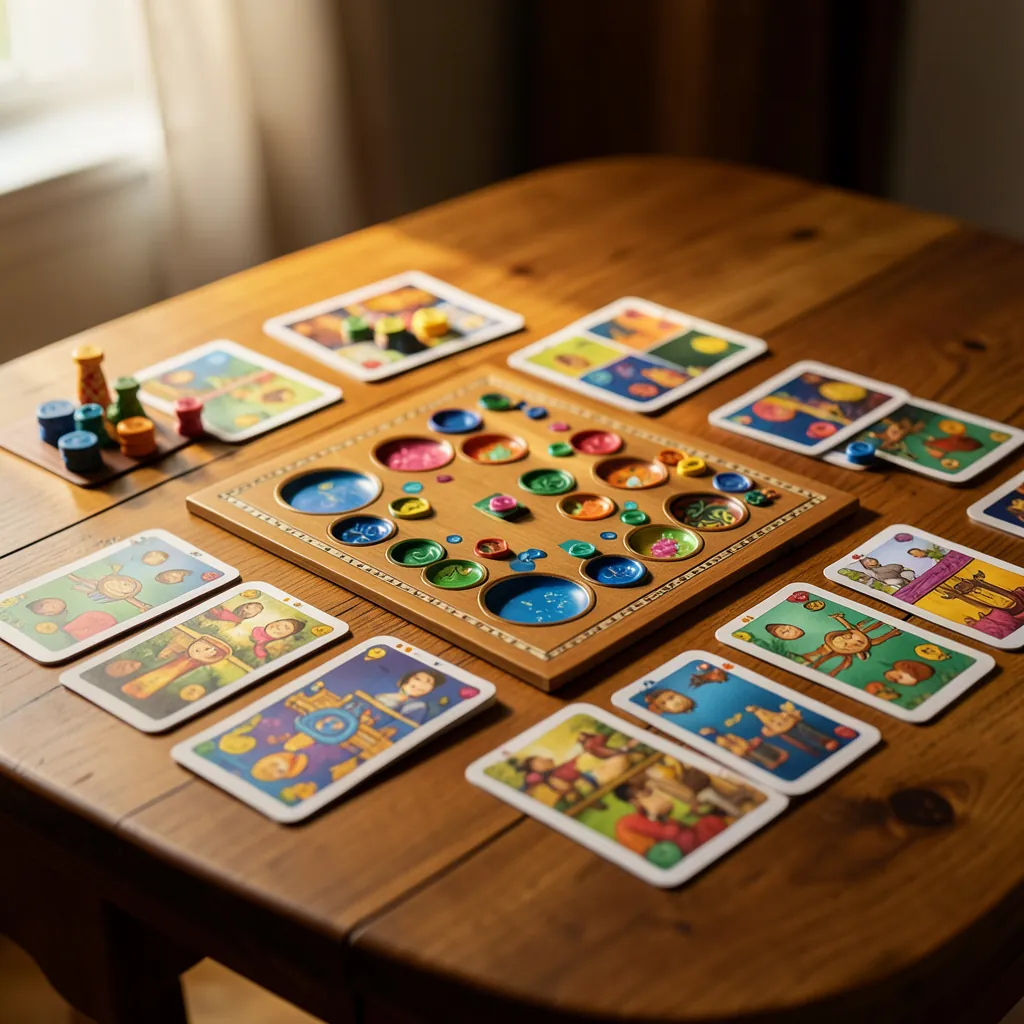
How to Play Mancala: Rules, Setup, Scoring and Variations
Contents
🎲 Mancala is a family of ancient “sowing” (count-and-capture) games played on a board with two rows of six pits plus one large scoring pit — the mancala — at each end; the Western version taught most often is Oware/Kalah. Two players take turns lifting every counter from one of their own pits and dropping them one by one around the board, and whoever collects the most counters in their own mancala wins.
Players: 2 (single players or two teams) Play Time: Roughly 10–20 minutes for the standard 6-pit game (the sources do not state a time; length depends on how fast players count and sow) Age: 6+ to make and play your own board (Source 4); the British Museum retail set is labelled 8+ (Source 3) — the sources disagree Difficulty: Easy — the rules are “simple” (Source 1) and the game is “amazingly addictive yet very simple” (Source 3) Type: Sowing / count-and-capture abstract board game (the variant usually taught is Oware/Kalah)
Setup
- Get a board with 12 small pits and 2 stores. A standard mancala board has two rows of six pits, plus one larger scoring pit — called a mancala or store — at each end (Sources 1, 3). No board? Dig holes in the ground, or use a dozen-egg carton: cut the lid off, cut the lid in half, and tape or glue one half under each end of the base to make the two stores (Sources 1, 2).
- Collect 36 counters. Seeds, dried beans, pebbles, marbles, glass beads or paperclips all work, and the colours do not matter — both players use identical, undifferentiated counters (Sources 1, 2, 3, 5).
- Place 3 counters in each of the 12 pits. Leave both stores empty (Sources 1, 2).
- Sit facing your opponent. Each player controls the six pits on their own side; in the egg-carton version, each player’s store is the half-carton at their right-hand end (Sources 1, 4).
- Decide who goes first. Source 4 suggests flipping a coin; any agreed method works.
How do the sources’ set-ups compare?
| Set-up detail | Standard 6-pit version (Sources 1, 2, 3) | Classroom version (Source 4) |
|---|---|---|
| Players | 2 players, or two teams (Source 2) | 2 players |
| Board | 2 rows × 6 pits + 1 store each end; wooden set is 44 cm × 13 cm (Source 3) | 12-cup egg carton + 2 lid halves as stores |
| Counters to start | 36 total = 3 per pit (Sources 1, 2) | 48 total = 4 pebbles per cup |
| Direction of sowing | To the right / anticlockwise (Source 1) | Counterclockwise (Source 4) |
| Extra turn trigger | Last counter lands in your own store (Sources 1, 2, 4) | Same |
| Capture trigger | Last counter lands in an empty pit on your side (Sources 1, 2, 4) | Same |
| Stated age | 8+ (retail set, Source 3) | 6+ (Source 4) |
Source 2 notes that if you are “feeling confident,” you can play the harder version with 4 markers in each of the 12 cups — which is exactly the count Source 4 uses.
How to Play
- Choose a pit on your own side. Pick up every counter from any one of the six pits on your side of the board. You may not start from your opponent’s side (Sources 1, 2, 4).
- Sow one counter per pit. Drop a single counter into each following pit, moving to your right — anticlockwise around the board (Sources 1, 4).
- Include your own store. When your sowing reaches your mancala, drop one counter into it and keep going (Sources 1, 2).
- Skip your opponent’s store. Never place a counter in the opponent’s mancala — leap over it and continue into their pits (Sources 1, 2, 4).
- Take another turn if you finish in your store. If the last counter of your handful lands in your own mancala, you go again (Sources 1, 2, 4).
- Capture from an empty pit on your side. If your last counter lands in an empty pit on your own side, you capture all the counters in the opponent’s pit directly opposite it and place them in your store (Sources 1, 2, 4).
- Note the one detail sources disagree on. Source 4 says the capturing pebble itself also goes into your store; Source 2 says you take “that marker, plus all of your opponent’s markers”; Source 1 mentions only the captured opponent counters. Agree which version you are playing before you start.
- End your turn after a capture. Unlike landing in your store, a capture does not grant another turn — play passes to your opponent (Sources 1, 2).
- Pass the turn if you land anywhere else. If your last counter lands in an occupied pit, or in an empty pit on your opponent’s side, your turn is over and your opponent sows (Sources 1, 2).
- Don’t handle counters casually. Source 4’s rule: neither player may touch the counters in a pit to check them — if you touch them, you must play that pit on that turn.
- End the game when one side is empty. The game stops as soon as all six pits on one player’s side of the board are empty (Sources 1, 2, 4).
Scoring
- Your score is the number of counters in your own store. The player with the most counters in their mancala wins (Sources 1, 2, 3, 4).
- The final sweep counts. When the game ends because one side is empty, the player who still has counters in their pits picks them all up and puts them in their own store before counting (Sources 1, 2, 4).
- There are no bonus points or partial credits — only stored counters count, which is why letting your opponent capture is so costly.
- Ties: none of the sources specify a tie-break rule, so agree one (for example, play another round) before you begin.
💡 Strategy Tips
- Count before you lift. Because sowing is deterministic, counting the counters in a pit tells you exactly where your last one will land — aim for your own store to earn the free turn (rules per Sources 1, 2; counting noted in Source 5).
- Don’t race to empty your side. Source 4 is explicit: “It is not necessarily a good strategy to be the first to clear out your cups” — the game ends when one side is empty, and the opponent then sweeps their remaining counters into their store.
- Engineer captures. Leave a pit on your side empty, make sure your opponent’s opposite pit is loaded, then land your last counter in the empty pit to take the lot (capture rule, Sources 1, 2, 4).
- Watch your opponent’s store. Keep their store out of their sowing path where you can — every counter that lands there is a point for them and possibly an extra turn.
- Common beginner mistakes: dropping a counter into the opponent’s store, forgetting the extra turn after landing in your own store, and picking counters up “just to count” — Source 4 rules that touching them commits you to playing that pit.
🎲 Variations
- 3 vs 4 counters per pit. The standard game starts with 3; Source 2 offers 4 per cup as a harder game, and Source 4 uses 4 throughout.
- Teams. Source 2 describes “two players or teams” taking turns — the simplest way to include more than two people, since every rules source describes mancala as a two-player game.
- Improvised boards. You don’t need equipment at all: holes dug in the ground with seeds, beans or stones as counters work fine (Source 1), as does a dozen-egg carton (Sources 2, 4).
- Different board sizes. Board configurations vary by variant — for example Endodoi is played on boards from 2 × 6 up to 2 × 10 pits (Source 5).
- Regional games. More than 800 traditional mancala names are known (Source 2). Best-known variants include:
| Variant name | Where it is played / noted |
|---|---|
| Oware | The popular two-row, six-pit version taught by the British Museum (Source 2) |
| Kalah | In the USA, “mancala” is often used as a synonym for Kalah (Source 5) |
| Main Chakot | Thailand — a boat-shaped ten-hole board (Source 1) |
| Congkak, Sungka, Bao, Omweso, Igisoro, Ünee tugaluulakh | Other named mancala games (Source 5) |
| Bohnenspiel / Ban-Ban | Historic European versions in the Baltic region and Bosnia (Source 5) |
| Ouril | Cape Verde, also played in Cape Verdean communities in New England (Source 5) |
❓ FAQ
How many players can play mancala? Two. Every rules source describes a two-player game played across a board, although Source 2 notes that two teams can play against each other.
How do you win at mancala? By finishing with the most counters in your own store. When one side’s six pits are empty, the other player sweeps their remaining counters into their store, and both totals are compared (Sources 1, 2, 4).
Can you play mancala with 2 players? Yes — two players is the standard game, and you need only one board and 36 counters, or an egg carton and a handful of dried beans (Sources 1, 2).
Is mancala hard to learn? No. The sources describe the rules as “simple” (Source 1) and the game as “very simple” (Source 3); the only fiddly parts are remembering to skip your opponent’s store and spotting capture opportunities.
How long does a game take? The sources don’t give a duration. A standard 6-pit game with 36 counters is quick — typically a few minutes to about 20 minutes depending on how carefully players count.
What do you need to play mancala? A board with two rows of six pits plus a larger store at each end, and 36 small counters such as seeds, beans, pebbles or glass beads. The British Museum’s wooden set (44 × 13 cm, with glass counters) retails for £25.00 and includes printed instructions (Sources 1, 2, 3).
How old is mancala? The sources conflict. Source 1 says it is “believed to have been invented by the Egyptians around 1400 BC” and Source 3 says it was “played since the time of the Pharaohs,” but Source 5 states there is “little verifiable evidence that the game is older than about 1300 years,” citing pottery-board fragments and rock cuts from 6th–7th century AD Aksumite Ethiopia and Eritrea — the same 500–700 CE dating given in Source 2. Treat the ancient-Egyptian origin as tradition rather than established fact.
Related guides
- Backgammon Direction of Play: Complete How-to-Play Guide
- How to Play Backgammon: Complete Rules, Setup & Strategy Guide
- backgammon how to