How to Play Kings in the Corners: Rules, Setup, Scoring, and Variations
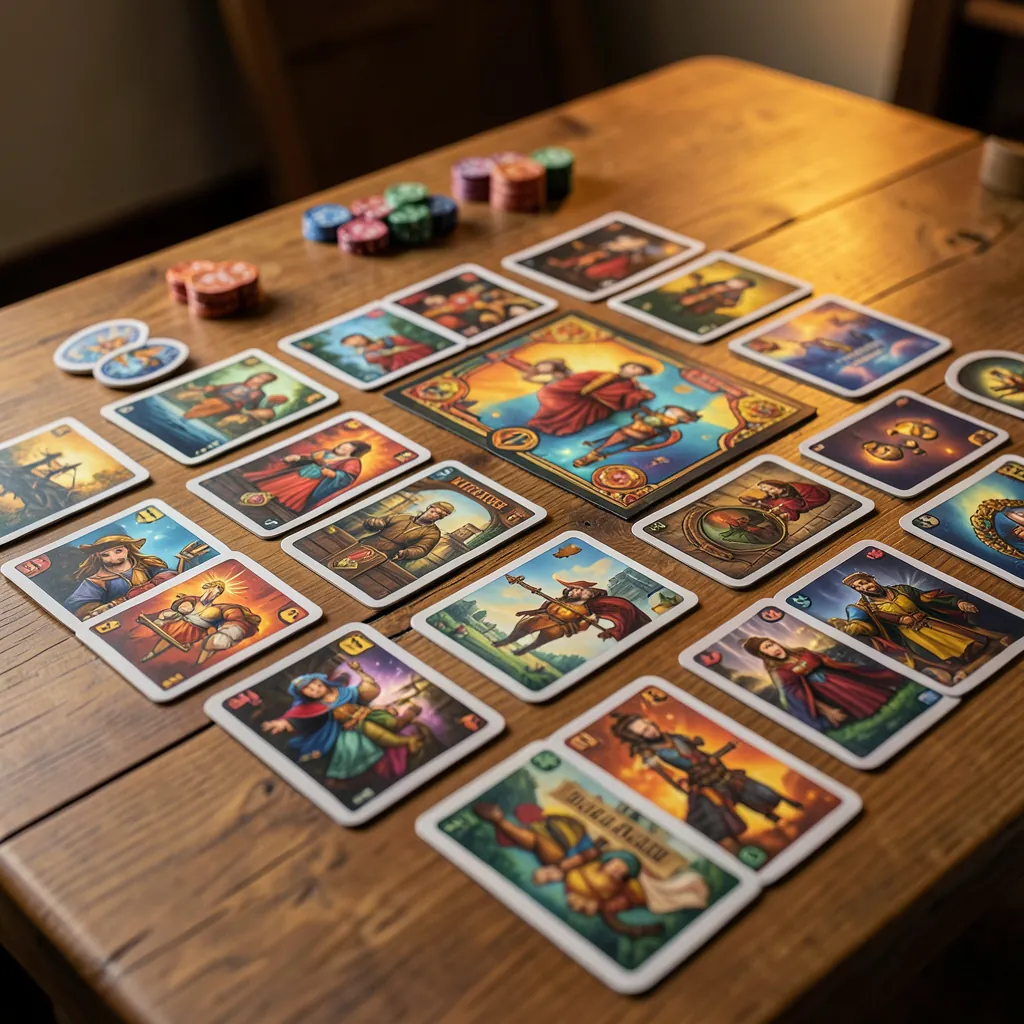
How to Play Kings in the Corners: Rules, Setup, Scoring, and Variations
Contents
🃏 Kings in the Corners (also called Kings Corners) is a solitaire-style shedding card game for 2–6 players in which you play cards onto shared piles in descending, alternating-color order and try to empty your hand first. Kings start the four corner piles; the first player out wins the round or pot, depending on the scoring version.
Players: 2–6 (four players often recommended) Play Time: Fast-paced; exact time is not stated in the supplied sources Age: 7+ for physical editions (some digital apps are rated 4+) Difficulty: Easy Type: Solitaire-style shedding card game
Setup
- Use one standard 52-card deck with jokers removed. You also need pennies or chips for the pot/scoring in chip-based versions; retail editions include cards, chips, and a fold-away control center.
- Shuffle the deck and deal 7 cards to each player. Sources support 2–6 players; HowStuffWorks says four is best.
- Turn four cards face up to form four central/orthogonal layoff piles.
- Leave the four corner spaces empty. They are reserved for kings; a corner becomes a new pile when a king is played there.
- If a king is among the four starting face-up cards, the first player may move it into a corner on their turn.
- Place the remaining deck face down in the center as the draw pile.
- The player at the dealer’s left goes first, and play moves clockwise.
How to Play
- On your turn, play any number of valid cards from your hand, extending your turn as long as you can. If you cannot make a single valid play, your turn ends; in chip-scoring versions, you pay one chip into the pot. Some online rules simply end the turn instead.
- Play a king into an empty corner. That corner becomes a new pile, and lower opposite-color cards can be built onto it.
- Play a card one rank lower and of the opposite color onto the top card of any pile. Example: a black 8 can go on a red 9. Ace is the lowest card, so piles build from King (13) down through Ace (1).
- Move an entire pile onto another pile when the bottom/base card of the moved pile is one rank lower and opposite in color to the top card of the destination pile.
- Play any card onto an empty central/orthogonal pile. Empty corner spaces remain king-only. Source 1 more broadly says any empty layoff space, while Source 4 narrows this to orthogonal piles and keeps corners for kings—this is a source conflict.
- At the end of your turn, if you did not go out, draw one card from the draw pile. Source 1 says draw after playing; BoardGameArena/Source 4 says draw first, then play—another source conflict.
- If you play your last card during your turn, you win the round immediately and do not draw.
Source conflicts in the core rules
- Draw timing: Source 1 draws at the end of the turn; Source 4 draws at the start.
- Stuck turn: Source 1 says pay a chip into the pool; Source 4 says simply end the turn.
- Empty piles: Source 1 says any card may be played onto an empty layoff space; Source 4 says any card on an empty orthogonal pile, while corners require kings.
- Player counts and scoring vary by edition and app; see the comparison table below.
Scoring
| Source/edition | Players/format | Age | Round win / scoring | Overall win |
|---|---|---|---|---|
| HowStuffWorks (Source 1) | 2–6; four best | Not stated | First out wins; losers pay 10 chips per king and 1 chip per other card; winner collects chips | Not specified; paper scoring can omit pass penalties |
| Scheels/Michaels physical editions (Sources 3 & 5) | 2–6 | 7+ | First out wins pot plus opponents’ point chips for unplayed cards | First to 100 points wins the game |
| BoardGameArena (Source 4) | Online implementation | Not stated | First out wins round; kings score −10 each, other cards −1 each | Round-based; solo mode: leave 5+ cards in deck to win |
| Google Play app (Source 2) | 2 players vs computer | Not stated | Solitaire-like layout; first to empty hand wins the round | Not specified |
| Apple App Store app (Source 6) | 4 players (you + 3 robots) | 4+ | Build 13 down to 1 with alternating colors; first to empty hand wins | Not specified |
Scoring is not identical across sources. In the physical chip-scoring game, the round winner takes the pot and opponents pay penalty chips for cards left in hand: 10 chips per king and 1 chip per other card (Source 1). The retail editions say the first player to reach 100 points wins the overall game (Sources 3 and 5), while Source 1 only describes collecting chips at the end of a round. BoardGameArena uses negative scores—kings −10, other cards −1—and its solo mode changes the win condition. Digital apps describe emptying your hand as the win and do not specify cumulative scoring.
💡 Strategy Tips
- Save a legal play for later when it is safe. Source 1 notes this can spare you from paying the pot next turn and may block the next players from making plays.
- Plan whole-pile moves before stacking singles. A pile move can expose a rank/color you need or create a better sequence.
- Treat kings as corner-starters, not normal central-pile cards. Playing a king opens a corner pile for lower opposite-color cards.
- Do not fill an empty central pile automatically. It may give opponents an easy play; Source 1’s blocking tip applies here too.
- Common beginner mistakes: forgetting Ace is low, mixing colors, drawing at the wrong point, and forgetting to pay the pot when stuck.
🎲 Variations
- 2 players: Physical rules support 2–6 players; use the same rules. The Google Play app is specifically 2 players vs the computer (Source 2).
- 3–6 players: Source 1 says 2–6 with four best; retail editions also list 2–6 (Sources 3 and 5). The Apple app uses 4 players—you plus 3 robots—and deals 7 cards each (Source 6).
- Solo mode: BoardGameArena lists a solo win condition: leave 5 or more cards in the deck to win (Source 4).
- Scoring/round length: Play one round for an immediate winner, or use the 100-point cumulative game from the retail editions (Sources 3 and 5). Chip-pot/pass penalties (Source 1) and paper negative scoring (Source 4) are both used.
- Draw-timing house rule: Because sources differ, agree before play whether you draw at the start (Source 4) or end (Source 1) of your turn.
❓ FAQ
How many players can play Kings in the Corners?
2–6 players in physical editions, with four often recommended (Sources 1, 3, and 5). Some digital versions are 2-player vs computer (Source 2) or 4-player (Source 6).
Can you play Kings in the Corners with 2 players?
Yes. Physical rules support 2–6 players, and the Google Play version is specifically 2 players vs the computer (Source 2). Agree on draw timing and scoring before you start.
How do you win Kings in the Corners?
Empty your hand first to win the round (Sources 1 and 4). In the 100-point physical game, you collect opponents’ penalty chips for unplayed cards—10 per king and 1 per other card—and the first player to 100 points wins the overall game (Sources 3 and 5; Source 1 gives the chip values). Some versions play only a single round.
Is Kings in the Corners hard to learn?
No. Sources describe it as easy to learn and solitaire-like (Source 5). The key rules are descending ranks, alternating colors, kings to corners, and whole-pile moves.
How long does a game take?
The supplied sources do not give an exact play time; they describe the game as fast-paced (Source 2). Actual time depends on player count, scoring target, and whether you play one round or to 100 points.
What do you need to play?
One standard 52-card deck plus pennies or chips for the pot/scoring (Source 1). Physical retail editions include cards, chips, and a fold-away control center (Sources 3 and 5).
Related guides
- How to Play Phase 10: Rules, Scoring, and Strategy
- How to Play War: Rules for the 2-Player Card Game
- 5 hundred card game
- 🃏 How to Play 500: The Complete Card Game Guide
- 500 Card Game Rules: How to Play Five Hundred