How to Play Skip-Bo: Setup, Rules, Scoring, and Variations
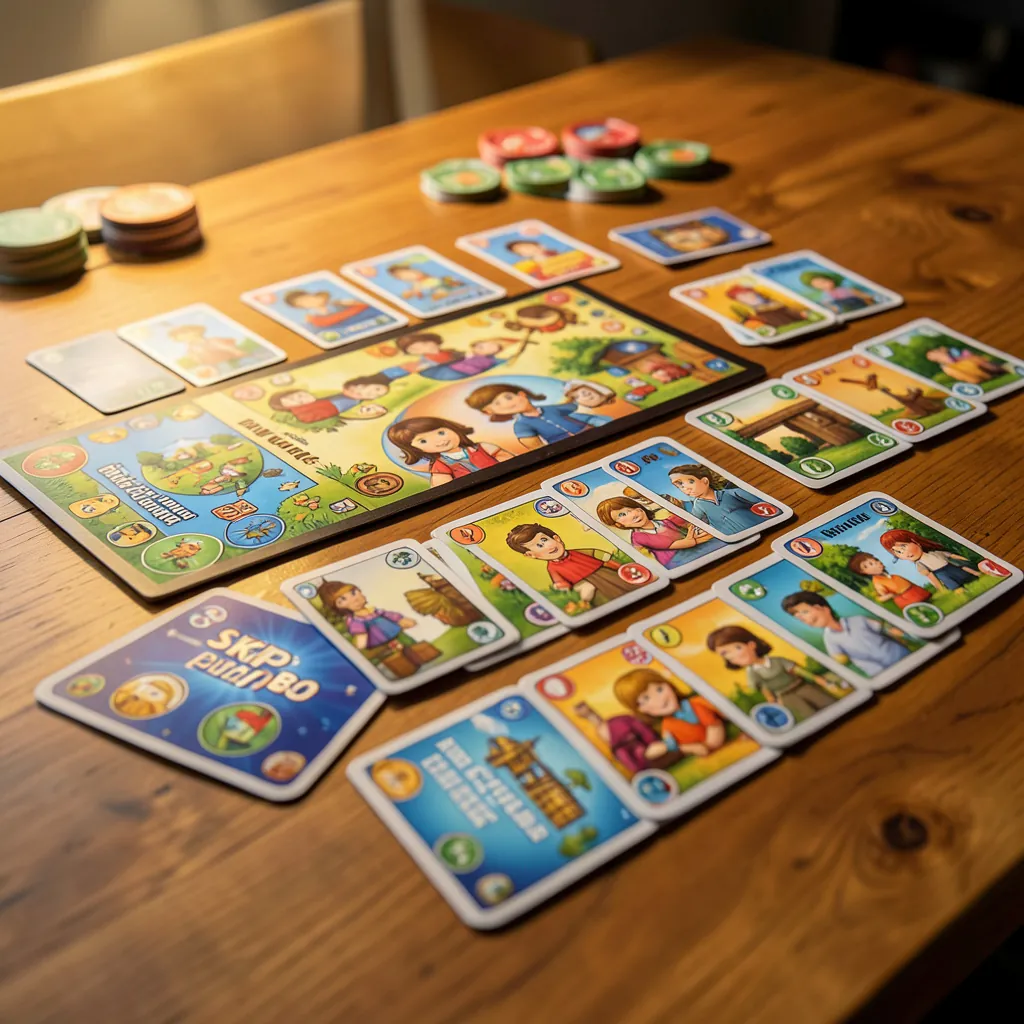
How to Play Skip-Bo: Setup, Rules, Scoring, and Variations
Contents
🃏 Skip-Bo is Mattel’s sequencing card game—often described as solitaire-like—where players build shared piles in ascending order from 1 to 12 while racing to empty their own stockpile. The first player to use all the cards in their personal Stockpile wins. This guide synthesizes the official Mattel product rules with common setup details and variants from the cited sources.
Players: 2–6 (Source 1 gives 30-card stockpiles for 2–4 players and 20-card stockpiles for 5–6; the template’s “3–5” is not supported by these sources.)
Play Time: Not stated in the cited rules; commonly estimated at 20–30 minutes.
Age: 7+ (Mattel and Source 1; the template’s “10+” conflicts with the cited 7+ rating.)
Difficulty: Easy
Type: Sequencing card game, not trick-taking (Mattel’s description; the template’s “trick-taking” label conflicts with the sources.)
Source conflict flags: Mattel lists ages 7+ and calls Skip-Bo a sequencing game, so the requested 10+ / trick-taking labels conflict with the cited sources. Source 1 gives player-count setup as 2–4 and 5–6, not exactly 3–5; play time is not specified in the cited Mattel pages. Source 4’s first-player drawing wording can be misread; follow the setup-deals-5 and later-refill rule below.
Setup
- Shuffle the 162-card Skip-Bo deck. The deck has twelve each of the numbers 1–12 and eighteen “Skip-Bo” wild cards (Source 4).
- Deal each player a personal Stockpile: 30 cards for 2–4 players, or 20 cards for 5–6 players (Source 1). Keep the Stockpile face down and turn only the top card face up (Source 1). For faster play, Source 1 also suggests a 10–15-card Stockpile.
- Deal each player a 5-card hand (Source 1). This is your first-turn hand; do not draw another five before your first turn.
- Place the remaining cards face down as the central Draw Pile (Source 1).
- Set out up to four shared Building Piles in the center and leave space for each player’s four personal Discard Piles (Sources 4 and 5). Discard Piles start empty.
- The player to the dealer’s left starts (Source 4). Source 1’s “youngest player goes first” line appears in its Skip-Bo Junior discussion, not the standard-game setup described here.
| Setup item | 2–4 players | 5–6 players | Source notes |
|---|---|---|---|
| Personal Stockpile | 30 cards each | 20 cards each | Source 1; its general FAQ also mentions 30 cards and 10–15 for faster play |
| Starting hand | 5 cards | 5 cards | Source 1; do not draw an extra five on the first turn |
| Shared Building Piles | Up to 4 | Up to 4 | Sources 4–5 |
| Personal Discard Piles | 4 | 4 | Source 5 |
How to Play
- First turn: do not draw. Use the 5-card hand you were dealt during Setup. On every later turn, first draw enough cards to bring your hand back up to 5 (Sources 1 and 4). Drawing another five at the start would give you 10 cards and is a common rules error.
- Start or continue Building Piles. A Building Pile must begin with a 1 or a Skip-Bo wild card. After that, play ascending numbers in sequence: 2, 3, 4 … up to 12. Colors are irrelevant; only the number counts (Source 1). There can be a maximum of four Building Piles at any time (Source 4).
- Make legal plays from three places. On your turn, you may play cards from your hand, the top card of your own Stockpile, or the top card of one of your own Discard Piles onto a legal Building Pile (Source 5). You may make multiple legal plays during your turn.
- Use Skip-Bo wild cards carefully. A Skip-Bo card is wild and may be played as any number. It can start a new Building Pile as a 1 or be played on top of a numbered card. You cannot play two Skip-Bo cards in a row; a Skip-Bo must be covered by a numbered card. Source 4 says this also means it cannot be left as a final 12.
- Complete piles at 12. When a Building Pile reaches 12, it is complete and set aside. Once the main Draw Pile runs out, shuffle the completed Building Piles together to form a new Draw Pile (Source 4).
- End your turn by discarding one card. After you finish making plays, you must discard one card from your hand onto one of your four personal Discard Piles. Discarding is required each turn, and you may discard a Skip-Bo card (Source 4). If you cannot make a play, you still discard one card and end your turn.
- Refill at the start of later turns. On your second and succeeding turns, draw enough cards to bring your hand back to five before you play or discard again (Source 4).
- Win by emptying your Stockpile. The first player to use all the cards in their personal Stockpile wins (Sources 2, 3, and 5).
Scoring
Standard Skip-Bo, as described in the cited sources, is not a point-scoring game. The first player to deplete all cards in their personal Stockpile wins immediately; Mattel does not list a point total, and Source 5 likewise says the winner is whoever empties their Stockpile first. If you use a faster variant with a 10–15-card Stockpile, the same win condition applies: empty your Stockpile first. No official point values are given in the provided rules.
💡 Strategy Tips
- Do not draw an extra five on turn one. Setup already gives you five cards. Draw only to refill to five on later turns—this is the most common beginner mistake.
- Save Skip-Bo wilds for key moments. Mattel says the wild cards “break up static situations” and may be played as any number. Use them when they unlock a sequence or help you empty your Stockpile, not just because you can.
- Organize your Discard Piles. Source 5 notes that strategy includes organizing cards into Discard Piles and knowing when to play from hand, Discard Pile, or Stockpile. Keep useful top cards exposed.
- Avoid setting up the next player. Source 5 specifically warns about care in not setting up opponents for good plays. Think before leaving an obvious continuation on a Building Pile.
- Prioritize Stockpile cards when legal. Since emptying your Stockpile wins the game, play its top card when it fits a Building Pile—but do not ignore better setup plays from your hand or Discard Piles.
🎲 Variations
- Player-count Stockpile sizes: For 2–4 players, deal 30 cards each; for 5–6 players, deal 20 cards each (Source 1). The cited sources do not give a separate two-player ruleset, so use the 2–4-player setup for two players.
- More than six players: Source 1 says to double the card set by adding three additional regular decks, for six decks total.
- Faster play: Source 1 recommends a 10–15-card Stockpile for faster games.
- Skip-Bo Junior: Source 1/4 describe a simplified Junior version with a 10-card Stockpile, two play levels, and the youngest player going first.
- Regular-deck conversion: Source 1 gives this mapping for playing Skip-Bo with regular playing cards:
| Regular card | Skip-Bo value |
|---|---|
| Ace | 1 |
| 2–10 | Face value |
| Jack | 11 |
| Queen | 12 |
| King or Joker | Skip-Bo wild card |
Use three regular decks for the base game; for more than six players, Source 1 says to add three more decks, for six decks total.
❓ FAQ
How many players can play Skip-Bo?
The cited setup supports 2–6 players: 2–4 players get 30-card Stockpiles, and 5–6 players get 20-card Stockpiles. Source 1 also mentions a more-than-six-player variant using extra decks. The template’s “3–5” figure is not supported by these sources.
How do you win Skip-Bo?
Empty your personal Stockpile first. There is no point total in the standard rules described by Mattel; the first player to use all the cards in their Stockpile wins.
Can you play Skip-Bo with 2 players?
Yes. Use the 2–4-player setup: give each player a 30-card Stockpile and a 5-card hand. The cited sources do not provide a separate two-player rule set, so standard rules apply.
Do you draw five cards on your first turn?
No. Setup already deals your 5-card hand. On later turns, draw enough cards to refill your hand to five. Drawing another five at the start would give you 10 cards and is a core turn-mechanic error.
Is Skip-Bo hard to learn?
No—difficulty is easy. Mattel calls it a sequencing card game, and the main challenge for beginners is managing the multiple piles. Source 1 notes that younger players may need help, and Mattel lists the age rating as 7+.
How long does a game take?
The cited sources do not give an official play time. Expect it to vary with Stockpile size: a standard 30-card Stockpile takes longer, while Source 1’s 10–15-card faster variant runs shorter. The common 20–30-minute figure is an estimate, not stated in the Mattel pages.
What do you need to play?
You need a 162-card Skip-Bo deck—twelve each of numbers 1–12 plus eighteen Skip-Bo wild cards—and table space for four shared Building Piles and four personal Discard Piles per player. Alternatively, Source 1 allows three regular decks mapped as Ace = 1, 2–10 = face value, Jack = 11, Queen = 12, and King/Joker = Skip-Bo.
Related guides
- How to Play Phase 10: Rules, Scoring, and Strategy
- How to Play War: Rules for the 2-Player Card Game
- 5 hundred card game
- 🃏 How to Play 500: The Complete Card Game Guide
- 500 Card Game Rules: How to Play Five Hundred