How to Play Dots and Boxes: Rules and Strategies
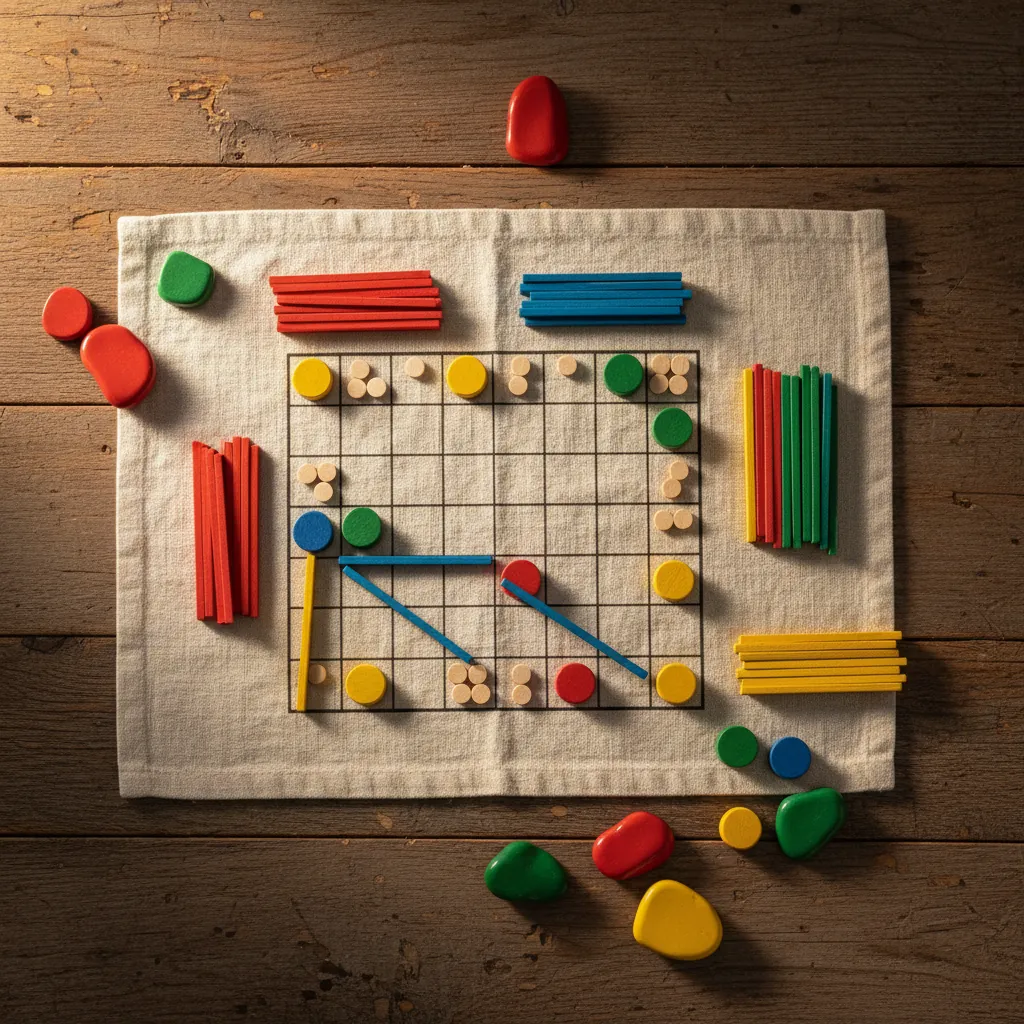
How to Play Dots and Boxes: Rules and Strategies
Contents
Dots and Boxes is a classic 2-player pencil-and-paper game where players connect dots on a grid to form boxes. Players take turns drawing lines between adjacent dots, aiming to complete the most 1x1 boxes to win. The game is suitable for ages 5+ and takes 5-15 minutes per round.
What You Need
- Grid of dots: Typically 4x4 or larger, evenly spaced (~1 cm apart)
- Writing tools: Pens/pencils (different colors recommended)
- Players: 2 (though variants exist for more players)
How to Play
- Draw the grid: Create a square grid of equally spaced dots (e.g., 4x4 for beginners).
- Take turns: Players alternate drawing horizontal or vertical lines between two unconnected adjacent dots (no diagonals).
- Claim boxes: When a player completes the fourth side of a 1x1 box, they mark it with their initial/color, score a point, and take another turn.
- End game: When all possible lines are drawn, count the claimed boxes. The player with the most boxes wins.
How to Win
- Control the board by forcing your opponent to open long chains of boxes for you to claim.
- Aim for more boxes than your opponent by strategically setting up multi-box captures.
Strategy Tips
| Tactic | Description |
|---|---|
| Avoid third sides | Don’t draw the third side of a box unless forced – it lets opponents claim it next turn. |
| Double-cross | Force opponents to create small chains (2-3 boxes), then take the larger subsequent chains. |
| Chain control | Leave an even number of small chains to secure the last moves. |
| Corner advantage | First moves in corners often provide more strategic options. |
FAQ
Q: Can you play with more than 2 players?
A: Yes – rules stay the same, with turns circulating among all players.
Q: How big should the grid be?
A: 4x4 to 6x6 is standard. Larger grids (10x10+) become more complex.
Q: Is there a tiebreaker?
A: No – ties are possible if both players claim equal boxes (common with even-sized grids).
Q: Who goes first?
A: Decide randomly (e.g., coin flip). The first player often has a slight advantage.
Q: What’s a “chain”?
A: A series of adjacent boxes where completing one automatically sets up the next.
History: First described by French mathematician Édouard Lucas in the 19th century as “La Pipopipette.” Also called “Pigs in a Pen” or “The Dot Game.”
Related guides
- How to Play Backgammon: A Complete Guide
- How to Play Battleship: Rules, Setup, and Strategy
- How to Play Checkers: Rules, Setup, and Winning Strategies (2026 Guide)
- How to Play Chess: A Complete Beginner’s Guide
- How to Play Connect Four: Rules, Strategies, and Setup Guide