How to Play Spoons: Rules, Setup, Scoring, and Variations
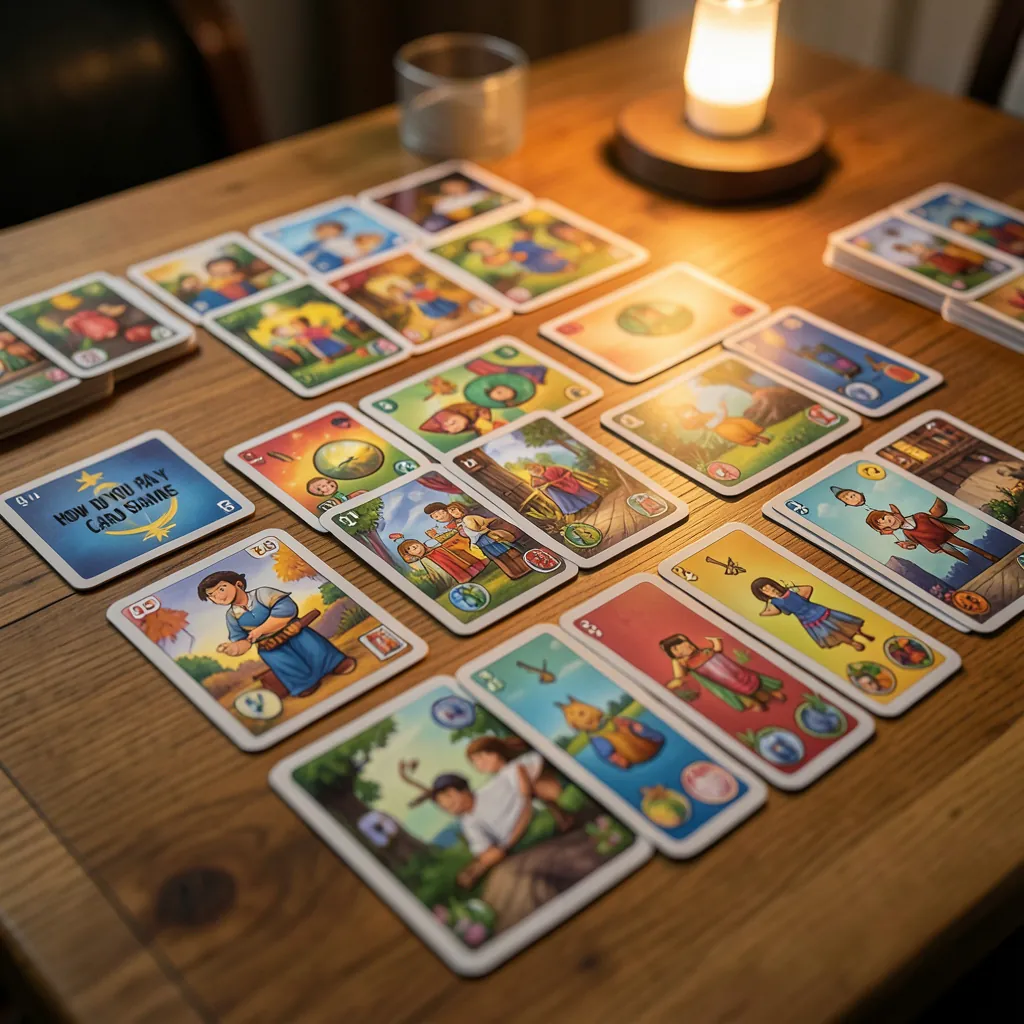
How to Play Spoons: Rules, Setup, Scoring, and Variations
Contents
🃏 Spoons is a fast, noisy card game in which players pass cards around a circle trying to collect four of a kind, then race to grab a spoon from the center. There is always one fewer spoon than players, so each round leaves one player empty-handed and holding a letter. The last player still in the game wins.
Players: 3–8 Play Time: 15–30 minutes Age: 4+ (all ages) Difficulty: Easy Type: Matching and speed card game
Setup
- Deck: Use one standard 52-card deck with no jokers (Source 1; Source 2).
- Spoons: Set out exactly one fewer spoon than there are players — if 8 people play, use 7 spoons (Source 2; also Source 1, 3, 4, 5).
- Seating: Have everyone sit in a circle with the spoons in the middle, positioned so no one is closer to the pile than anyone else (Source 2).
- Dealer: Choose a dealer for the first round; that player shuffles and deals (Source 2).
- Deal: Sources disagree on the hand size — the U.S. National Park Service deals 4 cards per player (Source 2), while the USC folklore archive and the patent describe 5 cards per player (Source 3, Source 5, Source 1). Four cards fits the “four of a kind” win condition most directly; five cards is a common house variant.
- Remaining deck: Keep the undealt deck in the center, within the dealer’s reach, since the dealer draws from it each turn (Source 2).
How to Play
- Deal the hands. Give each player 4 cards (Source 2) or 5 cards (Source 3, Source 5, Source 1), face down.
- Place the spoons. Put N−1 spoons in the middle of the circle, where N is the number of players (Source 1, Source 2, Source 3).
- The dealer draws. The dealer takes the top card of the deck and decides whether to keep it or discard it. A player may only ever hold the same number of cards they were dealt, so keeping a card means discarding one from the hand (Source 2).
- The dealer passes a discard. The dealer places the unwanted card face down in front of the player to their left (Source 2).
- The next player picks it up. That player looks at the incoming card, keeps it or discards it, and passes one card face down to the player on their left. Play continues clockwise around the circle (Source 2; Source 3).
- Keep the pace fast. Players pick up and discard as the cards come to them; the dealer keeps drawing and passing new cards from the deck (Source 2).
- Aim for four of a kind. The goal is to hold four cards of the same rank — four 7s, four Jacks, four Aces, and so on (Source 2; Source 3; Source 4).
- Grab a spoon. As soon as a player has four of a kind, they grab a spoon from the pile — sneaky or loud, depending on style (Source 2).
- Everyone else scrambles. Once one spoon is taken, all other players race to grab one of the remaining spoons (Source 2; Source 3; Source 4).
- The odd player out takes a letter. Because there is one fewer spoon than players, exactly one player ends up without a spoon and receives a letter (Source 2; Source 4).
- If the deck runs out, grab the discard pile to the left of the last player in the circle and continue (Source 2).
- Repeat rounds until only one player remains (Source 4; Source 1).
⚠️ Conflict flag: Source 1 (a patent filing) describes a different game that also travels under the name “Spoons” (sometimes “Pig” or “Donkey”): players start with 5 cards and try to get rid of all their cards by discarding a card matching the top discard in suit or rank, Crazy-Eights style. That is not the four-of-a-kind Spoons described by Sources 2–5, and the two should not be mixed. This guide follows the four-of-a-kind version.
Scoring
Spoons does not use points. It uses a penalty-letter system (Source 2; Source 4):
- The player left without a spoon each round earns the next letter of the word S-P-O-O-N, in order (Source 2).
- Once a player has collected all five letters and spelled “SPOON,” they are eliminated — the same mechanic as HORSE (Source 2; Source 4).
- The last remaining player is the winner (Source 4; Source 1).
- Casual variant: some groups skip elimination entirely and simply keep track of who lost the most rounds (Source 3).
- Immediate-elimination variant: Source 1 describes removing the spoonless player from the game right away, then playing the next round with one fewer spoon. The penalty word can also be varied — Source 1 notes the game is sometimes called “Pig” or “Donkey,” which changes the letters needed.
💡 Strategy Tips
- Read the discards. What you pass to your left is what your neighbor must work with, so watch which ranks keep disappearing and which keep coming back (Source 3).
- Keep a poker face. Don’t react when you complete four of a kind — a loud grab gives everyone else a head start on the spoons (Source 2).
- Commit fast. The game rewards speed over luck; hesitating on a keep-or-discard decision costs you cards and tempo (Source 3).
- Change targets when a rank dries up. If the 9s stop circulating, switch to a rank you are already close to instead of waiting.
- Common beginner mistake: holding the wrong number of cards. Always keep exactly 4 (or 5, if your table deals 5) — pick up, then immediately discard one (Source 2).
🎲 Variations
Quick reference: how the sources differ
| Rule detail | Source 2 (NPS) | Sources 3 & 5 (USC) | Source 4 (app) | Source 1 (patent) |
|---|---|---|---|---|
| Cards dealt | 4 per player | 5 per player | Four matching cards needed | 5 per player (conventional) |
| Winning hand | 4 of a kind | 4 of a kind | 4 matching cards | 4 of a kind (+ a data card in the patented version) |
| Spoons | Players − 1 | Players − 1 | Players − 1 | Players − 1 (patented version: players − 2 plus a “data spoon”) |
| Penalty | Letter; spell S-P-O-O-N | Elimination or track losses | Letter; spell the spoon’s name | Letter; final letter eliminates |
| Player count | 8 in the example | “Typically four… could be more” | All ages | 3–8 |
Common house rules
- Immediate elimination: instead of spelling a word, the spoonless player sits out and one spoon is removed for the next round (Source 1).
- Exercise version: put the spoons outside the circle or hide them, so everyone has to run or search when someone gets four of a kind (Source 2).
- Substitute objects: play for a hat, a cork, or any other grab-able item instead of spoons — the app version supports “hat, cork, spoon, etc.” for quick or full-length games (Source 4).
- Themed decks: play with animal, color, or scenery cards instead of a standard deck (Source 4).
- Educational variant: the patented version inserts N−1 “data cards” into the deck; the winning hand is four matching playing cards plus one data card, and the winner grabs the “data spoon” (Source 1).
- Two players: none of the sources describes an official 2-player rule. Source 1 gives a range of 3–8 players, and the one-fewer-spoon mechanic needs at least three to work as written. With two players you would need a single spoon and a house-rule workaround.
❓ FAQ
How many players can play Spoons?
Three to eight players, per the patent source, with four players being the most typical pickup game (Source 1; Source 3). You need one fewer spoon than players, so the count scales easily.
How do you win Spoons?
Be the last player left after everyone else has spelled out S-P-O-O-N and been eliminated (Source 2; Source 4). There is no point total — survival is the win condition.
Can you play Spoons with 2 players?
No standard version exists in these sources. Spoons is written for 3+ players because it depends on having one fewer spoon than players and a circle to pass cards around (Source 1; Source 2).
Is Spoons hard to learn?
No — it is an easy game suitable for all ages (Source 4). The only rule people fumble at first is keeping exactly the right number of cards in hand (Source 2).
How long does a game take?
Each round lasts only a minute or two; a full game with letters and eliminations typically runs 15–30 minutes depending on player count and how quickly someone spells SPOON (Source 2; Source 4).
What do you need to play Spoons?
One standard 52-card deck with no jokers, plus one spoon (or similar object) fewer than the number of players (Source 1; Source 2).
Related guides
- How to Play Phase 10: Rules, Scoring, and Strategy
- How to Play War: Rules for the 2-Player Card Game
- 5 hundred card game
- 🃏 How to Play 500: The Complete Card Game Guide