Flip Dual Game: How to Play *Dual* (and Why It's Not UNO Flip!)
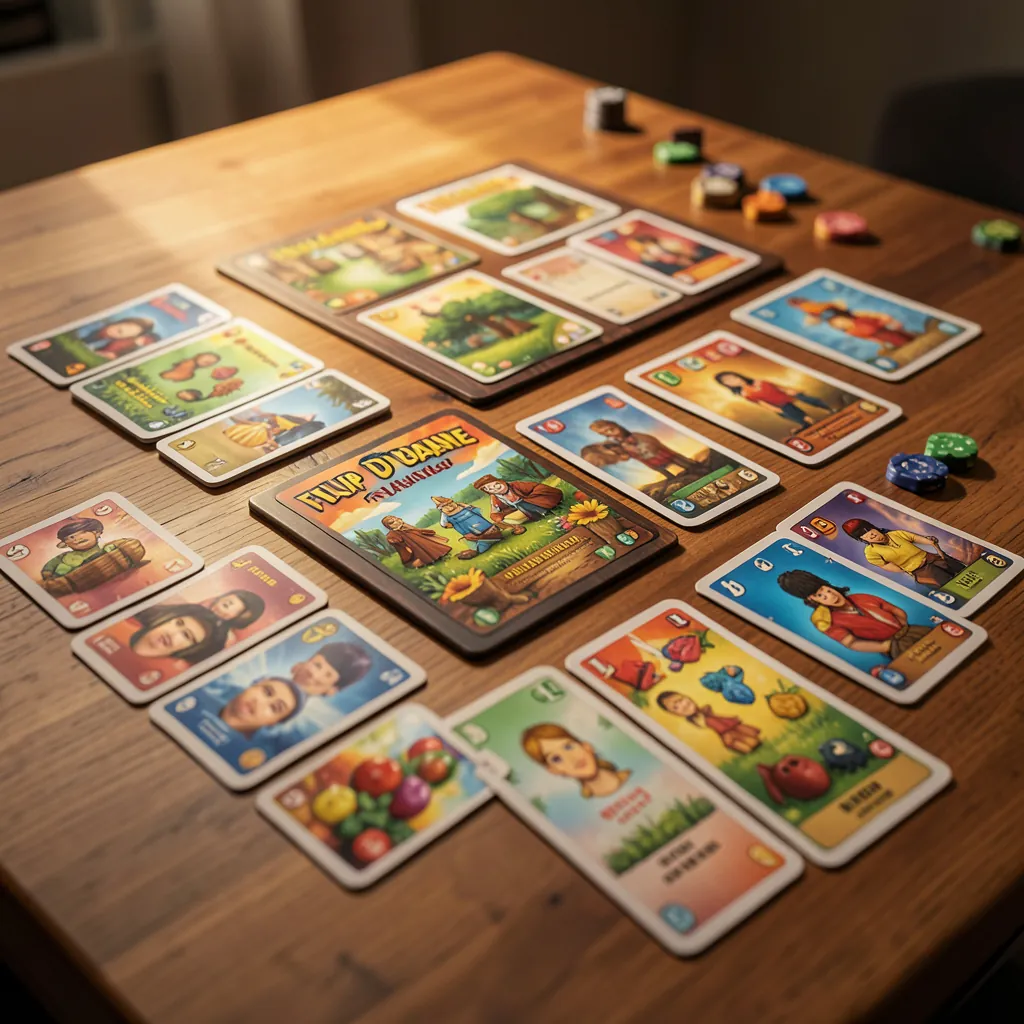
Flip Dual Game: How to Play Dual (and Why It’s Not UNO Flip!)
Contents
- Is “flip dual game” the same as UNO Flip!?
- Setup
- How to Play
- Scoring
- 💡 Strategy Tips
- 🎲 Variations
- ❓ FAQ
🃏 Dual is a compact trick-taking card game for 2–3 players in which every card carries two celestial spirits — one Awake, one Asleep — and the weakest player in a trick can flip a whole hand to change which suits are live. The goal is simple: collect the most coin, diamond and star tokens across five rounds.
Players: 2–3 Play Time: About 15–20 minutes (five rounds) Age: 10+ (publisher age rating is not stated in the sources — check the box) Difficulty: Easy to teach, thinky to play Type: Trick-taking card game
⚠️ Source conflict flagged up front. The sources for “flip dual game” actually describe two different products. Source 1 covers Dual, a 2–3 player celestial trick-taking micro game. Sources 2 and 5 cover UNO Flip! (Mattel, GDR44), a 2–10 player double-sided UNO variant. Sources 3 and 4 are unrelated entirely (a Windows handheld console and a mobile game). This guide teaches Dual as the main game and explains the UNO Flip! confusion in the comparison section below rather than merging the two rule sets, which would be inaccurate.
Is “flip dual game” the same as UNO Flip!?
No — they are separate games with different rules, player counts and components. Dual is a trick-taking game where flipping a hand changes which suits are active; UNO Flip! is a matching/shedding game where a FLIP card turns the entire deck from a Light Side to a Dark Side. The table below compares only what the sources actually state.
| Feature | Dual (Source 1) | UNO Flip! (Sources 2 & 5) |
|---|---|---|
| Publisher / brand | Zerua Games (Kickstarter, 2024) | Mattel Games, item GDR44 |
| Players | 2–3 | 2–10 |
| Age rating | Not stated in sources | 7+ |
| Cards | Two-spirit cards; each card shows a pair of numbers and suits, one Awake and one Asleep | 112 double-sided cards (Light Side / Dark Side) |
| Core gimmick | Weakest player in a trick may flip their own or an opponent’s hand | FLIP card flips all hands, draw pile and deck to the Dark Side |
| Signature actions | Suit-following based on the Awake celestial; star-count tiebreakers | Draw Five, Skip Everyone on the Dark Side |
| Card values | Mirrored — top and bottom values total 10 | New numbers and colours on the reverse side |
| Scoring | Coin, diamond and star tokens collected over 5 rounds | Classic UNO scoring: first to shed all cards wins the hand |
| Extras | Travel edition ships without the scoring tokens | Sturdy storage tin; instructions included |
| Price | Not listed in sources | $6.49 (Mattel US); last listed 1,299 UAH at jabko.ua (out of stock) |
Setup
- Shuffle the deck and deal each player a fixed hand. The exact deal count per player is not documented in the available sources, so follow the card that comes in your copy.
- Place the scoring tokens — coins, diamonds and stars — within reach of all players. These are the standard-edition components; the Zerua Games travel edition deliberately omits them and uses special scoring rules instead, so check which edition you own.
- Do not arrange or rotate your cards. In Dual, players are not allowed to reorder or turn the cards in their hand. What you’re dealt, in the orientation you’re dealt it, is what you play.
- Note your opponents’ card backs. Each card has an illustrated back, so the suits in every other player’s hand are visible information from the first turn.
- Agree on a starting player for the first trick.
How to Play
- Check which celestial is Awake. Every card hides two spirits, one Awake and one Asleep. The Awake side determines the suit and value you are currently playing with.
- The leader plays a card. The suit showing on that Awake side becomes the led suit for the trick.
- Follow suit using Awake faces. Each following player must play a card of the led suit based on which celestial is currently Awake in their hand. Because you cannot rotate cards, you may be forced to play off-suit simply because your matching card is face-down.
- Resolve the trick. Trick resolution is the part players most often get wrong — the sources describe it as “not straightforward.” Suit is compared first; when suit alone does not separate the cards, the star counts on the cards act as the tiebreaker.
- The weakest player may flip a hand. The player who is weakest in the trick has the option to flip their own hand or an opponent’s entire hand. Flipping swaps every card from Awake to Asleep and vice versa, instantly changing which suits are active and mirroring all values — a card’s top and bottom numbers always total 10, so a 7 becomes a 3.
- Collect the trick’s tokens. The winner of the trick takes the coin, diamond and star tokens associated with it for that round.
- Play out the round, then repeat. A full game runs five rounds, after which tokens are totalled.
Scoring
Points come from the coin, diamond and star tokens you collect during each of the five rounds. After round five, players total everything they have gathered; the highest total wins. The sources do not publish the individual token values, and the travel edition uses its own special scoring rules in place of the tokens — so confirm the exact token values in your edition’s rulebook before you start.
💡 Strategy Tips
- Count the cards. Reviewers note that to be good at Dual you have to track cards while simultaneously thinking about stars, opponent colours and flip timing.
- Read the card backs. Because suits are visible on every back, you can often tell whether an opponent can follow suit before they play.
- Save your flip for maximum damage. As the weakest player you can flip an opponent’s hand — do it when their matching suit is about to come up, or when mirroring their values (top + bottom = 10) turns a strong card into a weak one.
- Plan for the last trick. Deciding when to flip and how to win the final trick is repeatedly cited as the core skill of the game.
- Beginner mistakes: trying to rearrange or rotate your cards (illegal), and forgetting the star-count tiebreaker when suits tie. If a trick result surprises the table, re-check the stars first.
🎲 Variations
- Two players: Dual is designed for 2–3, and reviewers who tried it at two players found it played well and was easy to teach. Some felt the three-player game felt “a bit more like a two-player game,” so 2p is a legitimate and popular configuration rather than a house rule.
- Three players: Officially supported, but reception is split — one reviewer suspected three players “might not have served it super well,” while another wanted to try 3p specifically to see whether it helped or hurt. Try both counts.
- Travel edition scoring: The Zerua Games travel edition does not include the scoring tokens and instead applies special scoring rules. Treat this as an official variant, not a downgrade.
❓ FAQ
How many players can play Dual? Two or three. Dual is designed for 2–3 players. (Do not confuse it with UNO Flip!, which supports 2–10.)
How do you win at Dual? Collect the most coin, diamond and star tokens across five rounds. The player with the highest token total after round five wins.
Can you play Dual with 2 players? Yes. It is officially a 2–3 player game, and multiple reviewers report the two-player experience working well and being easy to teach.
Is Dual hard to learn? The core is easy to teach and easy to play, but the game is genuinely thinky. The main stumbling block is trick resolution — specifically the star-count tiebreakers — which players sometimes forget mid-game.
How long does a game take? Five rounds, which plays as a micro game in roughly 15–20 minutes. It is small and portable enough to carry in a bag.
What do you need to play? The Dual deck plus the coin, diamond and star scoring tokens. If you own the travel edition, the tokens are not included and you use the alternative scoring rules printed with that edition.
Related guides
- How to Play Phase 10: Rules, Scoring, and Strategy
- How to Play War: Rules for the 2-Player Card Game
- 5 hundred card game
- 🃏 How to Play 500: The Complete Card Game Guide
- 500 Card Game Rules: How to Play Five Hundred