Egyptian Rummy Rules: How to Play J'Achette (and Why "Egyptian Rummy" Confuses People)
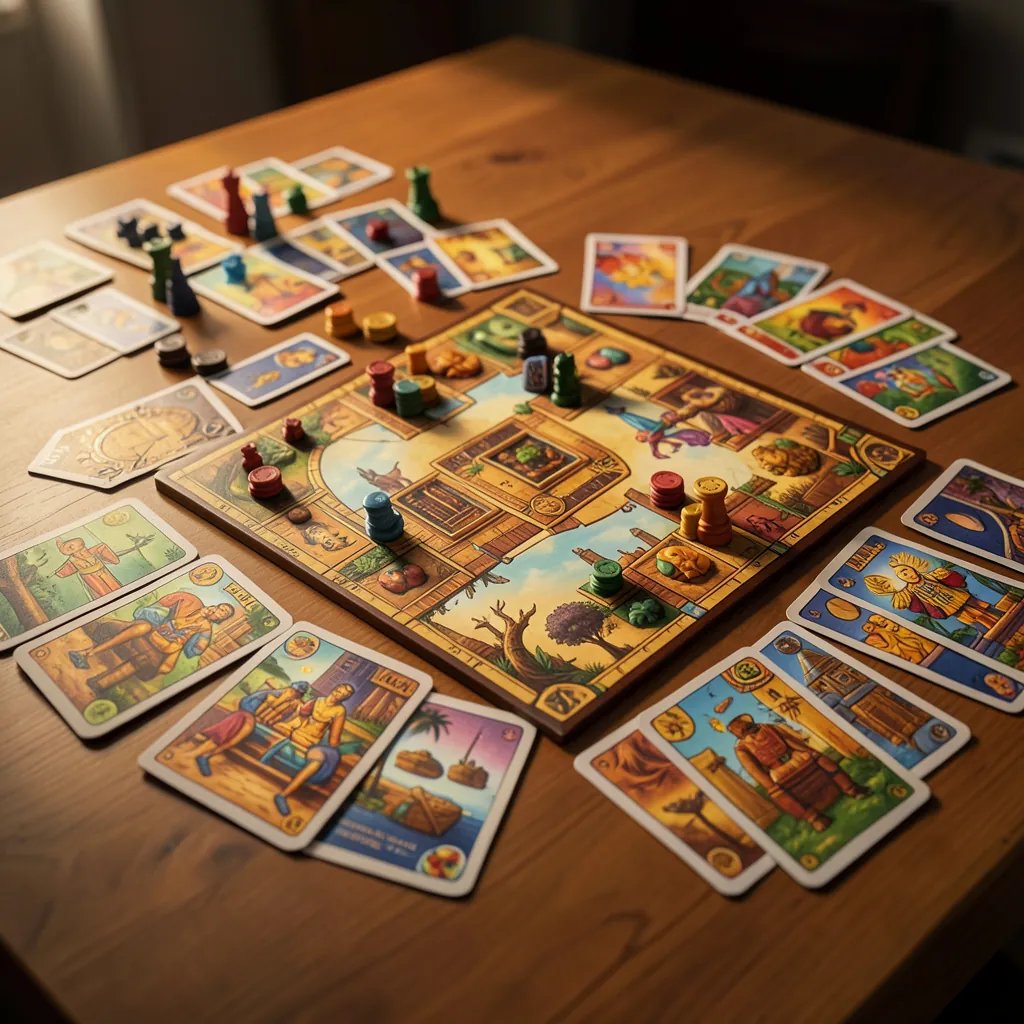
Egyptian Rummy Rules: How to Play J’Achette (and Why “Egyptian Rummy” Confuses People)
Contents
- Setup
- How to Play
- Scoring
- Is “Egyptian Rummy” the same game as Egyptian Ratscrew?
- 💡 Strategy Tips
- 🎲 Variations
- ❓ FAQ
🃏 Egyptian Rummy — best documented under its French name J’Achette (“I Buy”) — is a meld-building rummy game for 3–6 players using two decks plus Jokers, in which you race to table every card while pushing each opponent past 120 points to win the pot (the Poola). Fair warning: many English-speaking players use “Egyptian Rummy” for Egyptian Ratscrew, an entirely different slap-and-grab game.
Players: 3–6 (the Ratscrew game of the same nickname supports 2+) Play Time: Not fixed in the sources — one hand runs a few minutes, but a full Poola usually spans many hands Age: Not specified in the sources (rummy-family games are commonly listed 10+) Difficulty: Easy to learn, moderate to play well Type: Meld-building rummy card game with a “Buy” mechanic
⚠️ Naming note: the sources disagree about what “Egyptian Rummy” means. The comparison table below flags this; the main rules here follow the rummy game (J’Achette), which is the only actual rummy game in the sources.
Setup
The rules below follow the J’Achette ruleset recorded from players of the European community in Egypt.
- Build the deck. Shuffle two standard 52-card packs together, each including 2 Jokers — 108 cards total.
- Pick the first dealer. Every player draws a card at random and returns it to the deck; the highest card deals first. The deal passes one player to the left after every hand.
- Shuffle and cut. The dealer shuffles; the player to the dealer’s right cuts. The cut card is exposed and takes no part in the hand — unless it is a Joker, in which case the cutter keeps it and the dealer gives that player only nine additional cards. On a redeal, the Joker stays with the player who cut.
- Deal 10 cards each, two at a time, face down, starting at the dealer’s left.
- Set the stock and discard pile. The rest of the pack goes face down in the middle (the stock); the top card is turned face up beside it to start the discard pile.
- Start play. The player to the dealer’s left goes first, and play proceeds clockwise. If the first face-up card is a Joker, that player has first choice to take it.
How to Play
- Draw one card. On your turn, take either the top card of the face-down stock or the top card of the face-up discard pile.
- Respect the Buy rule. If you decline the top discard and draw from stock instead, any player in rotation to your left may Buy that declined card — but must also draw the top card of the stock as a penalty and does not discard. Play order does not change, the buyer may not table any cards until their next regular turn, and each player in turn has the same option. A fee is charged for the Buy and goes to the pot. Cards buried by a later discard cannot be taken or bought.
- Meld if you can (optional). Before discarding, you may lay down sets and/or runs from your hand. Your first meld must include a four of a kind, or a run of at least four consecutive cards in the same suit. Until you have “gone down,” you may not add cards to other players’ melds.
- Lay off after opening. Once you have opened, you may add cards to any melds on the table — your own or other players’ — in the same turn or later turns.
- Rearrange before discarding. If you change your mind about placement, cards you played during the current turn may be picked up and repositioned.
- Declare Jokers (optional). Once you have made your initial meld, you may announce that you hold one or more Jokers in your untabled cards (this reduces their penalty value — see Scoring).
- Discard exactly one card face up to end your turn.
- Exchange a tabled Joker when you hold the card it represents. You must already have at least a four-card meld on the table, and the Joker must immediately be re-tabled in a new meld or added to an existing one. In a run, swap the Joker for the exact card it stands for; for a Joker completing three of a kind, hand over both missing cards; for a Joker completing four of a kind, hand over the one missing card.
- End the hand. Play continues until one player tables all their cards and discards a final card. If someone finishes the hand on the same turn another player has bought a card, the fee is returned and the two bought cards are not counted in that player’s tally.
What counts as a legal meld?
- Set: three or four cards of the same face value in different suits (three Queens, four 7s).
- Run: three or more cards of the same suit in sequence. An Ace may sit high (above King) or low (below 2). No run may exceed 14 cards.
- Jokers are wild and can complete a set or fill any gap in a run. There is no limit on wilds in a meld as long as at least one natural card is present (one 7 plus two Jokers is legal).
- No duplicates in a set: two Kings of Diamonds cannot both appear in the same set. (Note the conflict: the standard double-deck Rami rules in Source 3 explicitly allow two identical cards in a set; J’Achette does not.)
What happens if the stock runs out?
If the stock dwindles to nothing before anyone goes out, play continues using the discards. When the current player declines the top discard, the discard pile is shuffled and play continues. If there is nothing left to reshuffle or every discard has been rejected, the pot for that hand jackpots to the next hand, cards are re-dealt by the next dealer, and no new costs are added to the hand or the Poola.
Scoring
When a hand ends, every other player totals the cards left in hand and adds that to their running score.
| Card | Penalty value |
|---|---|
| Joker | 25 (or 2 if declared) |
| Ace | 10 (or 1 if held alone) |
| K, Q, J, 10 | 10 each |
| 9 down to 2 | Face value |
- Scores climb from zero toward 120.
- If any player other than the hand’s winner is still under 120, the Poola continues.
- Every player who passes 120 returns to the game with a penalty of a Hat and the score of the highest player. A Hat is a penalty payable into the Poola.
- When all players other than the hand winner have passed 120, the Poola ends: that player wins and takes everything in the pot. If a new game starts, the winner deals the first hand.
- Alternative scoring: some groups run the system in reverse, subtracting tallies from a starting score and moving from 120 down to zero. Players report this is simpler, because your score is also the maximum you need to save.
Is “Egyptian Rummy” the same game as Egyptian Ratscrew?
No — and the sources genuinely conflict on the name. Three archived Usenet posts (1994) answer a request for “Egyptian Rummy” rules with the rules for Egyptian Ratscrew, a Slapjack/War hybrid that contains no melding at all. The J’Achette ruleset is the rummy game actually played in Egypt. Both are presented below so you can identify which game your table means.
| Feature | Egyptian Rummy = J’Achette (Source 1) | “Egyptian Rummy” = Egyptian Ratscrew (Sources 2, 4, 5) |
|---|---|---|
| Family | Rummy / meld-building | Slapjack + War reaction game |
| Cards needed | Two 52-card decks + 4 Jokers (108) | One standard 52-card deck |
| Players | 3–6 | 2 or more (sources describe 2-player and larger tables) |
| Object | Empty your hand; push every opponent past 120 | Win all the cards |
| Core skill | Melding, hand management, timing the Buy | Reflexes, memory, risk assessment |
| Turn | Draw → optionally meld → discard | Flip top card to a central pile |
Egyptian Ratscrew in brief: deal the whole deck face down, equally. Players flip their top card onto a central pile in turn. Play a face card and the next player must answer with a face card within a set number of flips — 4 for an Ace, 3 for a King, 2 for a Queen, 1 for a Jack; fail and the face-card player takes the pile. Whenever two consecutive cards match in value, the first player to slap the pile wins it. Illegal actions (“slurfs”) cost the offender the top card of their pile, placed face up at the bottom of the central pile. The game ends when one player holds every card. Regional names include Russian Ratscrew, Mongolian Mouse, and Global Thermonuclear War.
💡 Strategy Tips
- Open early. You cannot lay off onto anyone’s melds until you have gone down, so a hand that sits on its four-card opening loses tempo every round.
- Bank a natural card for a tabled Joker. Holding the card a visible Joker represents lets you swap, reclaim the Joker, and re-table it in a better spot — a big swing in one turn.
- Dump Jokers and court cards. An undeclared Joker costs 25 and every face card costs 10; getting them onto the table (or declaring Jokers once you’ve opened) protects your score.
- Buy sparingly. Buying costs a fee and a blind stock card, and locks you out of tabling cards until your next regular turn.
- Watch the 120 line, not just the hand. The Poola goes to the player who is still under 120 when everyone else has crossed it — a Hat and reset to the highest score is a costly setback. Common beginner mistake: playing for the hand and ignoring who is close to the limit.
🎲 Variations
- Player count. J’Achette is written for 3, 4, 5 or 6 players. The sources do not describe a 2-player version of J’Achette. For two players, the related standard Rami rules in Source 3 use a single 52-card deck.
- Reverse scoring. Subtract tallies from a running total and count down from 120 to zero instead of up from zero.
- Ratscrew house rules. Players report treating Jokers as an “instant double,” making any matching suit slappable (“ultrascrew”), capping false slaps at two per player per round (the “Ben Rule”), and requiring the winner to run through the whole deck one last time so others can still slap doubles.
- Regional Rami drift. Moroccan Rami and Lebanese Rami are not J’Achette with cosmetic changes — the sources note that a Moroccan and a Lebanese player may need to agree conventions before playing, and that a standard Rami opening meld often must total 51 points, a requirement J’Achette replaces with its four-card rule.
❓ FAQ
How many players do you need for Egyptian Rummy? J’Achette is played by 3, 4, 5 or 6 players with two 52-card decks plus 2 Jokers per deck. The Egyptian Ratscrew game that sometimes carries the same nickname needs only two players and one deck.
How do you win at Egyptian Rummy? Win the hand by tabling all your cards and discarding one final card — but the match (the Poola) is won by the player who is still under 120 points once every other player has passed 120. That player takes the whole pot.
Can you play Egyptian Rummy with 2 players? The J’Achette ruleset does not cover two players. For a two-player rummy in the same family, standard Rami uses a single 52-card deck, and Gin Rummy is the classic head-to-head version.
Is Egyptian Rummy hard to learn? The core turn is simple — draw, optionally meld, discard — but the Buy mechanic, the four-card opening requirement and the Joker-exchange rules add bookkeeping. Most groups grasp it in one hand.
How long does a game take? The sources give no fixed time. A single hand ends as soon as one player goes out, but a full Poola continues until every other player has passed 120, so a session typically spans many hands.
What do you need to play? Two standard 52-card decks including 2 Jokers each (108 cards), a way to track each player’s running score toward 120, and tokens or coins if your group charges a Buy fee and Hat penalties into a pot.