Egyptian Basra (Al-Komi / Ash Al-Walad): How to Play, Score, and Win
Egyptian Basra (Al-Komi / Ash Al-Walad): How to Play, Score, and Win
Contents
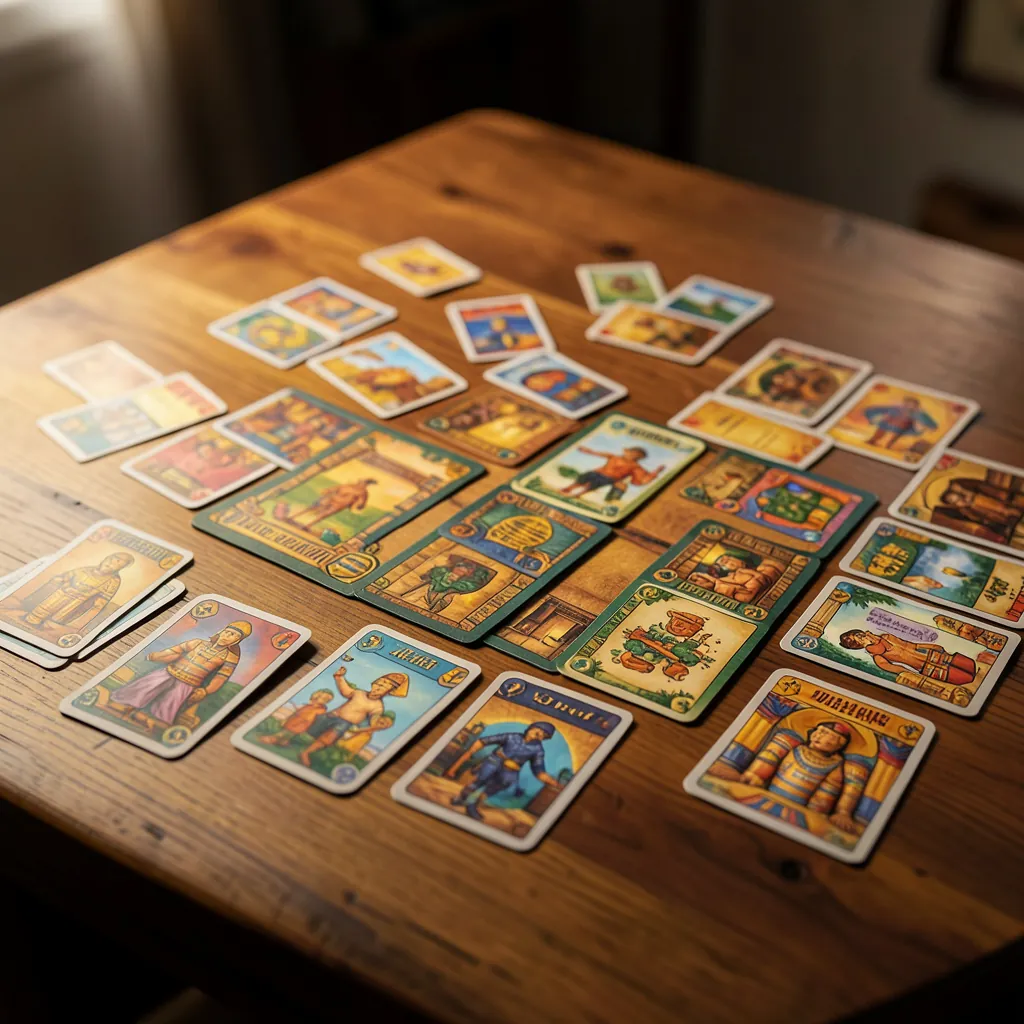
🃏 Egyptian Basra (also called Al-Komi, Al Kommy, Ash Al-Walad, or Ashara Koutshinah) is a two-player Egyptian capturing card game. The goal is to capture table cards by matching ranks or summing number cards, earn bonus points for Basras, and reach the agreed target score first.
Players: 2 (standard in all sources; online multiplayer is also 2-player)
Play Time: Not stated in the sources; multi-round play until a target score
Age: Sources conflict: app listings show 17+ and 18+, but one description says suitable for all ages
Difficulty: Easy (“very simple” in the sources)
Type: Egyptian capturing card game (Al-Komi / Ash Al-Walad)
Setup
- Use a standard playing-card deck; the sources refer to A, number cards, J, Q, K, and the special 7♦. No board is used.
- Choose one of the two players to deal.
- The dealer gives 4 cards to each player.
- At the start of the game, the dealer also places 4 cards face-up on the table/ground.
- The remaining cards form the stock for later redeals.
- The sources do not clearly state who starts the first round. In later rounds, the non-dealer/other player starts first (Sources 2, 4, 5), so agree the first starter before play.
How to Play
- On your turn, play one card face-up from your hand to the table/ground.
- If your card can capture table cards, take them and place them in your captured pile.
- If your card cannot capture anything, it stays face-up on the table.
- Capture rules depend on the card you play:
- Number cards: You may take a table card of the same rank, and/or any group of number cards whose values add up to your played card. Aces count as 1. Example from Sources 2, 4, and 5: if the table has A, 7, K, 8 and you play 8, you take the 8 plus A+7 because 1+7=8. If you play 9, you can take 8+A because 8+1=9.
- Do not use the same table card twice in different sum groups (Source 1).
- Q and K match only the same rank and are not used in sums (Source 1; Sources 2, 4, 5 exclude J, Q, K from sums).
- J takes all cards on the table.
- 7♦ is special: it can be played as any card to make a Basra if possible; otherwise it acts like a J and takes all table cards (Source 1; Sources 2, 4, 5 call this “Al Komi”).
- When both players have played all cards in hand, the dealer deals 4 more cards to each player—but not to the table—and play continues.
- Continue until the stock/dealer is out of cards and both players have played all their cards. That ends the round.
- Count captured cards and Basras using the scoring rules below.
- For the next round, exchange the dealing role; the other player starts first (Sources 2, 4, 5). Continue until the agreed target score is reached.
What counts as a Basra?
- A Basra is when one played card captures all cards on the table in a valid way (Source 1). It earns bonus points.
- Empty-table Basra: if the table is empty and your opponent plays a card, you can take that single card with a matching card as a Basra bonus (Sources 2, 4, 5). Avoid leaving a J or 7♦ as your last card, because the opponent may take the table and “burn” it, then later score it as a Basra.
- Sum Basra: if all table cards can be accounted for by one card in your hand through a direct match plus sums, that is a Basra. Example from Sources 2, 4, and 5: table 10, 5, 4, 1 and you play 10; you take the table 10 by match and 5+4+1=10 by sum.
- Jack Basra: a Jack sweeping a multi-card table is not automatically a Basra. Source 1 says a special Jack Basra happens only when a Jack matches a lone Jack on the table. Sources 2, 4, and 5 score a Jack Basra at 30 points.
- Koomi Basra: a 7♦ Basra is special. Sources 2, 4, and 5 say a Koomi Basra—when the 7♦ was burned and later taken as a Basra by any card—scores 30 points.
Scoring
Scoring is the main area where the sources conflict. Sources 2, 4, and 5 give concrete app-style values; Sources 1 and 3 describe bonuses but do not give the same numeric detail.
| Rule | Source 1 | Sources 2, 4, 5 | Source 3 |
|---|---|---|---|
| Most captured cards | Player with most cards gets “points”; draw = no one gets anything | 30 points to the player with most cards; other gets 0 | Player with most cards gets “this point”; no number given |
| Basra bonus | “Extra points”; no number | 10 points per Basra | Basra bonuses counted; no number |
| Jack Basra | Special Jack Basra mentioned; no number | 30 points | Not specified |
| Koomi / 7♦ Basra | 7♦ can make a Basra; no number | Koomi Basra = 30 points | No number |
| 7♦ role | Can act as any card for a Basra; otherwise acts as J; if on table, can be matched by any card | Takes Basra of any value or acts as J to take all table cards | Same as Sources 2, 4, 5 |
| Q/K in sums | Q and K match only themselves | J, Q, K are not included in sums; K only takes K | J, Q, K are not included in sums |
| Target score | “Total amount needed”; not stated | “Target score”; not stated | “Target score”; not stated |
Using the app-style scoring from Sources 2, 4, and 5: the player with the most captured cards scores 30 points, each Basra scores 10 points, and a Jack Basra or Koomi Basra scores 30 points. Source 1 says the most-cards player gets points and a draw gives no points, but does not give numbers; Source 3 also omits the numeric values.
Rounds continue with the deal alternating until a target score is reached. The sources do not state the target score, so agree it before play. The first player to reach the agreed target wins; Source 1 adds that if both players pass the target with a draw, they keep playing full games until one player is higher.
💡 Strategy Tips
- Do not hold J or 7♦ as your last card. Sources 2, 4, and 5 warn that the opponent can take the whole table and burn your special card, then later score it as a Basra.
- Check both direct matches and sum captures. A single card can take a matching rank plus a valid sum group—for example, 8 can take an 8 and A+7.
- Do not include Q or K in sum plans. Q and K match only themselves; J is special and takes the table, while Q/K are not sum cards.
- Avoid leaving table sums that give the opponent a Basra. If the table can be fully accounted for by one card in the opponent’s hand, they may take everything as a Basra.
- Track Basra bonuses, not just card count. In Sources 2, 4, and 5, a Basra is 10 points and a Jack/Koomi Basra is 30, so bonuses can swing the round.
🎲 Variations
- Standard two-player play: all sources describe Egyptian Basra as a two-player game. Some apps add online multiplayer rooms (Source 4) or Facebook/leaderboard support (Source 2), but the documented match is still two-player.
- No documented 3–5 player version: the sources do not provide rules for more than two players. Do not assume a partnership or rotation variant from these sources.
- Scoring variant: use the concrete 30/10/30/30 scoring from Sources 2, 4, and 5, or agree your own values if using the looser descriptions in Sources 1 and 3.
- Target-score house rule: because the sources do not state a target score, players should agree one before starting and continue rounds until someone reaches it.
- Name variants: the same game appears as Al-Komi, Al Kommy, Ash Al-Walad, and Ashara Koutshinah.
❓ FAQ
How many players can play Egyptian Basra?
Two players is the standard in every source. Some apps offer online multiplayer, but the documented game is still two-player; no 3–5 player rules are given.
How do you win Egyptian Basra?
You win by reaching the agreed target score first after multiple rounds. In Sources 2, 4, and 5, the player with the most captured cards scores 30 points, and Basra bonuses add 10 or 30; Sources 1 and 3 do not give those numeric values.
Can you play Egyptian Basra with 2 players?
Yes. Two-player play is the standard setup: deal 4 cards to each player and 4 to the table, then redeal 4 each when hands run out.
Is Egyptian Basra hard to learn?
No. The sources call it “very simple” or easy; the main things to learn are number-card sums, the special J and 7♦, and Basra bonuses.
How long does a game take?
The sources do not state a play time. Since play continues in rounds until a target score is reached, length depends on the target you agree on.
What do you need to play Egyptian Basra?
You need a standard playing-card deck and two players. The sources refer to number cards, A=1, J/Q/K, and the special 7♦; no board is used.
Related guides
- How to Play Phase 10: Rules, Scoring, and Strategy
- How to Play War: Rules for the 2-Player Card Game
- 5 hundred card game
- 🃏 How to Play 500: The Complete Card Game Guide
- 500 Card Game Rules: How to Play Five Hundred