How to Play Card Sequence: Setup, Rules, Scoring, and Source Conflicts
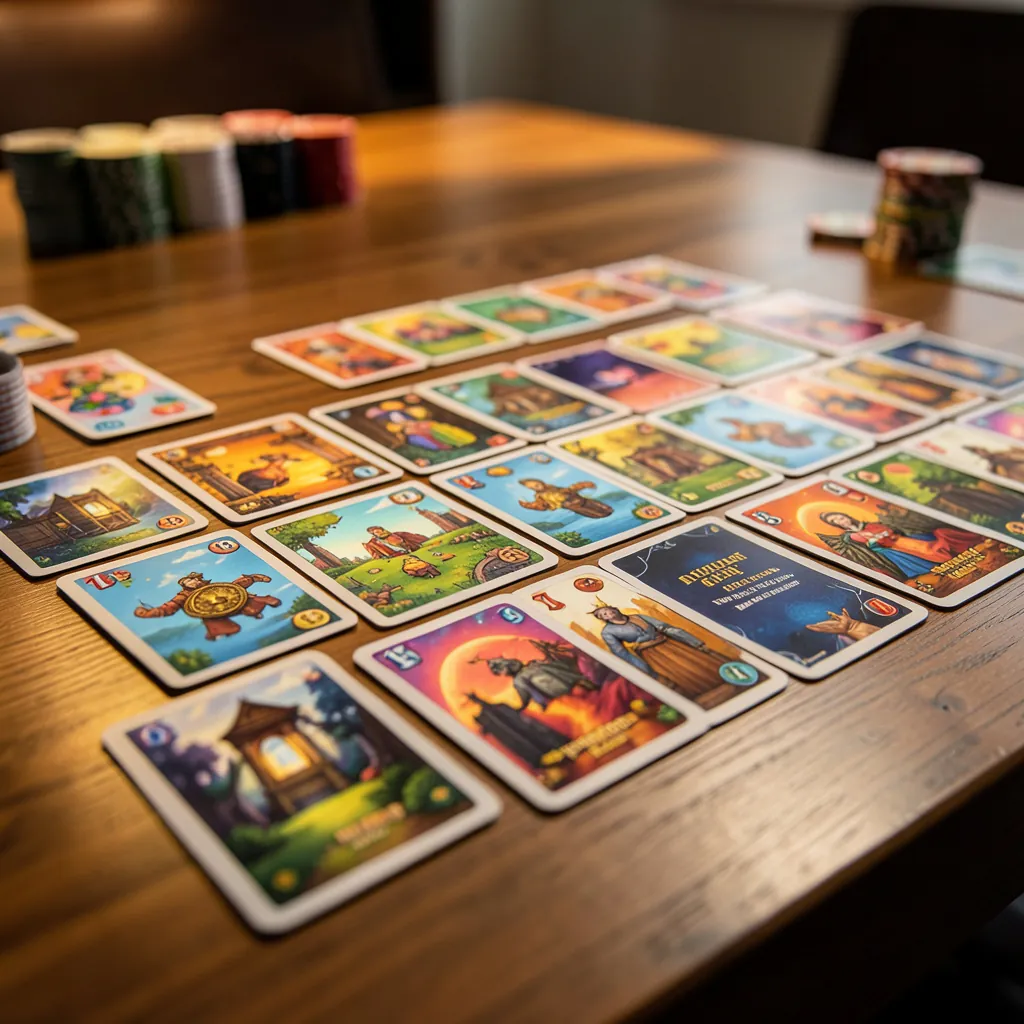
How to Play Card Sequence: Setup, Rules, Scoring, and Source Conflicts
Contents
- Setup
- How to Play
- Scoring
- How do the sources define “card sequence”?
- 💡 Strategy Tips
- 🎲 Variations
- ❓ FAQ
🃏 Card Sequence is a browser-based single- and multiplayer card game in which you reveal face-down cards and arrange them in order from A to K; the goal is to complete each suit and clear the board (Source 2). The sources below do not agree on what “card sequence” means, so this guide treats the playable game in Source 2 as the specific game and flags missing or conflicting rules rather than inventing them.
Players: Single-player and multiplayer (exact player count not specified in Source 2)
Play Time: Not specified in Source 2
Age: Not specified in Source 2
Difficulty: Multiple difficulty levels (Source 2)
Type: Browser card-arrangement/memory game (Source 2)
The sources do not supply a tabletop player count, play time, age rating, or trick-taking structure. Where that information is absent, it is marked “not specified.”
Setup
- Open Card Sequence in a browser on desktop, mobile, or tablet (Source 2).
- Choose single-player or multiplayer mode; Source 2 mentions both but does not give minimum or maximum player counts.
- Use the available difficulty settings if present; Source 2 lists “multiple difficulty levels.”
- Begin with face-down cards on the board. Source 2 does not describe a physical deal, hand size, starting player, or table layout.
- The target order is A → 2 → 3 → 4 → 5 → 6 → 7 → 8 → 9 → 10 → J → Q → K for each suit.
How to Play
- Start a game in the browser on desktop, mobile, or tablet (Source 2).
- Tap any face-down card to reveal it.
- Identify the revealed card’s rank and suit.
- Place cards sequentially from A → 2 → 3 → 4 → 5 → 6 → 7 → 8 → 9 → 10 → J → Q → K.
- Continue until each suit is completed.
- Clear the board to achieve the game’s stated goal.
Source 2 does not describe trick-taking, trump suits, partnerships, turn order, penalties, or multiplayer interaction rules. Do not assume those mechanics for this specific game.
Scoring
Source 2 does not describe a point-scoring system. The stated win condition is to reveal and arrange all cards in the correct order, complete each suit, and clear the board. There are no documented points, bonuses, or tie-breakers in the source.
How do the sources define “card sequence”?
| Source | What “card sequence” means there | What it contributes | Conflict or gap for this guide |
|---|---|---|---|
| Source 1: Wikipedia, “Run (cards)” | A run, straight, or sequence is a set of cards with consecutive rank values; suits do not normally need to match, and a same-suit sequence is a “suit sequence.” A natural sequence has no wild cards. Ace can be low or high depending on the game. | General card-game definition of sequences/runs. | It is a definition, not a complete playable game. It conflicts with Source 2’s fixed A→K order because ace high/low varies by game. |
| Source 2: “Card Sequence” game page | A browser card game where you tap face-down cards, place them in order A→K, complete each suit, and clear the board. It lists single/multiplayer, multiple difficulty levels, Daily Challenges, and achievements. Release/update date listed: July 18, 2026. | Primary source for the playable rules in this guide. | Does not specify player counts, play time, age rating, scoring, or multiplayer mechanics. |
| Source 3: Pokémon TCG booster-pack paper | Analyzes sequences of Pokémon trading cards in 11-card booster packs; discusses a possible common-card sequence of length 122 or 123 from 153 packs. | Shows “card sequences” in a different, non-gameplay context. | Not a tabletop game how-to; unrelated to Card Sequence play. |
| Source 4: “Juggling card sequences” | Uses cards to model juggling patterns and permutations. | Mathematical/combinatorial use of “card sequence.” | Not a tabletop or card game rule set. |
| Source 5: KanBo “Sequence Card Relation” | Describes previous/next card task dependencies in project-management software. | Another non-game use of “card sequence.” | Not a game; conflicts with the card-game focus. |
💡 Strategy Tips
- Use memory deliberately: Source 2 describes the game as challenging memory and planning skills, so track where revealed cards are and what ranks/suits remain.
- Work suit by suit: The stated goal is to complete each suit, so keep separate mental progress for each suit from A to K.
- Start at lower difficulty: Source 2 lists multiple difficulty levels; lower levels are the safer way to learn the A→K ordering pattern.
- Use Daily Challenges and achievements for practice: Source 2 mentions both as features, so they can help reinforce pattern recognition.
- Do not import trick-taking assumptions: Cards are arranged in sequence here; Source 2 does not describe tricks, trump, or partnerships.
🎲 Variations
- Single-player vs. multiplayer: Source 2 mentions both modes but does not specify exact player counts or how multiplayer turns work.
- Difficulty levels: Source 2 lists multiple difficulty levels, so the board/challenge difficulty can vary.
- Daily Challenges and achievements: Source 2 lists these as extra features rather than alternative rules.
- 2-player tabletop rules: Not specified in any source. Source 2 mentions multiplayer generally, but 2-player support is not confirmed.
- Ace high/low: Source 1 notes that ace can be low or high in different card games, but Source 2 fixes the sequence as A→K. Do not apply other games’ ace rules unless a source for that variant says so.
❓ FAQ
How many players can play Card Sequence?
Source 2 says it supports single-player and multiplayer, but it does not state an exact minimum or maximum player count.
How do you win Card Sequence?
You win by revealing and arranging all cards in the correct order, completing each suit, and clearing the board (Source 2).
Can you play Card Sequence with 2 players?
Multiplayer is mentioned, but Source 2 does not specifically confirm 2-player support or explain how two-player play works.
Is Card Sequence hard to learn?
Source 2 does not give an age or difficulty rating, but it lists multiple difficulty levels. The basic action is simple: tap a face-down card to reveal it, then place cards in A→K order.
How long does a game of Card Sequence take?
Source 2 does not specify a play time.
What do you need to play Card Sequence?
A browser on desktop, mobile, or tablet is listed as the platform (Source 2). Source 2 does not describe a physical deck requirement.
Related guides
- How to Play Phase 10: Rules, Scoring, and Strategy
- How to Play War: Rules for the 2-Player Card Game
- 5 hundred card game
- 🃏 How to Play 500: The Complete Card Game Guide
- 500 Card Game Rules: How to Play Five Hundred