How to Play Sorry! — Rules, Setup, Scoring, and Variations
How to Play Sorry! — Rules, Setup, Scoring, and Variations
Contents
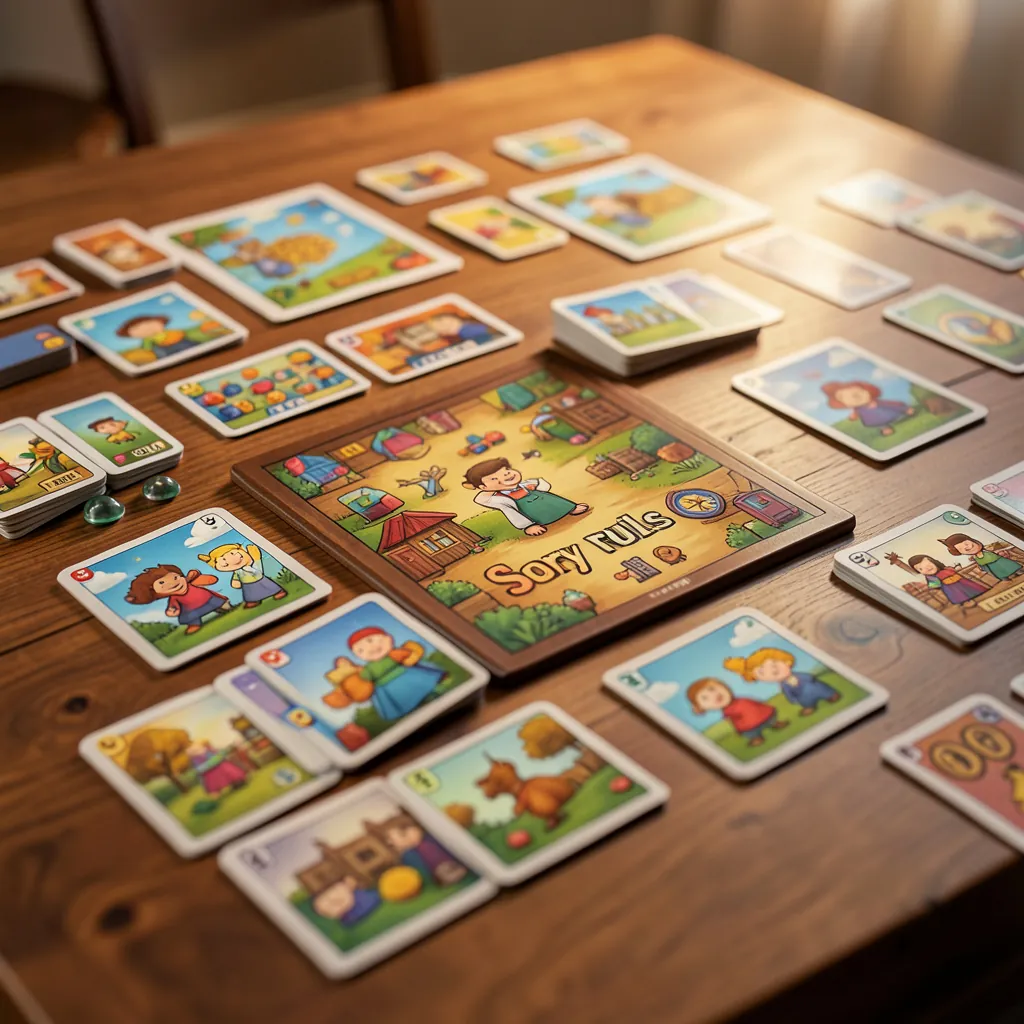
🎲 Sorry! is a card-driven board game in which players race four pawns from Start to Home by drawing cards and following the printed move. The goal is to be the first player—or partnership—to get every required pawn Home; slides, bumps, exact-count Home moves, and card-specific exceptions drive the tactics.
Players: Up to 4 in standard play (one per color); partnership uses 4. The rules do not state a minimum.
Play Time: Not stated in the rules; commonly about 20–30 minutes.
Age: Not stated in the rules.
Difficulty: Easy to learn; card exceptions add tactics.
Type: Card-driven board game / race-to-Home game.
Setup
- Shuffle the Sorry! deck. The 1939 Winning Moves rules list 44 cards: four each of 1, 2, 3, 4, 5, 7, 8, 10, 11, 12, and four Sorry! cards. The Hasbro sheet describes the same deck as having no 6s or 9s.
- Place the shuffled deck face down on the board’s “Place Pack” or center space.
- Each player chooses a color and places all 4 pawns of that color on the matching Start circle.
- Decide who plays first. The sources conflict here: the Hasbro sheet says to select a player, while the 1939 Winning Moves rules say each player draws a card, the highest card is the Leader, and the Sorry! card counts highest. The Leader chooses color and plays first. In both versions, the winner of one game goes first in the next.
- Turn order also differs by source: the Hasbro sheet says play continues right to left; the 1939 rules say the player on the Leader’s left draws next. Follow the edition or table convention you are using.
How to Play
- On your turn, draw the top card and place it face up on the discard space. Follow the card’s printed instruction. If you cannot make a legal move, you forfeit your turn. If a move is possible, you must make it—even if it is not to your advantage.
- Bring pawns into play from Start. Under the 1939 rules, a 1, 2, or Sorry! card can start a pawn. The Hasbro sheet specifically describes entry on 1 and 2 and describes Sorry! as a card that sends an opponent back. When a 1 or 2 is used to enter a pawn, place it on the entry circle outside Start; you do not also move it forward on that entry. A 2 then allows an extra draw after the entry/move is completed. You may not put two of your own pawns on the entry square; if an opponent is there, entering bumps that opponent to Start.
- Move forward in the direction of the arrows. Count every square, whether occupied or not. Pawns may pass each other. No two pawns may occupy the same square. If your only legal move would land on your own pawn, you forfeit. If your move ends on an opponent’s pawn, send that opponent back to Start.
- Use slides carefully. If a pawn ends its move on the triangle at the start of a slide of another color, it slides to the round end of that slide. Every pawn on that slide—including your own—is sent back to Start. You do not slide on a slide of your own color.
- Respect diamond squares. A pawn may not move forward over its own color’s diamond square. It may cross that diamond on a backward move, or by replacing another player’s pawn through a Sorry! or 11 card.
- Move backward only when a card allows it. A 4 moves backward 4 spaces. A 10 moves forward 10 or backward 1; if you cannot or will not move forward 10, you must move backward 1, even from the Safety Zone. A pawn moved backward at least two squares beyond its Start may later enter its Safety Zone without going all the way around the board.
- Enter the Safety Zone legally. A pawn may enter only its own color’s Safety Zone, and only by a forward move from or through the entrance square. No pawn may enter its Safety Zone by moving backward. A pawn may move backward out of its Safety Zone and later move back in as cards allow.
- Enter Home only by exact count. A card must allow the exact number of spaces needed to reach Home. If the only possible move would carry a pawn beyond Home, that move is forfeited. Once a pawn reaches Home, it is out of play for the rest of the game.
- Win by getting all required pawns Home. In the regular game, the first player to move all 4 pawns from Start to Home wins. In partnership play, the first partnership to get all 8 pawns Home wins.
Card-by-card reference
- 1: Start a pawn, or move one pawn already in play forward 1 space.
- 2: Start a pawn, or move one pawn forward 2 spaces. Complete the 2 move before taking the extra draw.
- 3, 5, 8, 12: Move a pawn forward that many spaces. If you cannot move the full number, forfeit.
- 4: Move a pawn backward 4 spaces. If your only pawn in play is in the Safety Zone and you draw a 4, you must move that pawn backward 4.
- 7: Split the 7 between two pawns. You may not use a 7 to start a pawn, and you may not use it to move a pawn backward. A split 7 can move a pawn Home if another pawn completes the full 7-square move; it can also combine bumps, slides, or both.
- 10: Move a pawn forward 10 spaces, or backward 1 space. If you cannot or do not wish to move forward 10, you must move backward 1.
- 11: Move a pawn forward 11 spaces, or switch places with an opponent’s pawn on a Margin Square. If you cannot move forward 11 and do not wish to switch, forfeit.
- Sorry!: Take one pawn from Start and move it to a legal space occupied by an opponent, then send that opponent back to Start. You cannot target Home, Start, or Safety Zone spaces. If you have no pawn in Start or no legal target, your turn ends.
Version conflicts to check
- Starting a pawn: The 1939 rules and common card text allow 1, 2, or Sorry! to start a pawn. The Hasbro sheet only spells out 1 and 2 for entry and describes Sorry! as a bumping card.
- First player: Hasbro says select a player; the 1939 rules say draw for highest card.
- Turn order: Hasbro says right to left; the 1939 rules say the player to the Leader’s left plays next.
- Sorry! with no target: The Stack Exchange card text says if you have no pawn in Start or no legal pawn to bump, end your turn. Do not use a live pawn elsewhere to “Sorry” someone.
Scoring
In the regular game, there is no point score: the first player to get all 4 pawns Home wins. In partnership play, the first partnership to get all 8 pawns Home wins; the 1939 rules also describe a double game if both partners get all 8 Home before either opponent gets 4 Home.
The Point Score variant uses points. All players score 5 points for each of their pawns in Home. The winner also scores bonus points:
- 5 points for each opponent’s pawn not in Home.
- 100 points if no opponent’s pawn reached Home.
- 50 points if no opponent has more than 1 pawn Home.
- 25 points if no opponent has more than 2 pawns Home.
💡 Strategy Tips
- Get more pawns into play early. A 1 or 2 used to enter a pawn gives you more legal moves on later turns. More pawns on the board means fewer forced forfeits.
- Use 7s to set up two threats. A split 7 can bump two opponents, start two slide setups, or help one pawn reach Home while another completes the full 7. Remember: no starting a pawn with a 7 and no backward 7.
- Do not park on slide triangles. A single opponent slide can send several pawns—including your own—back to Start. Treat another color’s slide triangle as a danger square.
- Use 4s and 10s to shortcut into the Safety Zone. A backward move can put a pawn near its Safety Zone entrance without a full lap, but you cannot enter the Safety Zone backward.
- Track exact Home counts. A pawn needs the exact card value to enter Home. Avoid leaving yourself with only one pawn that cannot use the card you draw. Common beginner mistakes include trying to start with a 7, forgetting that your own slide does not slide you, and forgetting that two pawns cannot share a square.
🎲 Variations
Partnership Sorry!
Partnership Sorry! uses four players in two teams: Red and Yellow are partners; Green and Blue are partners. On your turn, you may use the card for your own pawn or your partner’s pawn. You may not forfeit if either you or your partner has a legal move. A Sorry! card must be used even if it means sending a partner’s pawn back to Start when no opponent is available. A 7 may be split between your pawns and your partner’s pawns. When one player gets all their pawns Home, they continue drawing and using moves for their partner. The first partnership to get all 8 pawns Home wins.
Point Score Sorry!
In Point Score Sorry!, deal 5 cards to each player and place the rest face down as the Draw Pack. Each player starts with 3 pawns on Start and the 4th pawn on the starting space next to Start. On a turn, play one card from your hand, follow its instruction, then refill your hand to 5 cards from the Draw Pack. If you cannot use any card in hand, discard one card and draw a replacement, then end your turn. Use the point scoring above.
Faster game
The 1939 rules suggest a faster game in which each player uses 3 pawns instead of 4. This shortens the race considerably.
Two-player play
The sources do not provide a separate two-player rule set. The standard equipment supports up to four colors, so a two-player game is normally played with two colors and the regular rules; partnership play requires four players.
| Format | Players / pawns | Key setup | Turn control | Win / score |
|---|---|---|---|---|
| Regular Sorry! | Up to 4 players; 4 pawns each | 4 pawns on Start; shuffle 44-card deck | Draw 1 card, move or enter if possible | First to get all 4 pawns Home |
| Partnership Sorry! | 4 players in two teams; 8 pawns per team | Red + Yellow vs. Green + Blue | May use card for own or partner’s pawn | First team to get all 8 pawns Home; double game possible |
| Point Score Sorry! | Up to 4 players; 4 pawns each | Deal 5 cards; 3 pawns on Start, 1 on starting space | Play 1 card from hand, refill to 5 | 5 points per Home pawn plus winner bonuses |
❓ FAQ
How many players can play Sorry!?
Standard Sorry! supports up to 4 players, one per color. Partnership Sorry! uses 4 players in two teams. The sources do not state a minimum player count.
How do you win Sorry!?
The first player to move all 4 pawns from Start to Home by exact-count card moves wins. In partnership play, the first team to get all 8 pawns Home wins.
Can you play Sorry! with 2 players?
Yes, commonly with two colors and the standard rules. The sources do not include a dedicated two-player variant, so use the regular rules and ignore partnership rules.
Is Sorry! hard to learn?
No. The basic turn is simple: draw a card, move or enter a pawn, and follow the card text. The tricky parts are the exceptions on 7, 10, 11, Sorry!, slides, and exact Home entry.
How long does a game take?
The rules do not state a play time. A typical game runs about 20–30 minutes, and the 3-pawn faster variant shortens it.
What do you need to play Sorry!?
You need the Sorry! board, the 44-card deck with no 6s or 9s, and 16 pawns—4 each in 4 colors. For partnership play, use Red + Yellow against Green + Blue.
Related guides
- Backgammon Direction of Play: Complete How-to-Play Guide
- How to Play Backgammon: Complete Rules, Setup & Strategy Guide
- backgammon how to
- How to Play Backgammon: Complete Rules, Setup, Scoring, and Strategy