How to Play Dominoes: Rules, Scoring, and Variations
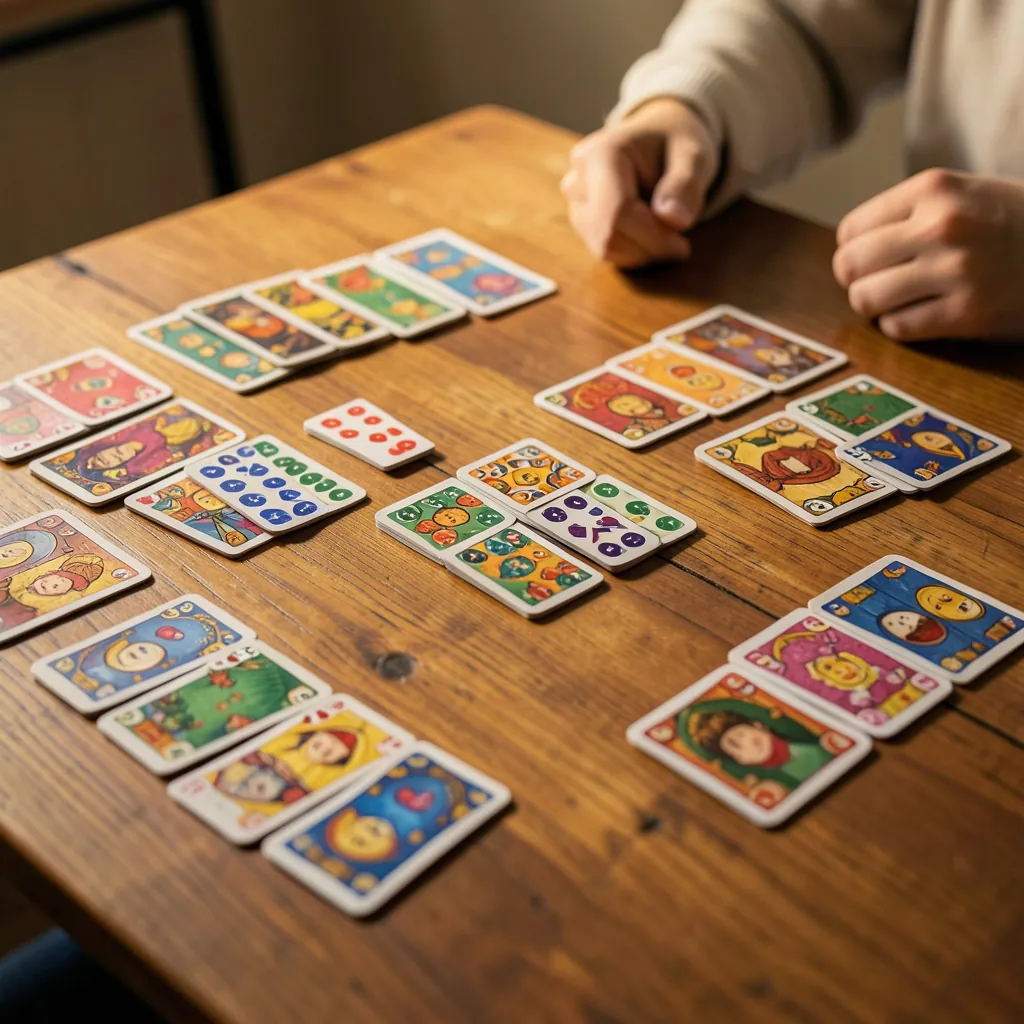
How to Play Dominoes: Rules, Scoring, and Variations
Contents
🀄 Dominoes is a tile game played with a double-six set of 28 rectangular tiles, each divided into two ends with 0–6 pips. To play, shuffle the tiles, draw a hand, and take turns matching a tile to an open end; the goal is to play all your tiles first or, in a blocked hand, hold the fewest pips. The winner scores the pips left in opponents’ hands.
Players: 2–4 (four-player games are common; partner play also appears in pub-style rules)
Play Time: No fixed time in the sources; play continues until the agreed target score, usually 100 points
Age: Not specified in the sources
Difficulty: Easy to learn
Type: Tile game (standard Block or Draw; not a trick-taking card game)
Setup
- Use a standard double-six domino set: 28 tiles. Source 1 notes that Block and Draw can also be played with double-nine or double-twelve sets.
- Shuffle the dominoes face down. Parker Brothers’ rules and Britannica say each player draws 7 tiles; Source 1’s pub-style description says 6 tiles per player. This is a source conflict—agree on hand size before play.
- Stand tiles on edge facing you or hold them so opponents cannot see the pips. Sort them into suits if that helps. The remaining tiles are the “sleeping” tiles, stock, pool, or boneyard.
- Determine the first lead. Most sources use the highest double: double-six, then double-five, and so on. Source 1 says the player holding double-six starts; if nobody holds a double, reshuffle and redraw. Britannica describes drawing to see who gets the highest spot, returning those tiles, then drawing hands. Parker Brothers says the highest double leads the first hand, then players lead alternately.
- For four-player pub-style games, Source 1 describes two partnerships sitting opposite each other. BBC’s street-domino example describes four individual players drawing seven tiles each.
How to Play
Block vs. Draw comparison
| Feature | Block game | Draw game |
|---|---|---|
| Tiles drawn | 7 per player in Parker Brothers/Britannica; Source 1 pub version says 6 | 7 per player in Parker Brothers/Britannica; Source 1 pub version says 6 |
| First lead | Highest double leads; Source 1 starts with double-six if held | Same setup as Block |
| If you cannot match | Pass; next player plays | Draw from the pool until you can match or exhaust it |
| Stock limit | No drawing | Parker Brothers says draw until exhausted; Britannica says the last two pieces may not be drawn—conflict |
| Hand ends | One player goes out, or all players are blocked | One player goes out, or all players are blocked |
| Scoring | Winner adds pips left in opponents’ hands | Same scoring as Block |
- Choose Block or Draw. In both, shuffle face down, draw the agreed hand size, and keep tiles hidden.
- The lead player sets the first tile. In the common rules this is the highest double held; Source 1 specifically starts with double-six, or failing that double-five, and so on.
- Players take turns playing one tile that matches an open end of the domino layout. A tile must match the pips on an end that is not already joined to another tile.
- In Block, if you cannot match an open end, you pass and the next player continues. Play continues until someone goes out or nobody can play.
- In Draw, if you cannot match, draw from the pool until you can play or the pool is exhausted. Parker Brothers says you must draw until you can match; Britannica says the last two pieces in the stock may not be drawn.
- A hand ends when one player plays their last tile and calls “Domino!” or when all players are blocked.
- Score the hand as described below, then begin the next hand until a player reaches the agreed game target.
Scoring
In standard Block and Draw dominoes, the winner of a hand is the player who plays all their tiles, or—if the hand is blocked—the player with the fewest pips left in hand.
The winner scores the total pips remaining in all opponents’ hands. Do not subtract the winner’s own pip count. For example, if the winner has 10 pips and the opponents have 25 pips total, the winner scores 25, not 15.
Parker Brothers adds that if two players tie for the lowest pip count and both are lower than the opponents, there is no count for that hand.
The game target is usually 100 points, though Parker Brothers says “one hundred, or less by agreement,” while Britannica says a game may be 50 or 100 points. Agree on the target before play. Related games use different targets: Muggins is 200 points for two players and 150 for more, while Matador is 100 or more by agreement.
💡 Strategy Tips
- Track which tiles have been played. BBC notes that strong players memorize the set and calculate what opponents may still hold.
- Use blocking as a real strategy. If you cannot go out immediately, play in ways that limit opponents’ matching options.
- In Muggins, announce your count immediately when you play. Parker Brothers says failing to announce it, or counting incorrectly, loses the count.
- In Matador, be careful with blanks. Source 2 advises not leading a blank unless you hold a Matador or a corresponding blank, and keeping the double-blank back can help force opponents to draw.
- Avoid the common blocked-hand scoring mistake: total the opponents’ pips; do not subtract your own hand.
🎲 Variations
- Draw Game: When blocked, draw from the pool until you can play or the pool is exhausted. Sources conflict on whether the last two tiles may be drawn.
- Four-player pub/partner dominoes: Source 1 describes four players as two partnerships sitting opposite each other, often drawing six tiles rather than seven.
- Dominican street dominoes: BBC describes four players drawing seven tiles, double-six starting, counter-clockwise play, and a knuckle rap on the table to signal “pass.”
- Muggins: Each player draws five; the highest double leads; scoring is by fives. Parker Brothers gives the target as 200 for two players and 150 for more, with blocked-hand scores rounded to the nearest multiple of five.
- Matador: Each player draws three; players must make the complement of seven rather than simply match pips. It can be played by two, three, or four players; with two players, three tiles are left undrawn. The target is 100 or more by agreement.
- Bingo: Parker Brothers describes this as a separate two-player domino game similar to Sixty-Six; blanks count as seven, and the double-blank is the highest tile.
❓ FAQ
How many players can play dominoes?
Common games are played by 2–4 players. Four-player pub and street games are common, and Matador explicitly allows two, three, or four players.
How do you win at dominoes?
Win a hand by playing all your tiles, or by having the fewest pips if the hand is blocked. The winner scores the pips left in opponents’ hands and the first player to reach the agreed target—usually 100—wins the game.
Can you play dominoes with 2 players?
Yes. Parker Brothers gives two-player targets for Muggins, and Matador can be played by two players with three tiles left undrawn. Standard Block or Draw can also be played head-to-head with an agreed target score.
Is dominoes hard to learn?
No. Block is the simplest basic form: match a tile to an open end and pass if you cannot play. Draw adds drawing from the pool, but the core matching rule stays the same.
How long does a game take?
The sources do not give a fixed time. Length depends on the variant, number of players, and target score; a game usually continues until someone reaches the agreed total, often 100 points.
What do you need to play dominoes?
A standard double-six domino set—28 tiles—and a flat playing surface. Source 1 notes that Block and Draw can also be played with double-nine or double-twelve sets.
Related guides
- Backgammon Direction of Play: Complete How-to-Play Guide
- How to Play Backgammon: Complete Rules, Setup & Strategy Guide
- backgammon how to
- How to Play Backgammon: Complete Rules, Setup, Scoring, and Strategy
- How to Play Basic Checkers (Draughts): Rules, Setup, Strategy and Variations