How to Set Up a Checkers Board: Complete Rules, Setup & Strategy Guide
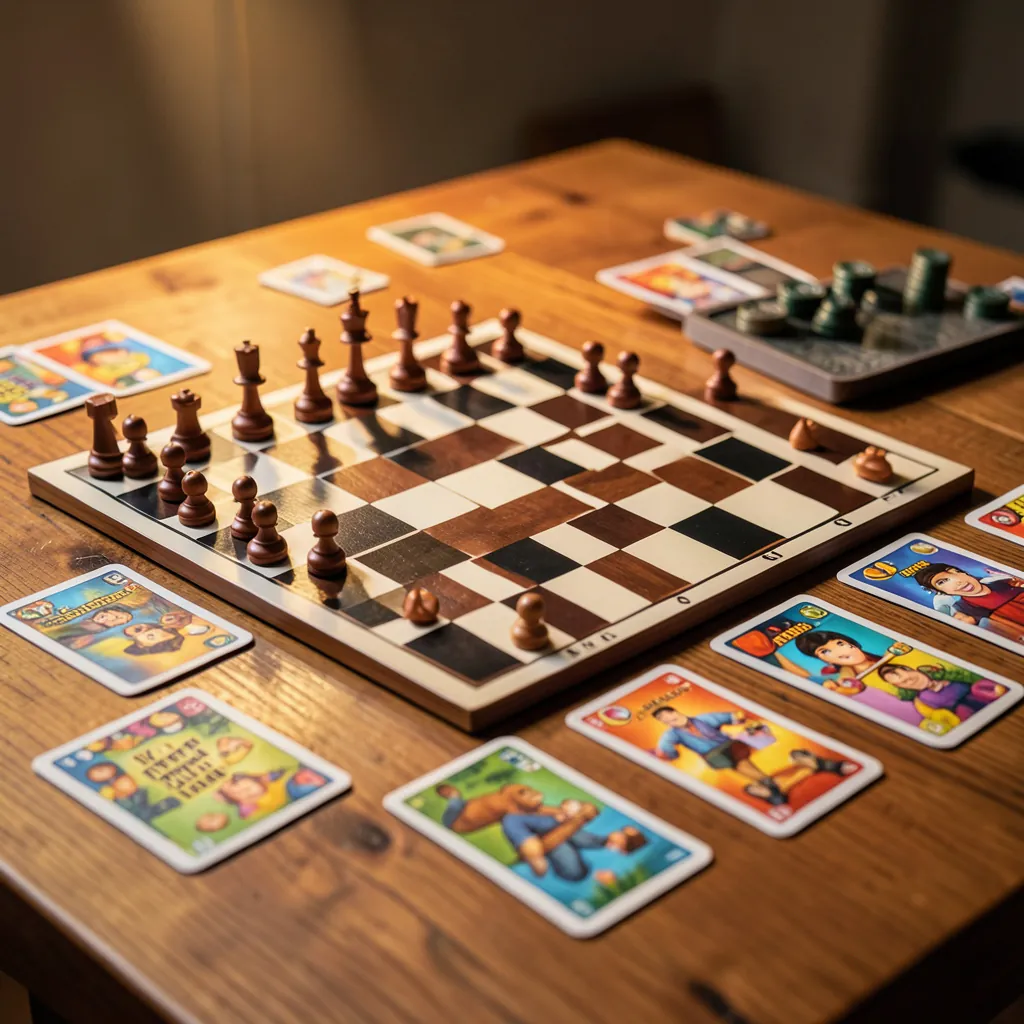
How to Set Up a Checkers Board: Complete Rules, Setup & Strategy Guide
Contents
♟️ Checkers (draughts in the UK and Australia) is a two-player abstract strategy game on an 8×8 board; you win by capturing all enemy pieces or blocking their moves. To set up, orient the board so each player has a dark square in the bottom-left corner, then place 12 pieces on the dark squares of your three nearest rows, leaving the two middle rows empty. Darker pieces move first.
Players: 2 Play Time: 30 minutes Age: 5+ Difficulty: Easy Type: Abstract strategy board game
Setup
What do you need to set up a checkers board?
- One standard 8×8 board (the same 64-square board used for chess), with 32 light and 32 dark squares.
- 12 pieces of one colour and 12 of another — traditionally one dark set (often red or black) and one light set (white or cream).
- A flat surface and about 30 seconds.
According to one standard rules digest, regulation boards use green and cream squares with red and white pieces, square sizes of 4.5–5 cm, and cylindrical pieces roughly 3–4 cm in diameter and 5–9 mm tall. The long-standing Jaques of London folding set is listed at £6.89, ages 5+, FSC timber, UKCA and CE tested, and the company has been making sets since 1795.
| Setup detail | Standard checkers/draughts (8×8) | International draughts (10×10) |
|---|---|---|
| Board | 64 squares (8×8), 32 dark | 100 squares (10×10) |
| Squares in play | Dark squares only (32) | Dark squares only |
| Pieces per player | 12 | 20 |
| Rows filled per player | 3 rows nearest you (4 pieces per row) | 4 rows nearest you |
| Empty rows between armies | 2 middle rows (8 dark squares) | Not specified in these sources |
| Board orientation | Dark square in each player’s bottom-left corner | Same method |
| Who moves first | Darker-coloured pieces (see the conflict note below) | Not specified in these sources |
How do you set up a checkers board step by step?
- Orient the board. Turn it so that each player has a dark square in their near-left (bottom-left) corner. Every source that covers orientation agrees on this.
- Choose colours. One player takes the dark pieces, the other the light pieces.
- Fill your back three rows. Place all 12 of your pieces on the dark squares of the three horizontal rows nearest you — four pieces per row across three rows.
- Mirror it. Your opponent does exactly the same at their end.
- Leave the middle empty. The two central rows (eight dark squares) stay bare as no-man’s-land between the two armies.
- Check the symmetry. A correct board has three rows of pieces at each end, two empty rows in the middle, and not a single piece on a light square.
Which way does the board go?
Dark square in each player’s bottom-left corner — that is the only orientation rule you need. This is why a shared chess/checkers board can feel wrong at first: chess uses the opposite convention, light square on the right. If you ever find a piece sitting on a light square, the board is turned 90 degrees — rotate it and the dark squares line up.
Where do the pieces go?
Only on dark squares, never on light squares, for the entire game. All 12 pieces per side start on dark squares in the three rows closest to that player. The USA TODAY guide describes the same layout from the other angle: place checkers on the dark spaces so that each player has an empty light square in the right-hand corner, in three rows of four. That is the identical arrangement to “dark square bottom-left.”
Note that the board itself is a normal chessboard with 64 squares; only the 32 dark squares are ever used, which is why the whole game travels diagonally.
Who moves first in checkers?
This is the one setup point where the sources genuinely conflict, so here it is side by side rather than silently resolved:
| Source | Rule on the first move |
|---|---|
| Jaques of London (Source 1) | Darker pieces conventionally move first |
| Sterling Chess (Source 3) | The player with the darker pieces moves first |
| Rules digest (Source 4) | Red moves first; starting colours are chosen by random selection, then alternated in subsequent games |
| USA TODAY (Sources 2 & 5) | The player who goes first takes the dark checkers; in rematches, the winner of the last game typically goes first |
The conflict: three sources tie the first move to the darker colour, while the USA TODAY guides make the first player the one who takes the dark pieces and hand the opening move to the previous game’s winner. In practice you can satisfy all of them by giving the dark pieces to whoever goes first — or simply agree a house rule before you start.
How to Play
- Confirm who opens. Agree the first player using the rule above (darker pieces is the most common convention), then alternate turns.
- Move exactly one piece per turn. There is no dice and no hidden information — checkers is a game of pure information, where all the skill lies in choosing which piece to advance and when.
- Move ordinary pieces (men) forward only. One square diagonally forward onto an empty dark square. A man can never move sideways, straight ahead, or backwards, so it has at most two simple moves available at any time.
- Capture by jumping. If your piece sits diagonally next to an opponent’s piece and the dark square immediately beyond it is empty, hop over it into that square and remove the jumped piece from the board. If you started blocking one direction, that direction is closed unless a capture is available.
- Chain multiple jumps. If your piece lands in a position to jump again, it continues jumping in the same turn, and keeps going for as long as further jumps are available. A single turn can sweep two, three or more pieces off the board. Each individual piece may only be jumped once during a single multiple-jump sequence.
- Take the capture — it is compulsory. In English draughts, if a jump is available you must take it; you may not play a quiet move instead. Where two or more different captures are on offer, you may choose which one (not necessarily the one that captures the most pieces), but you must take one, and once started a multiple jump must be completed.
- Crown kings on the far row. When a man reaches the far edge — the king row — it is promoted. Crown it by stacking a second captured piece of the same colour on top, or by flipping the piece over.
- End the turn on promotion. A piece that reaches the king row stops there even if it arrived by a jump; it cannot continue capturing on the same turn it is crowned. From your next turn the king roams freely.
- Use the king’s extra power. A king moves and captures one square diagonally in all four directions — forwards and backwards — which is why protecting your back row and racing a man to the far side matter so much.
- Keep playing until the game ends. Players alternate until one side has no pieces or no legal move (see Scoring).
| Piece | Ordinary move | Capture |
|---|---|---|
| Man | 1 square diagonally forward | Jumps forward over 1 adjacent enemy piece to the vacant square beyond |
| King | 1 square diagonally forward or backward | Jumps forward or backward over 1 adjacent enemy piece to the vacant square beyond |
A second conflict to flag: Sources 1 and 4 state that continuing a multi-jump is mandatory. Sources 2 and 5 describe a “double jump” as something you can make, without saying it is compulsory — which reads as optional. The compulsory version is the standard English draughts rule and the one to teach beginners.
A gap worth flagging: Sources 2 and 5 never mention compulsory capture at all. A guide built only on those two would leave out the single rule that shapes every tactic in the game.
Tournament details from the rules digest: a touch rule applies (touch a piece and you must move it unless you announce an adjustment first); an illegal move is first met with a caution and the move recalled, and later illegal moves in the same game can mean forfeiture; an illegal move is pardoned if your opponent replies without objecting; accidentally displaced pieces are replaced without penalty.
Scoring
Checkers is not a points game. There is no running score — you win, lose or draw.
You win by making the last legal move, which happens when:
- You have captured all of your opponent’s pieces, or
- All of your opponent’s remaining pieces are blocked and cannot move.
A win is also awarded if your opponent resigns, forfeits, or fails to meet a time control. Note that capturing everything is not the only route: the USA TODAY guides stress that you can win by blocking your opponent’s non-king pieces, especially in the corners.
A draw can occur by agreement between the players, or under tournament rules such as neither player being able to force a win, or specific endgame configurations that are proven draws.
💡 Strategy Tips
- Control the centre. Central pieces command more squares and diagonals than pieces stranded on the edge. Beginners instinctively retreat to the rails to avoid capture, but side pieces are passive — forming a compact pyramid in the middle keeps your pieces together and stops your opponent reaching your back row.
- Hold your back row as long as you sensibly can. The two pieces guarding your king row are what stop the enemy crowning a king. Every turn an opponent fails to make a king is a turn you stay level. Give up the back row only for a clearly bigger gain.
- Keep pieces in pairs. A lone checker is easy prey; moving in twos means a jump on one usually costs your opponent the other. Trading pieces is good when you are ahead (it simplifies toward a won endgame) and bad when you are behind.
- Weaponise the compulsory capture. Because a jump must be taken, you can offer a single piece to force a reply that opens a bigger jump for you — a two-for-one trade. This is the heart of checkers tactics.
- Know a named opening. According to Quadibloc (cited by USA TODAY), “Old Faithful” is the best and most popular first move: the checker on square 11 moves to square 15, i.e. second from the left, diagonally right. The standard reply for the second player is square 23 to 18, and a popular counter to 11-15 is 22-17.
Common beginner mistakes: leaving a piece where it can be captured (with compulsory capture, it will be taken); forgetting that a multi-jump must be finished once started; expecting a newly crowned king to keep jumping on the crowning turn; and moving edge pieces early, which does half the work.
🎲 Variations
- Checkers vs draughts. There is no difference in the game. “Draughts” is the British, Irish, Australian and Commonwealth name; “checkers” is the American name. Same 8×8 board, same 12 pieces, same diagonal movement, same compulsory capturing, same king promotion.
- International draughts (10×10). A larger board of 100 squares with 20 pieces per player, set up the same way on dark squares but filling the nearest four rows. The 8×8 game is what you play on a standard board.
- First-player house rules. Choose between “darker colour moves first,” “winner of the last game goes first,” or alternating colours each game. All three appear in the sources — just agree before the first move.
- Player count. Every source lists checkers as strictly a two-player game. None of them describes an official three- or four-player version, so there is no sourced multi-player variant to offer here.
- Board colour schemes. Traditional sets use black vs white or red vs white pieces; tournament-style sets use red and white on green and cream squares. Pieces and rules are otherwise identical.
❓ FAQ
How many players can play checkers? Two. Every source describes checkers/draughts as a two-person game; there is no official three- or four-player version.
How many pieces does each player start with? Twelve each, so 24 pieces are on the board at the start. They fill the dark squares of the three rows nearest each player, leaving the two centre rows empty.
Which way does a checkers board go? Each player should have a dark square in their bottom-left corner. This is the opposite of chess, which uses light-on-the-right. If any piece ends up on a light square during setup, rotate the board 90 degrees.
Do you have to jump in checkers? Yes, in English draughts capturing is compulsory — if a jump is available you must take it. If more than one capture is possible you may choose which, but you may not decline to capture. Once you have jumped, you must continue capturing until no further jumps are available.
How do you win a game of checkers? Capture all of your opponent’s pieces, or leave them with no legal move. A win is also awarded if your opponent resigns or forfeits; otherwise the game can be drawn by agreement or under tournament rules.
Is checkers the same as draughts, and is it hard to learn? Checkers and draughts are the same game under different names. It is easy to learn — the single movement rule can be taught in under a minute, which is why the game suits children from around age five — but the compulsory-capture rule gives it real tactical depth. A typical game runs about 30 minutes.
Related guides
- Backgammon Direction of Play: Complete How-to-Play Guide
- How to Play Backgammon: Complete Rules, Setup & Strategy Guide
- backgammon how to
- How to Play Backgammon: Complete Rules, Setup, Scoring, and Strategy
- How to Play Basic Checkers (Draughts): Rules, Setup, Strategy and Variations