How to Play Ticket to Ride: Rules and Setup Guide
How to Play Ticket to Ride: Rules and Setup Guide
Contents
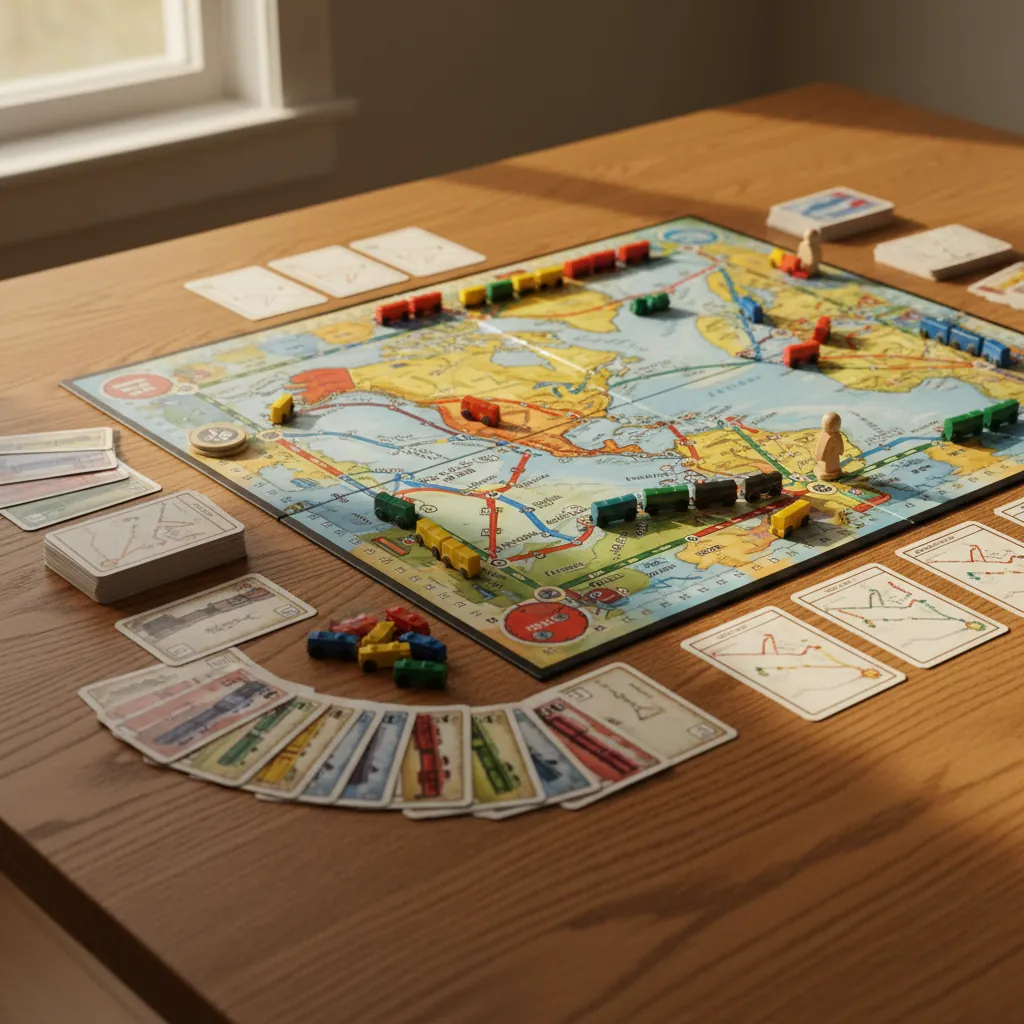
Ticket to Ride is a 2-5 player board game (ages 8+) where players compete to claim railway routes across a map by collecting matching train cards. Each game takes 30-60 minutes, and the winner scores the most points by completing routes, fulfilling destination tickets, and building the longest continuous train path.
What You Need
- Game board (North America map in standard edition)
- 240 colored train cars (45 each in 5 colors + spares)
- 110 train cards (12 each in 8 colors + 14 wild locomotives)
- 30 destination ticket cards
- 5 wooden scoring markers (1 per player)
- Longest Continuous Path bonus card
- Rulebook and scoring reference card
How to Play
-
Setup:
- Each player takes 45 trains in their color and places their scoring marker on “0”
- Shuffle train cards, deal 4 to each player, and reveal 5 face-up cards
- Deal 3 destination tickets to each player; keep at least 2 (return extras to deck bottom)
-
On your turn, choose one action:
- Draw train cards:
- Take 2 cards from face-up row and/or deck (replace face-up cards immediately)
- Exception: If you take a face-up locomotive, it must be your only draw
- Discard/replace all face-up cards if 3+ are locomotives
- Claim a route:
- Play cards matching the route’s color/length (e.g., 3 blue cards for a 3-space blue route)
- Place your trains on the route and score points (1-15 per route length)
- Gray routes accept any color; locomotives are wild
- Double routes: Only one can be claimed per player (both usable in 4-5 player games)
- Draw destination tickets:
- Take 3 tickets, keep ≥1 (return extras to deck bottom)
- Draw train cards:
-
Game end triggers when a player has ≤2 trains left. All players get one final turn.
How to Win
- Points come from:
- Claimed routes (scored during play)
- Completed destination tickets (add points; subtract if uncompleted)
- Longest continuous path (+10 bonus)
- Tiebreaker: Most completed tickets → longest path if still tied
Scoring Table
| Route Length | Points |
|---|---|
| 1 space | 1 |
| 2 | 2 |
| 3 | 4 |
| 4 | 7 |
| 5 | 10 |
| 6 | 15 |
Strategy Tips
- Early game: Focus on collecting sets of 1-2 colors for critical routes
- Mid game: Block opponents by claiming key chokepoints first
- Ticket management: Keep overlapping routes; avoid high-risk tickets unless leading
- Locomotives: Save for long/high-value routes (6+ spaces)
FAQ
Q: Can I connect routes through other players’ trains?
A: No, only your own trains count for continuous paths.
Q: What if I can’t complete a destination ticket?
A: You lose the ticket’s points at game end (e.g., -10 for failure).
Q: Can I claim multiple routes per turn?
A: No, only one route per turn.
Q: Are double routes mandatory for completion?
A: No, either path suffices unless blocked.
Related guides
- How to Play Go Fish: Rules, Strategy, and Variations
- How to Play Mexican Train Dominoes
- How to Play Sequence
- How to Play Backgammon: A Complete Guide
- How to Play Blackjack